Tuesday, April 7, 2009

Please, Can We Have Just A Little Reality Here?

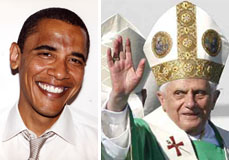
Another blow to the hi jacked Jesus of the political right. This article, from which I stole this photo (I mean borrowed) is well worth reading.


Vermont becomes fourth state to legalize same-sex marriage.
Montpelier, Vt., Apr 7, 2009 / 05:48 pm (CNA).-

Today Vermont narrowly became the fourth state to legalize same-sex "marriage" joining Connecticut, Massachusetts and Iowa, despite opposition from the governor and the local Catholic bishop. (Love the snide quotation marks.)

Unlike the previous three states who moved to allow gay "marriage," Vermont’s decision came through the legislature instead of the courts. The final vote in the House was 100 to 49, and at least 98 votes were required to override the governor's veto. (There it is again, the quotes, and as you will see, they are consistent.
Less than a day after Republican Governor Jim Douglas’ veto on the same-sex "marriage" legalization, both the House and the Senate received enough votes to override his decision. Douglas told the Associated Press that he was not surprised with the vote and remarked that the gay "marriage" issue was a distraction from the more urgent current economic situation.

"What really disappoints me is that we have spent some time on an issue during which another thousand Vermonters have lost their jobs," Douglas stated. "We need to turn out attention to balancing a budget without raising taxes, growing the economy, putting more people to work." (Please tell this to your fellow Republicans. Most of the US Catholic population would agree with you, that the economy is a big issue. Stop with the 'culture wars' until we can afford them, (not that we really can), because right now we can't and abortion statitics are going up. By the way, that's not Obama's fault.)

Burlington, Vermont Bishop Salvatore R. Matano had previously spoken to the judiciary committee regarding the Catholic Church’s position of same-sex "marriages."

According to the Vermont Catholic Tribune, Bishop Matano testified that the Church desires “the good for all people” and respects “the rights of our fellow citizens to seek the truth and pursue the common good.” Nevertheless, we “have the duty to uphold and to defend the traditional definition of marriage as it has been upheld and revered over the ages.” (The reality is the property rights of males concerning females has been "revered over the ages". I'll get into the 'common good' for gays in another posting.)

He continued by quoting the Catechism of the Catholic Church. It is our firm belief that “The matrimonial covenant, by which a man and a woman establish between themselves a partnership of the whole life, is by its nature ordered toward the good of the spouses and the procreation and education of offspring …” (I'd be more inclined to buy this argument if you reserved sacramental marriage to fertile couples. Oh, but then maybe sacramental marriage would be seen as a glorified pagan fertility ritual.)

Bishop Matano also emphasized that this “core teaching, which we believe to be rooted in God, does not allow the Church to give an alternate definition of marriage. ‘The intimate community of life and love which constitutes the married state has been established by the Creator and endowed by Him with its own proper laws …God himself is the author of marriage’.
(Why, in a secular democratic society, with mulitple religious traditions, should the Church's catechism take precedence over the will of elected representatives?)

Despite his opposition, the announcement of the legalization of gay "marriage" prompted cheers from activists in the gallery and lobby. (Maybe they weren't Catholic.)


Wendy Wright from the Concerned Women for America commented on the vote legalizing same-sex "marriage" by saying that legislators are undermining society.


"Marriage is the unique relationship between a man and a woman who together provide children with the benefits of the two sexes, male and female” and “cannot be complete without both sexes. While government officials may change definitions, they cannot change nature. The first human relationship was between one man and one woman, and it became the foundation of all society,” she explained in a press release. (Tell that to the children who have one parent or are being raised in orphanages, or by gay parents. Then there is the story of Lot.
That one would have us believe that mankind is the product of generational incest. (Well actually, so does the Adam and Eve story.) Maybe we should only allow marriage between a father and his daughters---after drinking copious amounts of wine.)


“Vermont legislators' futile attempt to replace God by vainly redefining marriage eerily follows how that first man and woman acted on the first temptation -- and the root of all temptations -- to act as if they were gods,” Wright said. “That one decision by Adam and Eve to believe that they could 'be like God' separated them from God, destroyed the peace that they had experienced, and ushered in what some would call 'unintended consequences' of pain and destruction.” (This is just a tad bit of hyperbole. Lots of other creation stories don't even come close to suggesting the incestuous relationships between generations that Genesis does.)


She closed her statement by urging other states to begin working to protect the institution of marriage. (Maybe this is the message that Vermont legislators were sending. States don't really want to have millions and millions of dollars (out of state dollars at that)
pumped into an unconstitutional battle over the gay right to marry. Maybe they think it's better to leave all marriage benefits in tact than to take the other equality path, which is to rescind all benefits accrued to marriage.)


*******************************************************************


It may be that we are beginning to see the backlash over Proposition 8 in California. States seem to be taking a proactive approach to stopping this crusade before it can get started in their states. I'll be highly surprised if the Iowa Supreme Courst decision is challenged with a constitutional amendment. In the first place it can't make the ballot before 2012, and by then things could have really changed. That's another four years in which younger voters, who support gay rights, will have had time to mature to voting age. Demographics are not working in the favor of traditional marriage advocates.


Neither are their arguments. The specious procreative argument is just that, specious. Until Roman Catholicism stops sacramentally approving infertile marriages between heterosexuals this argument is silly.


I asked a friend of mine, who had such a relationship sacramentally approved, how this could be. He said their priest told them there could always be a miracle like with St. Anne having John the Baptist. The problem was in his case this would have been a whole lot more miraculous since my friend's wife had had a total hysterectomy. Menopause is one thing, but the complete absence of a uterus and ovaries is a whole different miracle ball game.


He sheepishly admitted it kind of bothered him, given a number of his friends are in committed gay relationships, and a whole lot of other of his Catholic gay friends are terrified of getting into one for fear of losing their jobs with the diocese or in specific parishes--not because they don't love someone. I appreciated his honesty about the hypocrisy. I also took his wedding photos and attended his wedding. I understood the importance of love and commitment and what this meant to my friend.


Here's the really hypocritical thing. Gay marriage will not effect heterosexual marriage, but civil unions do because this lesser contractual form is also available to heterosexuals, and they are legally easier to get out of. I have written about this previously.


In one of the comments posted about that article it was pointed out that with regards to the heterosexual divorce statistics addressing the reasons is pastoral, but condemning the results is legalistic. This, unfortunately seems to be the path of choice for the hierarchy. It doesn't matter if the issue is abortion, or marriage, or adoption, the pastoral choice regarding reasons for these choices is always ditched in favor of the legal solution--which is not a solution. This is the exact opposite approach taken by Jesus. He went to the heart of the issue, not the law regarding the issue.


I am getting so tired of legal solutions for pastoral problems. Please bishops, stop testifying in front of legislatures and cameras, and start being pastoral. Catholics don't need the state to enforce Catholic dogma, they need pastoral workers to help them through their moral choices. Is this really so difficult to understand? Using the state to enforce doctrine your sheep don't necessarily agree to is abrogating your pastoral responsibility. Maybe it's time you actually listened to the bleating of the sheep.


Is It Time For The Pro Life Right To Practice Holy SIlence?

Russian Icon entitled 'Holy Silence" is a depiction of Jesus. 400 plus Bishops appear to be practicing 'Holy Silence' on the Notre Dame controversy.


The following is an excerpt from Msgr. Harry J Byrne's blog Archangel. In his post Msgr. Byrne is speaking to the Notre Dame controversy, wondering how much damage this controversy could wreak on Catholic dialogue with the Obama administration and Americans in general. This part deals with questions posed by Archbishop John R Quinn. Archbishop Quinn asks some very pertinent questions. I wonder if he felt free to ask them precisely because he's retired.


Retired San Francisco Archbishop John R.Quinn has posed a number of significant questions to be reflected upon by the petitioners and those puzzled by the controversy. Quinn's questions, in summary, are these: If President Obama is forced out, will that diminish the number of abortions in our country? Will it further our pro-life efforts? Will it increase cooperation between the Catholic Church and the administration or will it create tensions and deepen hostility? Will it cause more people to join the pro-life effort? How will it impact on the image and mission of the Church? Might the banishment of the first African-American president from Catholic college campuses be seen as grossly insensitive to our nation's heritage of racial hatred? Will it be used to paint our bishops as supporters of only one political party? Will our Church be seen as not sincerely seeking dialogue but only acquiescence?


The obvious answers to these questions indicate the grave consequences of how this issue plays out. Until recently our bishops have restricted themselves to making judgments about policy, but not about political personages. That has changed. Some bishops have banned pro-choice candidates from Holy Communion; other bishops have told them not to approach the altar. This moves our bishops from confronting issues to confronting personalities. It is an historic move. It neglects the role of the personal conscience of candidates, most of whom are good people, but who erroneously give a priority to the freedom of women over the right to life of the unborn. It is a practice that is the basis of the charge that the Church puts a "don't vote" label on a pro-choice candidate by putting this public spiritual penalty on them without any inquiry process whatever. It is also contrary to our bishops' "Faithful Citizenship" document that counsuls broad consideration of many issues, not a narrow focus on one. (The confrontation with personalities is not only historic, it's predominately happening only in the US, only to Democrats, and only over one issue. In the meantime certain clerics are bending over backwards to bring Republicans like Newt Gingrich into the fold--even with his history of adultery and three ex wives. I'm all for forgiveness for past sins, but not when it appears to be applied selectively.)


Despite radical differences on "pro-choice", NY's Cardinal Egan invited Obama, the then presidential-candidate, to speak at the 2008 Al Smith dinner. Cardinal O'Connor was a personal friend of pro-choice Mayor Ed Koch. He even wrote a book with him! Soon to be NY's archbishop, Timothy Dolan, has invited President Obama to his installation on April 15. Obama recently said it well: "We do not govern out of anger." We may well understand the outrage of the extremist anti- abortion people, but we Catholics cannot permit their anger to shape our relationships and the relationships of our Church. (Where's the outrage over this one? Where's the concern about the 'agent of Satan' bringing is malevolent energy into this ceremony? Surely this has to be considered an honor being extended to President Obama? Maybe Archbishop Dolan is only honoring the office and not the man.)


*****************************************************************


Fr. John Kavanaugh over on Americamagazine, writes:


But we Catholics, we Christians, are in danger of becoming known not by how we love but by how we hate. We will be known as the group that can be outraged only by abortion and stem cell research— not torture, nor the yearly death of 15 million children under 5, nor the reckless launching of wars, nor other deadly sins. We will also present ourselves as oblivious to our fundamental Catholic teachings on the nature of conscience, the judgment of others’ interior lives, and the sin of slander. There is little or nothing of Christ in the rhetoric of hatred. But ample justification is claimed for the ugliest of acts, especially if it is against “Herod” or evil itself. Most puzzling in the James comment was its ending: “As Ayn Rand said, ‘When you compromise with evil, evil wins.’”


Ayn Rand. There we have it: Ayn Rand’s ramblings as a proof text. Not Benedict, not John Paul II, not the fathers of the church or the Gospels themselves, but Ayn Rand, anti-theist and pro-abortionist. (In the Objectivist of October 1968 she declared: “An embryo has no rights. Abortion is a moral right.”) Among her articulated principles are that money is the only scale of success, pride the only virtue and “I” the one word indicating the only God.


Father Kavanaugh then ends his article by wondering if the Cardinal Newman Society would call for the Notre Dame boycott if the speaker was Ayn Rand rather that Barack Obama. I too, have thought it kind of strange the Ayn Rand's name keeps popping up in discussions regarding President Obama and Notre Dame or in defending Catholic doctrine on abortion. Seems kind of a hypocritical grasp, but she is loved by conservative neocon Republicans, and I guess she wrote more than enough words that proof texting could come up with support for virtually any single position. Of course you can only do that by ignoring the over all context of her writing.


Msgr. Byrne's article asks some really important questions of all who have any claim on the Catholic Church. Can we really afford to let one single issue dominate the discussion in the Public Square and still retain any moral authority in any other arena? Is this one issue so important that it over shadows anything else Barack Obama has accomplished on any other of the important Catholic teachings? Since I have been unable to find any conservative site that has given President Obama any credit for anything he did or said in Europe, I am left to believe that abortion is the only issue which counts.


The last statistic I saw indicated that two Cardinals and 15 Bishops had written Fr. Jenkins asking for the invitation to be rescinded or castigating Notre Dame for their lack of orthodoxy. That leaves over 400 Bishops and Cardinals unaccounted for. I'm not sure what this says, except that we do seem to have a very vocal and very minor group of Bishops setting the agenda for American Catholicism. Are the other 400 quietly acquiescent in the face of the few, or do they have enough sense to see that the few are tearing this Church apart on political party lines. Perhaps they hope their deafening silence will actually send a different message? In any even this silence isn't exactly affirming their solidarity with their one issue vocal brethren. It seems to call it into question. Given all this silence, I don't suppose it's shocking that the only person who actually has dared to question this campaign is a 'retired' Archbishop.


If I was a professional pro life strategist, (paid Republican activist) I would be seriously considering dropping the Notre Dame campaign. The longer this goes on the more damage it will do to the supposed Catholic wall of intransigence on recriminalizing abortion, and give more credence to the Catholic pro lifers who understand the legal battle is a dead end and are working with the Obama administration to deal with the root causes. However, as one of those pro lifers who is in the progressive camp, I hope they keep it up. The faster the campaign to recriminalize abortion is discounted, the faster we can get down to dealing with strategies that actually do save lives. In this campaign President Obama does represent life, unlike his predecessor.


Monday, April 6, 2009

Benedict's Palm Sunday Message On Love And Ego

This doesn't really have anything to do with this post, but it's a very cool photo taken from the Hubble telescope. This is an infra red shot of the Sombrero Galaxy.


Benedict XVI Says Love Defines Man's Journey

VATICAN CITY, APRIL 5, 2009 (Zenit.org).-


Benedict XVI is affirming that love, a true gift of self as exemplified in the Cross of Jesus, gives meaning to life, and that its absence brings emptiness and boredom.

The Pope said this in a homily this morning at the Palm Sunday Mass in St. Peter's Square. He blessed palm and olive branches and presided over the liturgical celebration.

The Pontiff explained that Jesus, the King who entered Jerusalem in a triumphal procession, comes to introduce a new type of kingdom.

This kingdom, he said, "passes through the cross." He added, "Because Jesus gives himself totally, he can as the Risen One belong to everyone and make himself present to all."

The Holy Father noted that Christ's kingdom is also "universal" and "knows no more borders."

This is possible, he said, "because it is not a political kingdom, but is based solely on the free adhesion of love -- a love that, for its part, answers to the love of Jesus Christ that has given itself for all."

He continued: "Universality includes the mystery of the cross -- the overcoming of ourselves, obedience toward the universal word of Jesus Christ in the universal Church.
"Universality is always an overcoming of ourselves, a renunciation of something that is ours. Universality and the cross go together. Only in this way can peace be created."

Selflessness

Benedict XVI affirmed: "He who wants to have his life for himself, live only for himself, squeeze out everything for himself and exploit all the possibilities -- he is the one who loses his life.

"It becomes boring and empty. Only in abandoning ourselves, only in the disinterested gift of the 'I' in favor of the 'Thou,' only in the 'Yes' to the greater life, precisely the life of God, our life too becomes full and more spacious."

He added: "Love, in fact, means leaving yourself behind, giving yourself, not wanting to hold on to yourself, but becoming free from yourself: not getting preoccupied with yourself -- what will become of me -- but looking ahead, toward the other -- toward God and the people whom he sends to me.

"It is this principle of love that defines man's journey, it is once again identical with the mystery of the cross, with the mystery of death and resurrection that we encounter in Christ."
The Pope emphasized that this "Yes" to the Lord must be repeated every day, especially when "we just want to hang on to that 'I.'" He added, "There is no successful life without sacrifice."

Real prayer

Though it is difficult, he affirmed, we can pray like Jesus, who "felt driven to ask that he be spared the terror of the passion."

The Pontiff continued: "Before God we must not take refuge in pious phrases, in a world of make-believe. Praying also means struggling with God."

"In the end," he said, "God's glory, his lordship, his will is always more important and more true than my thoughts and my will."

The Holy Father added: "And this is what is essential in our prayer and in our life: understanding this right order of reality, accepting it interiorly; trusting in God and believing that he is doing the right thing; understanding that his will is the truth and is love; understanding that my life will be a good life if I can learn how to conform to this order.

"The life, death and resurrection of Jesus are the guarantee that we can truly entrust ourselves to God. It is in this way that his kingdom is realized."


*****************************************************


This is one heck of a sermon. The only thing I might have added, is that "understanding this right order of reality, accepting it interiorly, trusting in God and believing that He is doing the right thing", is a process and at times it seems to be an endless process. Especially now, in these kinds of times, when everything we believed in and trusted about this world seems to have been turned topsy-turvy and fear is everywhere.


But if one looks closely, one can see that God is truly at work. For instance, I never thought I would live to see the day when I would hear an American President announce that America's goal is to rid the world of nuclear weapons and mean it and begin to act on it.
In his message Sunday, in Czechoslovakia, President Obama even admitted it was up to the US, as a moral imperative, to lead the way in this process since we've been the only country who ever used nuclear weapons. This is a perfect example of what Pope Benedict means by getting over your own ego. Sometimes those ego issues belong to nations--and to Churches. Like people, nations can't get over their own egos if they aren't willing to trust other nations, believing that common interest can be pursued above and beyond national interest.


The counter example to this came on the same day that President Obama delivered this speech when North Korea, that bastion of national mistrust, launched a three stage rocket over Japan. There always seems to be a direct challenge from old thinking when new thinking starts to express itself. It will be informative to watch what kind of unified response the rest of the world will make in this instance. The unfortunate thing about North Korea is that the national expression is essentially the ego expression of one man. This is also another trait of very old energy. Fear and paranoia are not environments in which trust can grow.

I am frequently amazed at how on target Benedict can be in explaining the true underlying messages about the life of Jesus, but then turn around and manage the Institutional Church from a fear based position. It's an inconsistency that's hard for me to reconcile. Maybe it's because it doesn't show much real trust in all the People of God. Or maybe it's because he's placed too much trust in the very People of God who don't trust and in turn can't be trusted. People he seems to think share his vision of the Church. Well, they may share his vision of the Church, but they don't seem to share his vision of Jesus or what it means to be truly Christian, as opposed to Orthodox Catholic. The two are not necessarily synonymous.

Benedict certainly experienced that with the SSPX. Bishop Fellay seems to have a terminal case of tunnel vision when it comes to anything about the Church after 1962 and seems to have arrogantly decided that he and his group are the only keepers of the flame of Tradition. Lots of ego and old energy in this position, and a lot of backlash for Benedict. I think the big lesson for Benedict is that if you truly want to move forward you can not be held back by old energy and old attitudes. They will suck you right down to their level.

One of the things I've noticed in studying the life of Jesus, is that once he threw aside all ego concerns via His temptation experience in the desert, He never looked back. He kept going forward, and even the ego concerns of His followers didn't distract Him or suck Him down: Then they came to Capernaum ; and when [Jesus] was in the house he asked them, "What were you arguing about on the way?" But they were silent, for on the way they had argued with one another who was the greatest. He sat down, called the twelve, and said to them, "Whoever wants to be first must be last of all and servant of all." - Mark 9:33-35

Essentially Jesus is telling them get over yourselves. The only thing that should concern you is that you are servants of all, which makes you least among all. You and your egos are nothing. It is your spirit which is everything and it needs nothing that can not be provided for you, because God the Father is the greatest servant of all and He is in you and will provide for you.

Benedict so seems to get this on some levels, and then not on others. George Weigel had an interesting article on Benedict in which he writes that Benedict didn't want to be Pope precisely because he recognized he wasn't good at governance. He wanted to retire to Bavaria and get out of the Vatican. Unfortunately for Benedict, there were other Cardinals who wanted to use Benedict for their own agendas, and they pushed his candidacy. According the Weigel, their biggest fear was that he wouldn't accept.

I wonder if Pope Benedict wishes he hadn't accepted because some of these supporters are doing neither him nor the Church any favors, and, lo and behold, they are not representatives of the progressive wing. They are some of the most conservative members of the College of Cardinals, and the most conservative and cultic of the 'new movements'. It could be the progressive wing of the Church is starting to look a little more inviting to Benedict.

In the meantime, I have yet to find one article on any conservative site which is extolling President Obama's G20 or nuclear initiatives. They are still pounding on Notre Dame and calling President Obama "baby killer, and agent of the culture of death'. Unfortunately that includes more and more bishops, who seem compelled to cc: the Cardinal Newman Society with their letters to Fr. Jenkins and Notre Dame. Well, there is one way to completely eliminate abortion--nuke the world till it glows, a strategy President Obama doesn't endorse.


Sunday, April 5, 2009

Celibate Priests and SUV's--The Vatican Should Take A Lesson From GM

GM's latest offering for the niche celibate priest market. Also known as the Holy Hummer


"The Myth of Male Celibacy"

Sojouners July/August 2002 by Richard Rhor


THE REVELATIONS OF the last year seem to be the beginning of the end of what some call "the myth of celibacy." It's not that male celibacy was always false or deceitful, but it was in great part an artificial construct. Men, with the best of original intentions, found out that they were not the mystics that celibacy demanded. (Celibacy is a lot easier to follow when you are a genuine mystic.)


That is exactly the point. Celibacy, at least in the male, is a most rare gift. To succeed, it demands conscious communion with God at a rather mature level, it demands many transitions and new justifications at each stage of life, and it demands a specific creative call besides. Many who have ostensibly "succeeded" at it have often, by the second half of life, actually not succeeded—in the sense of becoming a God lover, a human lover, and a happy man besides. (One should not forget in reading the above paragraph that priests are hardly the only group called to a mandatory celibacy.)


Practically, however, the demand for celibacy as a prerequisite for ministry is a setup for so many false takers. Not bad men, just men who are still on a journey: young men who need identity; insecure or ambitious men who need status; passionate men who need containment for their passions; men who are pleasing their pious mothers or earning their Catholic father's approval; men who think "the sacred" will prevent their feared homosexuality, their wild heterosexual hormones, or their pedophilia; men with arrested human development who seek to overcompensate by identification with a strong group; men who do not know how to relate to other people and to women in particular.


None of these are bad men; they are just on a many-staged journey, and we have provided them an attractive way-station that often seems to work—for a while. But then they go on to the next stage and find themselves trapped, searching, conflicted, split, acting out, or repressing in, and often at variance with their now public and professed image.


The process lends itself to a Jekyll-and-Hyde syndrome, even among men who are very honest and humble in other areas. The price is far too high once you have committed your life publicly and sacredly. I know how hard it continues to be for me, my closest priest friends, and many that I have counseled and confessed. Many of us stay in not because we believe the official ideology of celibacy anymore, but because we believe in our work, we love the people, and we also know God's mercy. But that loss of belief in the very ideology is at the heart of the whole problem now. We cannot prop up with law and social pressure what the Spirit does not appear to be sustaining. The substructure has collapsed. "Unless the Lord builds the house, they labor in vain who build it" (Psalm 127:1). (I wish some one in authority would actually spend some time on this very question. Why is it the Spirit does not appear to be sustaining celibacy? Could it be because forced celibacy undercuts the Spirit?)


Add to that a rather large superstructure of ascribed status and security, and we have a system that is set up for collapse. Studies of male initiation say it is dangerous to give ascribed status to a man who has not journeyed into powerlessness. He will likely not know how to handle power, and may even abuse it, as we have now seen. (This is so true, and it's seen in the whole concept of military basic training, the ultimate definition of male powerlessness, which is for all intents and purposes a male right of initiation. Just ask a Marine.)


In general, I think healthy male celibacy is rare, and it probably is most healthy as an "initiation" stage to attain boundaries, discipline, integrity, depth, and surrender to God. In the long run, most men, as the Buddha statues illustrate, need to have one hand touching the earth, the concrete, the physical, the material, the sexual. If they do not, the other hand usually points nowhere. (Or too frequently at themselves.)


WE SHOULD MOVE ahead reaffirming our approach to grace, healing, mercy, solidarity with sinners, patience, and transformation—while also cooperating with the social system whenever there are true victims' rights to be redressed. We should do this generously, magnanimously, and repentantly.

We Catholics should also see celibacy as primarily an intense initiation course of limited (one to 10) years, much like the monks in many Asian countries. Celibacy has much to teach the young male about himself, about real passion, prayer, loving others, and his True Self in God. We dare not lose this wonderful discipline and container. (Who knows, maybe both Jesus and Paul were still in that early period of life?!) It could be a part of most Catholic seminarians' training, and during that time much personal growth could take place. Some would likely choose it as a permanent state. Most would not.


How differently the entire process of priestly formation would be configured. What a gift to the religious orders (where celibacy is essential). Our precise charism would become clear, although we would surely become much smaller. What an opening to the many fine men who are attracted to a marriage partner. And what focused intensity this could give to spiritual formation during that celibacy period, instead of all of the hoop games, telling the directors what they want to hear, mental reservations, non self-knowledge, acting out, and "submarine" behavior that make many seminaries a haven for unhealth. Seminaries would not drive away sincere spiritual seekers, but would attract them. Not men looking for roles, titles, and uniforms to disguise identity, but men looking for holiness and God through which to express identity.


Male sexuality does not go away. It is not easily sublimated or integrated. It is either expressed healthily or it goes underground in a thousand different ways. Sex is and probably always will be a central issue for most males, and it can never develop honestly inside of a "hothouse" of prearranged final conclusions. (This "hot house" of prearranged final conclusions is hardly limited to priestly celibacy. It's becoming an across the board norm.)

We should not be looking for a system where mistakes can never happen, but just a system that can distinguish health from unhealth and holiness from hiding. Like no other institution, the church should be the most prepared to deal with mistakes. That is our business. The steps to maturity are necessarily immature. Let's start by mentoring the good and the true, and also surrendering to that mystery of grace, forgiveness, and transformation that is our birthright as Christians. Many priests and seminarians have always done this, and I hope this gives them the courage to know why and how they are both "sons and heirs" of a true wisdom tradition. Such disciplined sons, and only such sons, have earned the authority of "fathers."


************************************************************


This is actually part of a longer essay which addresses more than just priestly celibacy. Fr. Rohr is a Franciscan priest of the New Mexico Province and one of my favorite Catholic essayist on the spiritual process.


In one sense the above discussion on celibacy can be seen as a metaphor for how Catholicism approaches most moral teachings. They are almost always presented as a " 'hothouse' of prearranged final conclusions." Final conclusions which leave one with no real chance at maturing into them, but only condemnation for not following them scrupulously from day one.


This does seem to be more and more the direction the institutional Church is following. It no longer leaves room for maturing into a Catholic spiritual life, just conformity to a Catholic doctrinal life. I suppose that's why some of the most vocal doctrinal supporters are converts. They matured into Catholicism and so the doctrines are more comfortable. If one is born into Catholicism it's a whole different ball game. The maturation or conversion process isn't supposed to be on one's radar. It's hard to authentically spiritually mature when one is presupposed to already be mature and just needs to follow the doctrine. Too bad real life doesn't work that way.


In many respects the current priest crisis is a true metaphor for so many problems with in institutional Catholicism. Most secular corporations would take a serious look at their product if they couldn't find people to sell it or buy it. General Motors comes to mind as a prime example of a corporation involved in internal navel gazing as an excuse to avoid the hard product decisions. We all know what's happened to them. It looks to me the Church could be on the same path if it refuses to make some hard decisions about the celibate priesthood. Insisting it's a good product when no one is buying it didn't work for GM. In the end GM was left with GM purists and that didn't begin to compensate for their global structure.


The other point that Fr. Rohr makes is that confessors and spiritual advisers operate from a different paradigm. That paradigm sees people in a maturation process and that part of the process involves finding the ability to forgive themselves errors of immaturity, ignorance, and dysfunction. Most especially they can not try to pretend they are something they are not. Good therapists more or less operate on the same paradigm. Less than healthy behavior is overcome through integration and then moving beyond, it's usually not overcome by denial, repression---or amputation.


For a spiritual endeavor, there seems to be a whole lot of amputation going on in Catholicism. Jesus didn't practice healing by amputation. He returned people to wholeness. Ideally that's what the spiritual journey is about, returning us to a sense of wholeness with our Creator. In this context amputating parts of our God given self is counter productive. The priesthood is a classic example of the fallacy of that approach.


I understand that changing the celibacy requirement for the priesthood would fundamentally alter more than the priesthood in Catholicism. But it's also true the pivotal person in Catholicism is the priest and so altering that pivot is bound to have repercussions. The question the Vatican has to answer is this one: Does not altering the celibacy requirement result in even more profound and debilitating repercussions?


Personally I think the Vatican is principally refuseing to deal with the thought that the laity have matured beyond the need for a special celibate holier than thou priesthood---that the laity is maturing beyond our current clerical structure and that's the real influence of the Holy Spirit. This is a similar process to American auto buyers maturing beyond the need to define self worth by huge horse power and huge SUV's. GM refused to deal with this change, apparently to their virtual corporate extinction. The Vatican would be wise to look to GM's example. Maybe Catholics no longer need the high octane, maintenance expensive, celibate clerical system.


Saturday, April 4, 2009

American Catholic Dark Age?

The trial of the disinterred Pope Formosus. An example of the control needs of real fundamentalists during the real dark ages. Even death did not free a pope from their control.


The following article is an excerpt from a much longer reflection written by an unidentified English Catholic just prior to the death of JPII. Entitled "A Catholic Dark Age" it's a reflection on the loss of Catholic laity, the decline in the priesthood and the Institutional church's responses or lack there of. It's also a thoughtful piece about the various splinter groups and factions with in the Church and how these have come about....


Since the mid-nineteenth century theorists of modernization have argued that economic development is attended by widespread cultural change. But this does not mean that sets of beliefs and values perish inevitably and entirely. Cultural values, according to other theorists, have a continuing influence in society despite modernization and development. Data from many surveys show that despite the decline in religious practice in advanced industrialized societies at the end of the twentieth century there is a persistence and even a rise in spirituality.


Released from the pressures of traditional practice imposed by ethnic immigrant communities, people in advanced and pluralist societies see their religious lives more as personal quests than familial and ethnic ritual obligation. Discovery, trial, curiosity, a willingness to mix and blend influences-as for example Eastern spirituality with Western-mark the religious journeys people make in prosperous industrial societies. Religion in everyday life is not, nor can it be, promoted or received top-down; religion in these contexts survives or dies as a result of the choices made by individuals and groups of individuals. The apparent privatization of religion appears to be a condition of its survival in a late modern environment, but to the orthodox this smacks of self-help consumerism, "cafeteria" Catholicism. (The individual quest for authentic spirituality was echoed by Jesus when he warned following Him may mean leaving family and comfortable social groupings behind. It is cultural ethnic Catholicism which is the 'non traditional' practice of Christianity. At least as Jesus taught it.)


The Mother Church of Christianity, steeped in tradition and memories of holiness and suffering, insists that the Church, not the individual, must be the ultimate guide. Who could possibly propose that an individual knows better than the 2,000-year wisdom of the Catholic Church, infused, as Catholics believe, with the Holy Spirit? (Jesus essentially proposed that following Him did mean moving beyond the 3000 year old history and tradition of Judaism. Paul certainly believed following Jesus did just that.)


But what is the Church? And where, and in whom, does the Holy Spirit dwell? Does God's presence in the Church permeate downward and outward-as nowadays it seems-exclusively from the Holy Father in Rome? Or does God dwell in all the faith communities of the world? In the early 1960s the Second Vatican Council attempted to resolve the paradox between the greater and the local Christian communities by restoring an ancient understanding of the meaning of the Church-affirming that each group of Christians gathered around its bishop is in that place, "the fullness of the church, the Spirit's temple, sacrament of Christ." Every Catholic knows instinctively that the latter is true, I certainly feel that to be true in my church in Covent Garden, and yet today it appears all too often that inspiration, guidance, and truth is supposed to flow only from the Roman center.


At the heart of the divisions and fragmentation among Catholics today are running disputes over centralization and devolution, inclusiveness and closure, pluralism and fundamentalism. The issues differ from country to country, from society to society, from culture to culture while the underlying source of conflict remains constant: is human flourishing, through spirituality and religion, better served by freedom or control? (This sentence hits on the real difference between religion and spirituality. Religion is based in control and spirituality in exercising freedom through informed choice.)


John Paul II has made his position abundantly clear on dissent, whether it comes from individual bishops, theologians, or the voices and actions of the laity. In response to a call from Archbishop John R. Quinn of San Francisco for greater encouragement to moral theologians in September 1987, John Paul said:


It is sometimes said that a large number of Catholics today do not adhere to the teaching of the Church on a number of questions, notably sexual and conjugal morality, divorce and remarriage. . . . It has also been noted that there is a tendency on the part of some Catholics to be selective in their adherence to the Church's moral teaching. It is sometimes claimed that dissent from the magisterium is totally compatible with being a "good Catholic" and poses no obstacle to the reception of the sacraments. This is a grave error . . . bishops should encourage assent to that which is given both to those who proclaim the message and to those to whom it is addressed.


The uncompromising terms in which dogmatic teaching on sexual morality is stated, against the background of the realities of mass "dissent," suggests a denial of the extent and power of the forces driving the spread of secularism. But the "them" and "us" dichotomy, the proclaimers and the receivers, betrays the pyramidal top-down model of centralized Church authority, with the faithful-including the bishops-as passive receptacles of teaching and guidance issuing from the Roman pinnacle, branch managers responding to the orders of the chief executive at the head office. (The JPII as a sort of Jim Jones on a global scale, would also be a legitimate analogy. Scriptural references to Peter and the keys not withstanding. No other pope in the history of the Church made himself such a cult figure nor had the communication capacity to centralize so much authority in himself.)


The faithful, however, are proving to be anything but passive; and whether the Pope likes it or not they are voting with their feet. As a recent editorial in The Tablet puts it, "Some authorities in the Catholic Church fear that societies in which this occurs are lost. In fact it is the Church which is lost unless it can recover and foster true Christian pluralism, while maintaining its ability to draw the lines." (I don't know that I agree with the 'draw the lines' thinking. Set the ideals might be better.)


The predicament presents a state of crisis for the coming papacy. Is Catholicism headed for sectarian breakup?


Much depends on the next Pope. An ultra-conservative Pope would likely move to exclude those many millions of Catholics who refuse to abide by the Church's teaching. A recklessly progressive Pope could prompt the voluntary self-exclusion of many groups of traditionalists. Meanwhile, even a neutral Pope could find himself presiding over a Church which is splintering into myriad congregationalist groups. (Benedict seems to be both ultra conservative on individual levels, and more moderate on social levels. He's mostly doing a better job on the social levels and fomenting more division on the individual level.)


There are no easy solutions to the divisions within the Catholic Church. What seems clear, however, is that Catholics must rediscover the imperative of Christian love between themselves if they are to avoid breakup. (It may be that this can only be accomplished in small congregations where social politeness fosters inclusion and non judgement. When one's attachment is to Rome however, one is not connected to the local congregation. It may be this fostering of connection directly to the person of the pope that will be the lasting legacy of John Paul II. It will be a legacy that includes the willful destruction of parishes and individuals by JP II true believers. That's not about love, that's all about control.)


*********************************************************


There are a number of stories today which tie in directly to the above observations. Bishop Morlino is back in the news. Apparently he met with the parish of Ruth Kolpack last night and heard the voices of the 400 people who showed up to support her. Although he himself did not speak with reporters, according to one attendee "Bishop Morlino said that it was 'external forces' that made him fire Ruth." I'm sure Bishop Morlino didn't mean the devil made him do it. I do wonder who those 'external forces' really were.


My intuition tells me they were probably the same kind of external forces which prompted Bishop Thomas G Doran of Rockford Illinois to send his objections to President Obama speaking at Notre Dame. The good Bishop proved his orthodoxy by also sending his take to the Cardinal Newman Society. In it Bishop Doran suggests Notre Dame change it's name to the "Fighting Irish College" or "The Northwestern Indiana Humanist University".


On the CNS website Bishop Doran is joined by Archbishop Neinstedt of San Francisco who added the charge of "supporting gay rights through out the nation" to the list of sins of this 'anti Catholic' politician. He also states he will not give his support to Notre Dame in the future unless Obama is dis invited. I wonder how much money he donated in the past? Brigham Young University will probably get his donations now.


And then there are the bishops in Iowa who are stroking out over the Iowa Supreme Court decision to strike down that state's heterosexual marriage only law. This was a unanimous decision based in Iowa constitutional law, but to the bishops it was 'social engineering' and will 'grievously harm marriage and families'. They also think marriage rights "are not something that the state creates or may redefine." I'm curious as to how they can take that stance since the history of marriage is far more about contractual law than any thing else and has always been the in the purview of state's to define and redefine.


On the other hand, I'm still breathlessly waiting for the proof that gay marriage rights 'grievously harm marriage and families'. Maybe they think adultery in heterosexual marriages is somehow caused by gays. Although, come to think of it, that is somewhat true in Evangelical adultery. Gays pretending to be straight do seem to have run into some adultery issues.


I just love that our bishops are seemingly being forced to answer to 'external influences' like the Cardinal Newman Society in order to prove their orthodoxy. Wow the power of some kinds of laity is truly impressive. No wonder the left tends to take these bishops with a grain of salt when they harp on their independent authority in their own dioceses. What independence?


There is a very serious and very troubling side to this capitulation to the control freaks. A comment was left on my blog from a reader who described the latest orders given to Eucharistic ministers in her parish: This week at our church,those distributing Communion were told that if someone that they knew to be "living in sin" "presented themselves", they were to give them Communion and report them to the priest. So the dogs are supposed to herd them to the wolves? Great question. It does look like that.


We are truly on our way to a dark age in American Catholicism when Eucharistic ministers become communion police, our own president can't speak at a Catholic university, and a bishop fires a beloved parish employee because of 'external influences'. No wonder good Catholics are dropping out in droves.

Friday, April 3, 2009

Authoritative vs Authentic Teaching

Real Shepherd with trustworthy Catechist.


I'be been avoiding commenting on the Ruth Kolpak story principally because it involves Bishop Robert Morlino and I have history with Bishop Morlino. This is a history, from his time as Bishop of the Diocese of Helena, Mt, of which I'm sure he is unaware. It's a bitter history.


That's the trouble when bishops make decisions strictly from ambition or fear, they don't take into account any of the collateral damage. Bishop Morlino made a number of such decisions while he was in Helena, and it seems he is now inflicting his 'pastoral' ability on Madison, Wi, and once again he cares little for any of the damage these decisions may cause.


I don't know that one can expect a Bishop who sits on the board of WHINSEC, or School Of The America's, to give a fig about collateral damage. I'm also convinced that Bishop Morlino is right at home with a military training school which places great emphasis on following the chain of command with out question. Obedience without question necessitates a great deal of trust in one's command or structure. Trust is always Bishop Morlino's fall back position and he is always the victim of distrusting associates. The following is a typical of this reasoning. It is taken from the website of the Diocese of Madison. It is a Q/A session in which 'typical' questions are answered by an anonymous diocesan writer, and pertain to the Kolpak situation


Q: Is it true that Ms. Kolpack was not given an opportunity to confront her accusers, and that there was no due process in this matter?


A: What is true is that this should never have happened. A bishop should be able to trust that every priest, deacon, religious and lay person tasked with catechesis is teaching the truths of the Church. But this is not always the case. (This is the standard opening in which Bishop Morlino will continue to paint himself as a victim of misplaced trust.)


The optimal process, as described above, would have seen any issues resolved, lovingly, in a one-on-one basis, within parish structures. But again, this is not always the case.
If a serious concern has not been dealt with, or dealt with properly, at these other levels and reaches the bishop or even the Holy See, then the process is different. The question is not who, or how many people, are raising how many concerns. Rather, once it is put to the bishop, the questions are: "Are the concerns of a serious nature?", "Are they warranted?", "Has the accused person been given the benefit of the doubt?" and "What action needs to be taken?"

(This is a clear indication the 'Temple Police' are totally supported in Madison. It's never who or how many, it's always the merit of the accusation, which means you are guilty and will be given very little chance to prove yourself innocent, and let's not even get into trustworthy.)


In Ms. Kolpack’s case, there is well-warranted and serious concern. She was given the benefit of the doubt for a number of years and alternate resolutions were sought, prior to the meeting at which she was let go. The serious concerns brought to the bishop’s attention should not have been news to Ms. Kolpack. As stated previously, Ms Kolpack had an opportunity to establish the bishop’s trust to teach in his name, in his parish. (This statement is very very interesting. It's incumbent on Ms Kolpack to re establish HIS trust because it's HIS NAME and HIS PARISH. So much for pastoral concern about her soul, or the parish. Oh well, it's HIS parish so I guess that means it's none of the actual parishioners concern.)


"Due process" has its place in criminal matters. Were this a criminal accusation, canonically or civilly, the proper canonical or civil process would then come into effect. This is not a trial, but simply a matter of trust. Can the bishop trust that Ms. Kolpack will teach the Truth of Jesus Christ as revealed to His Church, without compromise? In the end, in his prudential judgment, the bishop decided he could not. Ms. Kolpack was let go and her termination did follow a process. (She forced him to fire her because she abused his trust. No formal procedure was necessary. It's a matter of trust, and that's way beyond silly canonical or civil concerns about due process.)


If there was a breakdown in the optimal process, that necessitated that the bishop address the situation himself, then this is something that must also be addressed. Because, again, this should have never happened. (This should never have happened but, there you go, she abused his trust. He will never trust her again and she has to go. Divorce Bishop style. Ooops I mean annulment. See she wasn't fired, she was annulled.)


*********************************************************


I loved this Q@A thing because it so demonstrates how Bishop Morlino operates. He is always the victim of misplaced trust and because of that, it's never a matter of canonical or civil law, it's personal betrayal. Should Ruth Kolpak decide to fight this it will quickly become a matter of religious freedom and state interference in the exercise of HIS apostolic authority, an attack on Catholicism itself, and it will get even more personal. Until it's all about poor put upon Bishop Morlino. The righteous right will come and prop him up and all will be restored in the Bishop's strange personal world. And more scandalized and frustrated Catholics will exit parish doors in Madison, Wi.


Over on the website Talk2Action, blogger Frank Cocozzelli has another point of view about this situation in Madison, but he does hit on the big reason Bishop Morlino and other's like him are such divisive problems in the American Catholic Church:


In his distrust of humanity, Bishop Morlino eerily echoes the infamous Dostoyevsky character: this modern-day Inquisitor does not believe that the most of us can handle the choices that Jesus offers in Christian thought let alone those afforded all citizens in a liberal pluralistic democracy such as ours.


The truth is that real every day Christianity is always played out in the choices we make. Jesus taught that those choices must come from a center of love, not obedience to the law. It's first, foremost, and always about choice. Bishops like Morlino are all about removing choice and keeping it all in their hands precisely because they don't trust the laity when it comes to choice about the direction of the Church.


Mr. Cocozzelli then goes on to say:


In another recent article the Bishop Morlino remarked, "When people start to see religion as the enemy of freedom rather than the friend of freedom, then, we're headed for secularism." He went on to say, "Secularism is the absence of God in daily life."


Beyond his eminence's fractured and inaccurate view of "secularism" in a pluralistic democratic society, Bishop Morlino's own unbending and strident worldview blinds him to the obvious: The forward-thinking religious inclusiveness of Ruth Kolpack is a far more effective example of a healthy faith than his own exclusive, reactionary dogmatism.


The threat to the Church is not secularism. It is the small-mindedness of Bishop Morlino and his ilk that has caused growing numbers of Americans to see religion, particularly Catholicism as the enemy rather than the friend of freedom. By stifling dissent and discussion they marginalize rather than fortify the faithful; drive people away from rather than lead people towards God; and sew distrust of the Catholic Church by both members and non-members. Their behavior both inside and outside the Church is strong evidence that they don't understand that they risk destruction of American Catholicism.


But in the name of unquestioning orthodoxy, it is a risk they are all too willing to take.


I agree with Mr. Cocozzelli's assessment, but having seen Bishop Morlino in action, I can tell him Morlino doesn't see himself destroying American Catholicism but protecting it from being destroyed by heretics. He doesn't give a damn about how many disenfranchised and marginalized Catholics walk out the door, or how his behavior is crippling the authentic moral voice of the Church in secular society. It isn't about any authentic moral voice, it's about an authoritative moral voice which is hell bent on removing our freedom to choose in any other way except the way of his and those of his ilk. In his world, authority trumps authenticity every single time and that's why he can't trust anybody who isn't above him in the chain of command.


When a real Shepherd doesn't trust his dogs, he can't work with his flock or his dogs, and will then resort to coercion to keep them all in line. Ultimately this leaves both sheep and dogs with one choice, quiver in conformity, or bolt.

Seems like Bishop Morlino has more or less given his human flock the same choice.

Thursday, April 2, 2009

President Obama Helps Deliver Pope Benedict's G20 Wish List


Here is what the Pope was hoping to have happen at the G20 Summit.


CNA

Ahead of the G20 gathering in London, Pope Benedict XVI has written to Prime Minister Gordon Brown to insist that any solution to the financial crisis involves the inclusion of ethics and be founded upon a "positive faith in the human person," especially those in extreme poverty.'

Gordon Brown, who currently chairs the Group of 20 Finance Ministers and Central Bank Governors from industrialized and emerging nations, received a letter from Pope Benedict as the leaders prepare for their April 2-3 meeting.

The Pope praised the "noble objectives" they have set themselves, saying that they arise from the conviction "that the way out of the current global crisis can only be reached together, avoiding solutions marked by any nationalistic selfishness or protectionism."

The upcoming G20 summit, the Pope noted, is intended to "coordinate, with urgency, measures necessary to stabilize financial markets and to enable companies and families to weather this period of deep recession, as well as to restore sustainable growth in the world economy and to reform and substantially strengthen systems of global governance, in order to ensure that such a crisis is not repeated in the future."

Examining what led to the current global recession, the Holy Father said that "a key element of the crisis is a deficit of ethics in economic structures." This same crisis, he insisted, "teaches us that ethics is not 'external' to the economy but 'internal' and that the economy cannot function if it does not bear within it an ethical component."

The Holy Father also drew upon his recently concluded trip to Africa to impress upon the G20 leaders the gravity of their decisions. While in Africa, the Pope wrote, he was able to "see first hand the reality of severe poverty and marginalization, which the crisis risks aggravating dramatically."

And although the poor would be the most affected population, Pope Benedict pointed out that their voice has little chance of being heard by the G20, where "sub-Saharan Africa is represented by just one State and some regional organizations."

This, he writes, "must prompt a profound reflection among the summit participants, since those whose voice has least force in the political scene are precisely the ones who suffer most from the harmful effects of a crisis for which they do not bear responsibility."

The solutions arrived at by the G20 must involve "a courageous and generous strengthening of international co-operation, capable of promoting a truly humane and integral development. Positive faith in the human person, and above all faith in the poorest men and women - of Africa and other regions of the world affected by extreme poverty - is what is needed if we are truly to come through the crisis once and for all, without turning our back on any region, and if we are definitively to prevent any recurrence of a situation similar to that in which we find ourselves today," he wrote.

The Pope concluded his letter by expressing the wish to add his voice "to those of the adherents of various religions and cultures who share the conviction that the elimination of extreme poverty by 2015, to which leaders at the UN Millennium Summit committed themselves, remains one of the most important tasks of our time."

Gordon Brown replied to the Pope's letter by saying that he agreed with the Holy Father's ideas and that "...we stand ready to support the most vulnerable in society. It is vital that rich countries keep their promises on aid, even in these tough times."


****************************************************************


Here is what came out of the first day:


LONDON – G-20 leaders pledged an additional $1 trillion to restore credit, growth and jobs in the world economy on Thursday, announcing a broad raft of measures designed to hasten the end of the global financial crisis.

The leaders also declared a crackdown on tax havens, regulation of hedge funds and a new supervisory body to flag problems in the world financial system.

"Today the largest countries of the world have agreed on a global plan for economic recovery and reform," said the host, British Prime Minister Gordon Brown.
A sweeping G-20 communique appeared to bridge the gap between the United States and major European countries over how far to push changes on regulation to curb the market excesses that led to the current crisis.

The result of the dramatic one-day gathering was swiftly praised by German Chancellor Angela Merkel and French President Nicolas Sarkozy.

Sarkozy praised President Barack Obama and Brown at the end of the meeting, despite having threatened earlier to walk out if unsatisfied with the outcome. The French leader said Obama helped in creating consensus and in persuading China to agree to publish lists of tax havens.

Sarkozy said Obama was a "very open man" and "completely in line with what we wanted: that politicians take their responsibilities."

European and U.S. markets surged ahead Thursday as the outcome of the summit came into view. (In fact, the last I looked the US Dow was over 8000 for the first time in over two months,)

While they did not announce any new stimulus measures — as some in the United States had hoped — Brown said the $1 trillion deal to boost funds for the International Monetary Fund, World Bank and other global institutions was unprecedented.

"For the first time we have a common approach to cleaning up banks around the world to restructuring of the world financial system. We have maintained our commitment to help the world's poorest," Brown said. "This is a collective action of people around the world working at their best."
The G-20 leaders also said that developing nations — hard-hit and long complaining of marginalization — a greater say in world economic affairs. They said they would renounce protectionism and pledged $250 billion in trade finance over the next two years — a key measure to help struggling developing countries.

(Protectionism has been hugely detrimental to developing countries, especially those whose primary exports are agricultural.)
The leaders also agreed to new rules on linking executive pay to performance, Brown said.


************************************************************

In an earlier speech Pope Benedict listed tax havens, executive compensation, and protectionism as issues which sorely needed to be addressed. I would imagine he is somewhat pleased with the outcome of the G20 summit as these leaders seem to have genuinely decided the same ole, same ole, was not going to work.

Our President has done himself proud this week, and I'm not writing this as some sort of Obamamaniac. First he and President Medvedev of Russia agreed to joint reduction of nuclear weapons, committing themselves to a new START treaty, and they agreed to work together on terrorism, joint economic issues, and the Middle East. Both of them admitted to a cooling of the relationship between the United States and Russia and both were excited that a new era of relationship was now possible. This is wonderfully positive news.

Secondly, President Obama seems to have convinced China they have obligations to the world economic community. Releasing information on Chinese tax havens is a biggy, as I'm sure these havens had a lot to do with Western investment in the Chinese economy. Pope Benedict was right on target about the evils of tax havens. Now if only the Caribbean would follow China's lead.

If Africans saw a voice for them in President Obama, he, along with President Sarkozy, Prime Minister Brown and Chancellor Merkel seemed truly concerned that Africa not be left out, and indeed it wasn't. It may just be that this global economic crisis has indeed woken up politicians to "take their responsibilities". As far as Presidents Medvedev and Obama, it looks as if those 'taken up responsibilities' go far beyond the economic ones. This is all almost too much to take in, given the US position in global affairs for the last eight years.

I'm sure though, and it makes me sad, that none of this will matter in the Notre Dame debate. That President Obama was a major player in bringing to fruition so much of what Pope Benedict hoped and prayed for at this summit, will count for naught. Obama will continue to be called a baby killer and an agent of death over the one single issue of abortion. That what he has helped to accomplish at the G20 Summit may save incalculable number of lives, both born and pre born, won't matter a diddly squat.

I'm sure our provincial bishops will continue to call for the condemnation of both Notre Dame and President Obama, and Governor Sebelius and Nancy Pelosi and Joe Biden and John Kerry and Ted Kennedy and on and on and on, because abortion trumps all other evil. This in spite of the fact the Pope takes a more nuanced position. But then again, maybe it isn't about Catholicism at all. Maybe it's about the Republican culture war.

The only thing I can say at this point is thank God the world's political leaders aren't paying any attention and don't buy into the bs, and that this includes our current President.


Wednesday, April 1, 2009

The Legion To Have Apostolic Visitation

This investigation would never have happened under this Pope. Kudos to Pope Benedict.


Vatican to Investigate Scandalized Religious Order
By THE ASSOCIATED PRESS Published: March 31, 2009


NEW YORK (AP) -- Pope Benedict XVI has taken the extraordinary step of ordering a Vatican investigation of the Legionaries of Christ, the influential, conservative religious order that has acknowledged that its founder fathered a child and molested seminarians.

Cardinal Tarcisio Bertone, the No. 2 man in the Vatican, said church leaders will visit and evaluate all seminaries, schools and other institutions run by the Legion worldwide.
Bertone, the Vatican secretary of state, said in a statement made public Tuesday that the Vatican was stepping in ''so that with truth and transparency, in a climate of fraternal and constructive dialogue, you will overcome the present difficulties.''

The Legion revealed in February that its founder, the Rev. Marcial Maciel of Mexico, had fathered a daughter who is now in her 20s and lives in Spain. Maciel died in 2008 at age 87.
The disclosure caused turmoil inside the religious order and its lay affiliate, Regnum Christi. The groups teach that Maciel was a hero whose life should be studied and emulated.

The news also raised many questions -- from the order's critics and defenders alike -- that the Legion still hasn't publicly answered, about whether any current leaders covered up Maciel's misdeeds and whether any donations were used to facilitate the misconduct or pay victims.

There is no way to predict the outcome of the evaluation. Germain Grisez, a prominent moral theologian at Mount St. Mary's University in Maryland, has said the Legion should be shut down.
In a statement Tuesday, the director of the religious order, the Rev. Alvaro Corcuera, expressed his ''deep gratitude'' for the review, called an Apostolic Visitation.

Yet, the Holy See undertakes these extraordinary investigations when it considers a group unable to correct a major problem on its own. In 2002, at the height of the clergy sex abuse scandal, the Vatican ordered an evaluation of all U.S. seminaries.

''The Vatican is -- in an exquisitely cautious way -- trying to decide whether to keep the Mexicans who are running the order and to determine whether the Legion is a kind of cult,'' said Jason Berry, a New Orleans journalist who has written about the Legion for years and produced the film ''Vows of Silence,'' about the Holy See's review of abuse claims against Maciel.

The Legion was formed in 1941 and became one of the most influential and fastest-growing orders in the Roman Catholic Church. Pope John Paul II championed the group, which became known for its orthodox theology, military-style discipline, fund-raising prowess and success recruiting priests at a time when seminary enrollment was generally dismal.

The group says it now has more than 800 priests and 2,500 seminarians worldwide, along with 50,000 Regnum Christi members. In the U.S. alone, the Legion has two dozen or so prep schools, along with a few seminaries for teenage boys, and it has been building a college -- the University of Sacramento -- in California.

Yet, the order and its lay affiliate, Regnum Christi, had detractors throughout its rise. Critics condemned the group's secrecy vows that barred public criticism of a superior, and its practice of limiting contact between seminarians or Regnum Christi members and their families.

Former members eventually formed support groups, such as the ReGain Network, to warn others against joining, and, in some cases, to help families get their relatives out. In 2007, the Legion sued ReGain to stop them from publicizing internal documents from the order.

The Legion was partly insulated from criticism by prominent supporters of its work, including George Weigel, the American biographer of John Paul; former U.S. drug czar William Bennett; and Mary Ann Glendon, a Harvard University law professor who was a U.S. ambassador to the Vatican under President George W. Bush. Legion leaders often vilified the order's critics as liberals who wanted to attack John Paul and the church.

But the group's reputation began unraveling in 2006, a year into Benedict's pontificate, when the Vatican instructed Maciel to lead a ''reserved life of prayer and penance'' in response to the abuse allegations. Nine men had told the Vatican that Maciel had molested them decades before when they were young adults studying for the priesthood.

Around the same time, several U.S. dioceses -- including those in Atlanta, St. Paul and Minneapolis, and Baton Rouge, La. -- set strong limits on the Legion's work. Last year, Baltimore Archbishop Edwin O'Brien restricted the Legion's local recruitment for the priesthood.
However, it was only after the disclosure this year about Maciel's daughter that leaders acknowledged publicly that the priest also molested seminarians.

''He (Maciel) was asked to do penance in 2006 and still they were holding him up as their hero, their icon,'' O'Brien said in an interview, after warning local parishioners last month they should not join the group. ''That shows how insensitive they were and I think, right now, unaware of the damage that's being done not coming out and saying things.''

Jay Dunlap, a former national spokesman for the Legion who now teaches in its schools, wrote an apology on his personal blog for defending Maciel.

''It is now clear that Father Maciel did, in fact, abuse his power and abuse young people in his charge,'' Dunlap wrote.

Weigel and other supporters of the religious order have been pressing leaders for a full disclosure of Maciel's wrongdoing so the Legion can move forward.

The end result of the global investigation depends largely on the Vatican's instruction to the bishops who are appointed to lead the review, and whether the prelates are able to pierce what Weigel has called the Legion's ''institutionalized culture of defensiveness.''

The team of investigators will be named by the Vatican and begin work within the next several months.


***********************************************************


There are a number of things which I find curious about this press release. The letter from Cardinal Bertone is dated March 10th, but the Legion didn't officially release this information until the 31st. The interesting thing about March 10th is that it was also Maciel's birthday. If the Vatican was trying to send a message with the date of the letter, the Legion apparently didn't get the message or ignored it's significance. Maciel's birthday was a big feast day with in the Legion.

The letter itself came from The Secretary of State's Office and Cardinal Bertone. Usually Apostolic Visitations are conducted by the prefect of the Vatican Congregation for Institutes of Consecrated Life and Societies of Apostolic Life, which is headed by Cardinal Frances Rode. Rode was an unabashed supporter of the Legion and many people both with in and with out of the Vatican felt he was far too biased to have anything to do with an investigation of the Legion. Apparently Pope Benedict agreed.

This is the second time in three weeks that Rode's prefecture has been by passed or it's influence curtailed. The first time is when Benedict placed the SSPX issue in the hands of both the Congregation For the Doctrine of Faith and Rode's prefecture. Benedict did this in his letter to all bishops in which he apologized for the damage caused by the SSPX situation. It would appear that Cardinal Rode is not in Benedict's good graces. Cracks are appearing in the Vatican Wall of Apostolic Solidarity.

A number of other commentators have noted that Bertone's letter does not use the 'charism' in regards to the Legion. This is an important omission and I for one do not believe it is an over site. The Legion, as an independent apostolate, stands or falls on it's approved charism and founders always determine the charism. Bertone uses the word mission rather than charism. On the other hand Fr. Corcuera, the Director General of the Legion, does use the word charism in his letter to Regnum Christi and the Legion and states that God entrusted their special charism to the Legion.

What is that 'charism' you may wonder. According to Cardinal Bertone: In this holy season of Lent, a time of grace and salvation, I am pleased to remember that many people benefit from the works of education and apostolate which the Legionaries of Christ carry out in various parts of the world, moved by your desire to establish Christ’s Kingdom according to the demands of justice and charity, among intellectuals, professional people and those engaged in teaching and social action. Is it any wonder we see some very familiar names popping up around the Legion. The very same names we see popping up all over the Catholic neocon media movement and rightwing blogs. (Oh, by the way, now we can add Newt Gingrich to the list of Catholic neocons. Apparently his third wife influenced his recent baptism into the Church.)

This would seem to be a highly specific charism, and one which is frequently in conflict with Opus Dei. Both groups seem to proselytize the same groups of people. Or maybe in some cases it's the other way around as both the Legion and Opus Dei have friends in high places. Both groups have gotten themselves in trouble with Diocesan Bishops such as Archbishop O'Brien of Baltimore. Both groups have the same moneyed supporters such as Tom Monaghan and other members of Legatus. Priests from both groups vie for national media attention and claim to speak for the 'true' church. Both groups use coercion and secrecy in their recruitment of lay members and then vigorously deny they are cults. This in spite of the fact that both groups have spawned their own versions of deprogramming support groups. And finally both groups are products of fascist Spanish influence who came to prominence in Franco's Spain. Maybe that's why both groups insist a member's spiritual formation must stay in house with their confessors.

I suspect the outcome of this investigation is that the Church won't have both groups. It will have one group--Opus Dei. After all Opus Dei's founder is already a canonized saint and Opus Dei is recognized as the one and only Personal Papal Prelature. Maybe they can call them the Legionaire's of Opus Dei or something.

Actually I don't care what the outcome of this visitation is if it doesn't result in some serious answers about how the Legion really operates, where their money comes from and where it goes, and some serious transparency about Maciel's and the Legion's financial and sexual abuses.

It is really tiring to hear these groups claim to represent authentic Catholicism and then wallow in secrecy and power abuses. If that's authentic Catholicism then the Church is in real trouble, no matter how many priests are in formation or how much Eucharistic adoration is practiced by their members.

In reality maybe it's time the Church took a serious look at all these newer movements which claim to form a class of lay 'uber Catholics'. In reality I'm having a difficult time discerning the difference between an Opus Dei numerary and a vocation to a religious order. Seems to me they are engaged in exactly the same type of apostolate that more liberal American Orders of Religious are engaged in. They have the vows, (er I mean promises) the commitment to celibacy, they live in common, they follow a particular daily schedule, they work in the 'real' world as opposed to being cloistered, and they wear no habits or other distinctive garb.

Maybe that's why JPII supported the Legion and Opus Dei. Principally because they siphoned off committed young people from the existing orders by giving them the same life style without infecting them with 'liberalism', Vatican II notions of Catholicism, or the ability to think for themselves. Interesting and scarey thought.
Hmm, I wonder what the other Apostolic Visitation will find and then recommend? I'd hate to see the Benedictine's have to start recruiting like Opus Dei does. Sister Joan Chittister would stroke out.