Monday, September 28, 2009

Firing Childhood Imagination--The TLM Of Pope Benedict, And The Wizard Of Oz

Dorothy looks behind the curtain of 'mystery and awe' and finds out she alone has the only power which is real and will take her home again.


The following is excerpted from a Zenit article on the recent meeting between Pope Benedict and Russian Orthodox Archbishop Hilarion Alfeyev. The two men met to discuss common objectives of Roman Catholicism and the Russian Orthodox Church. Apparently the meeting was very cordial. So cordial in fact that the Vatican has released very little information concerning the talks, as to not raise hopes about any pending unification talks. It didn't stop Zenit from speculating as the article was unapologetic about hopes for the potential healing of the schism between the Vatican and Moscow.

My interest was peaked at the very end of the article, when the author switches from hopes for unity to common interests between the Pope and the Archbishop. A major commonality was their respective attitudes towards the liturgy:

"As a 15-year-old boy I first entered the sanctuary of the Lord, the Holy of Holies of the Orthodox Church,” Hilarion once wrote about the Orthodox liturgy. “But it was only after my entrance into the altar that the 'theourgia,' the mystery, and 'feast of faith' began, which continues to this very day.

"After my ordination, I saw my destiny and main calling in serving the Divine Liturgy. Indeed, everything else, such as sermons, pastoral care and theological scholarship were centered around the main focal point of my life -- the liturgy."

These words seem to echo the feelings and experiences of Benedict XVI, who has written that the liturgies of Holy Saturday and Easter Sunday in Bavaria when he was a child were formative for his entire being, and that his writing on the liturgy (one of his books is entitled "Feast of Faith") is the most important to him of all his scholarly endeavors.

"Orthodox divine services are a priceless treasure that we must carefully guard," Hilarion has written. "I have had the opportunity to be present at both Protestant and Catholic services, which were, with rare exceptions, quite disappointing… Since the liturgical reforms of the Second Vatican Council, services in some Catholic churches have become little different from Protestant ones."

Again, these words of Hilarion seem to echo Benedict XVI's own concerns. The Pope has made it clear that he wishes to reform the Catholic Church's liturgy, and preserve what was contained in the old liturgy and now risks being lost.

Hilarion has cited the Orthodox St. John of Kronstadt approvingly. St. John of Kronstadt wrote: "The Church and its divine services are an embodiment and realization of everything in Christianity... It is the divine wisdom, accessible to simple, loving hearts.

"These words echo words written by Cardinal Ratzinger, now Benedict XVI, who often said that the liturgy is a "school" for the simple Christian, imparting the deep truths of the faith even to the unlearned through its prayers, gestures and hymns.

Hilarion in recent years has become known for his musical compositions, especially for Christmas and for Good Friday, celebrating the birth and the Passion of Jesus Christ. These works have been performed in Moscow and in the West, in Rome in March 2007 and in Washington DC in December 2007.

Closer relations between Rome and Moscow, then, could have profound implications also for the cultural and liturgical life of the Church in the West. There could be a renewal of Christian art and culture, as well as of faith.

All of this was at stake in the quiet meeting between Archbishop Hilarion and Benedict XVI on Friday afternoon, in the castle overlooking Lake Albano.


**************************************************


I sincerely hope that Pope Benedict doesn't really understand the function of liturgy as an appeal to the simple, the uneducated, and for children. This would be a truly frightening thought, but would explain a great deal about his actions when it comes to his own liturgical services.

If his goal is to return a sense of sacred and mystery to liturgical rites, it's true that one of the easiest ways to do that is to make a direct appeal to the child inside the adult. Hollywood has this down pat, which is why the Wizard of Oz, the Star War trilogies, and Lord of the Rings were so successful across all generational lines. They were magical, had sacrificial heroes, and were ultimately about hope.

My personal favorite is still the Wizard of Oz because as I've grown older, I've been able to relate to it on more mature levels. I went from understanding it as a black and white, good witch/bad witch movie, to a story about the nature of personal relationships, self understanding, and the power of community to effect change. The exact kind of change that was profound for both the individuals and the community at large.

One of the technological tricks they did in the Wizard of Oz was change from black and white film to color when Dorothy lands in Oz. To current generations that change is easy to gloss over, but to the original movie audiences, who had never before seen a color movie, that was one of the most profound things about the movie. It underscored that Dorothy "was not in Kansas anymore".

I could say the same thing for the Mass of Paul VI. It underscored the Church wasn't in Vatican I anymore. The Norvus Ordo Mass was colorful and engaging in a way the older Tridentine Mass was not--and this in spite of the fact that for the celebrant it was literally far less colorful. Which leads me to wonder about Benedict's memories about this Mass.

I can see him as a young boy focusing on the priest, surrounded by incense and gold, dreaming of wearing the same colorful chasubles and imagining himself in that role. Much the same way my imagination as a young girl was fed by the Wizard of Oz. Dorothy was my hero--er heroine--in a way I absolutely could not connect with the priest in the Tridentine rite. She was a she, not a he, and she was powerful because she was a girl learning to doing womanly things. That is, more or less raising her male acolytes to stand up and act like responsible adult males.

In a way, the Wizard of OZ was the 'anti clerical' movie for the ages. The ending is priceless. We see an exposed fallible human old man, manipulating the gears and levers behind the scenes which created the illusion of Wizardly power, screaming, "IGNORE THAT MAN BEHIND THE CURTAIN."

While Pope Benedict has the power to revert the Church to his childhood experience of the Mass, the Wizard of Oz has informed far more childhood imaginations. Latin may return and the priest may face ad orientam and we may have to be like little children and be fed the Eucharist, but in the back of my mind I'll be saying: LONG LIVE DOROTHY!


Saturday, September 26, 2009

Speaking From The Heart Will Change Hearts And Minds


Pope delivers upbeat message in ambivalent spot
by John L Allen Jr on Sep. 26, 2009

In the first spiritually evocative moment of his itinerary in the Czech Republic, Pope Benedict XVI paid a visit early this afternoon to the Church of Our Lady of Victorious, home to the famed statue known as the “Infant of Prague.”

The pope’s words were warm and devotional, even if the spot has a somewhat more ambivalent spot in the popular Czech imagination.

The 16th century statue of the child Jesus is known for its reported miraculous powers, but Benedict’s remarks today dwelt instead on the reminder it offers of Christ’s early years under the care of his parents, Mary and Joseph. That led Benedict to offer a few words about the families of his listeners “and all the families in the world, in their joys and difficulties.”

“We pray for families in difficulty,” Benedict said, “struggling with illness and suffering, for those in crisis, divided or torn apart by infidelity.” Family harmony, the pope said, is important “for the true progress of society and for the future of humanity.”

The infant Jesus also offers a reminder, Benedict said, that every human being is a child of God. “May our society grasp this truth!” the pope urged. “Every human person would then be appreciated not for what he has, but for who he is, since in the face of every human being, without distinction of race or culture, God’s image shines forth.”

This theme of the family naturally led the pope into a reflection on children, calling them “the future and the hope of humanity” and warning against their “exploitation by the unscrupulous.”
Strikingly, the pope did not make two points which typically surface whenever he ventures into the theme of the family: opposition to abortion and gay marriage.

In general, Benedict’s approach on the first day of his visit to one of the most secular nations on earth appears to be to stress the positive, presenting Christianity as a resource for a more humane society. (This is the strength of Christianity. If the hierarchy would concentrate on presenting the positive face of Christianity we would all be a lot better off.)

Though the pope’s tone was upbeat and affirmative, some local observers noted that the venue this afternoon was a bit more ambiguous.

The “Church of our Lady Victorious” was originally built as a Lutheran church in 161, at which time it was named for the Holy Trinity. The church was later reclaimed by Catholics and assigned to the Carmelites during the Counter-Reformation, after Protestant forces were defeated in the Battle of White Mountain in 1620.

In some ways, the Church of Our Lady Victorious became the symbol of what some Czechs remember as the forced re-Catholicization of their nation under Jesuit missionaries and with the official backing of the Austro-Hungarian Empire. The church is built in the Baroque style, an architecture associated with the Austro-Hungarian period that stands in contrast to the Gothic look of other Czech landmarks.

Indeed, the word “victorious” in the name of the church recalls the Catholic triumphalism of that era, which still leaves a bad taste in some circles here.

Welcoming the pope, Prague’s major, Pavel Bern, said that precisely because the Czech Republic “has the reputation of being one of the most atheistic societies on earth,” the papal visit is “an exceptional event … that means a great deal to us.”

Both before and after his brief remarks, Benedict spent time greeting the Carmelites in the church, as well as ordinary Czech Catholics who gathered both outside and in the church itself. He was accompanied, as he will be throughout the trip, by the 77-year-old Cardinal Miloslav Vlk of Prague, who has announced that this will be his last major public event before retirement.


******************************************************


Before I fell asleep last night, I was thinking that for some reason this visit of Pope Benedict to Czechoslovakia is going to be important for the future direction of the Church as it relates to the world. I was really encouraged to read John Allen's words that the Pope was stressing the positive contribution Christianity offers to the world, rather than the usual condemnation of gay marriage, abortion, and dire warnings about secularism.

Plus there was the additional statement that: “Every human person would then be appreciated not for what he has, but for who he is,". I appreciated this comment because one of the most devastating aspects of secularism is consumerism, and we don't hear too much about this aspect of secularism from the usual voices.

Speaking of which, Archbishop Burke's speech, given at Deal Hudson's little get together for InsideCatholic.com, has been published. Burke spent many many words on abortion, gay marriage, and warning against secularism. It left me more or less unmoved. It started out OK, but soon hit all the main talking points we've come to expect. Ostensibly he's offering advice on how to advance the cause of human rights in the US, but apparently advancing the cause of human rights of one group involves taking away the human rights of another group.

Advancing the cause of the traditional family can not be accomplished by taking away the rights of gays to marry. Advancing the cause of the unborn will not be advanced by rescinding Roe v Wade. Appreciating the fact that our children are our future will not be advanced by ignoring the real needs or born children in favor of the unborn. It is not dignifying for any child to be forced to be born into situations which instantly deny them any dignity at all. In my mind I still see the photo of five year old children scrounging for food on the garbage dumps in Manila, and the battered face of a seven month old child whose 'parents' were high on meth and not inclined to be parental. Picking out one or two threads in the 'seamless garment' just weakens the whole garment. (Come to think of it, that may be Burke's whole motivation.)

The easy and deceptive path is to concentrate on one side of the equation in these debates--the legal side. From this vantage the debate is clean, cerebral, and also totally out of touch with reality. I think the Bishop Martino resignation was in some part all about Martino distancing himself from the reality of his diocese. It is reported that he had virtually isolated himself in his chancery by the last six months of his reign, impossible to see face to face. This self imposed isolation freed him up to enforce his Catholic world view on his diocese with out any debate or reality check, but in the end it probably cost him his position and his humanity. (if not his sanity) Moral teaching can not be effectively presented in an academic vacuum or from a walled off fortress, be that actual or mental. It must be lived in the real world to have meaning.

Pope Benedict seems to have operated from his heart, and not his vast intelligence when in the presence of the Infant of Prague. That's a good thing because it is when we operate truthfully and humbly from the depth of our souls, that we change hearts and minds. Pope John XXIII frequently operated openly from his heart, and that's why he was known as the beloved pope. Reason may indeed inform faith, but reason devoid of heart falls on deaf ears. Maybe Benedict's reason is being informed by Pope John's heart.

This speaking from the heart and allowing compassion to inform reason is what my definition of the "Spirit of Vatican II" was on about. That's why you won't find the Spirit of Vatican II referenced in the documents. It was an attitude, a Spirit if you will, brought with you when you read the documents and interpreted the doctrine and Canon. It's that Spirit that is being lost. Hopefully it's found Pope Benedict in Prague.


Friday, September 25, 2009

Benedict Goes To The Czech Republic Where He Will Find Many Secular Atheists


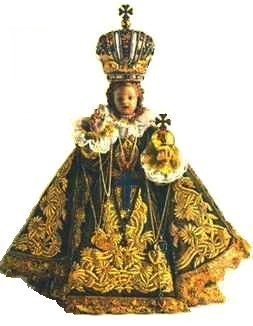
The Infant of Prague in one of the seasonal costumes in which the Icon is dressed through out the year. Thank God my daughter did not know about this. Purchasing certain Barbies was expensive enough.


Pope Benedict to Confront Secularism on His First Czech Visit
By Jeffrey Donovan-Bloomberg.com 9/25/09

Pope Benedict XVI will confront secularism when he visits the Czech Republic, a former communist nation with a centuries-long history of religious and ideological conflict where the percentage of Roman Catholics is declining.

The Catholic leader, who speaks out often about the risk of secular Europe losing its Christian roots, arrives in Prague tomorrow for a three-day visit to one of the few European countries yet to ratify a treaty on relations with the Vatican. The trip is his first as pope to the Czech region, the theater of religious wars from the 15th to 17th centuries, and comes 20 years after the fall of the Soviet-backed regime in Prague.

“The Czech Republic is geographically and historically in the heart of Europe, and after having endured the dramatic events of the previous century, it needs, as does the entire continent, to rediscover the reasons for faith and hope,” Benedict said on Sept. 20 in Castelgandolfo, south of Rome, site of the papal retreat.

Benedict’s trip comes as religious practice is at a historic low in the country, where the government and the Catholic Church have yet to resolve a dispute over the restitution of property confiscated by the former communist authorities.

Atheist groups have called the visit a violation of the secular constitution, while critics of the Vatican’s ban on artificial means of birth control plan to hand out 10,000 condoms during a papal Mass in Brno on Sept. 27, the CTK news agency said on Sept. 24.

Dwindling Faithful

The pope will focus his trip on the country’s dwindling Catholic population, Vatican spokesman Federico Lombardi said. He “will encourage the local church to bring hope and vitality to a very secularized environment,” Lombardi told reporters in Rome on Sept. 23. (Perhaps it would help if the Vatican stopped trying to officially sexularize Europe with their constant interference in internal politics concerning abortion and marriage.)

Benedict, 82, will address Czech political leaders and Prague-based diplomats in a speech in English tomorrow at Prague Castle. While German was spoken widely in the Czech lands of Bohemia and Moravia before World War II, the German-born pontiff will speak in public only in English, Italian and Czech during the visit, Lombardi said.

About 100,000 people, including pilgrims from neighboring countries, will attend the Mass in Brno, the capital of Moravia, the country’s most Catholic region, Czech Bishop Vaclav Maly told reporters in Prague yesterday. Some 50,000 will be present when the pope leads a ceremony celebrating St. Wenceslaus, the Czech patron saint, on Sept. 28 in Stara Boleslav, north of Prague, Maly added.

European Topics

“His themes will touch on Europe, on the construction of Europe, on its Christian roots, and on democracy and freedom” in Europe after the collapse of the Soviet bloc in the autumn of 1989, Lombardi said. He added that the pope won’t discuss relations with the Czech state or the property dispute, though such issues may come up in a meeting between Prime Minister Jan Fischer and Tarcisio Bertone, the Vatican’s secretary of state.

The Catholic Church has a tumultuous history in the region. Jan Hus, a forerunner of the Reformation, was burned at the stake by Catholic officials in Constance in 1415, becoming a national martyr. His death helped set off two centuries of religious wars that devastated the area.

Centuries of Austro-Hungarian rule that sought to re-impose Catholicism also left a lasting mark, said Father William S. Faix, a U.S.-born Catholic priest at St. Thomas Church in Prague.

‘Sense of Resentment’

In 1939, about 80 percent of the population was baptized Catholic, Faix said, adding that the number had fallen to 40 percent by 1990 and stands at just 20 percent of today’s population of 10 million. The Czech Republic was the second- least religious country in Europe, after Estonia, according to a 2005 Eurobarometer poll, which found that only 19 percent of Czechs believed in God. (I wonder how true this is. It could be that Czechs are more inclined to agnosticism rather than particular religious denominations.)

“The Czech nation was under the tutelage of the Hapsburgs from 1526 to 1918, and they did use religion as a source of centralization, and this created a sense of resentment on the part of the Czech people,” Faix said in a telephone interview. “They felt manipulated, ideologically and politically, and this was only exacerbated by the communist regime.” (Perhaps there's a message in this for the United State of America. It does seem certain folks are tryinig to use religion as a source of centralization and engendering resentment.)


*********************************************************


This should be an interesting trip for Pope Benedict. In some respects it has the potential for more pitfalls than his recent trip to Israel. The politics may not be as life and death in a literal sense, but Benedict's visit may have quite the effect on the future life of Catholicism in Czechoslovakia.

The Czech's, along with the East German's have by far the lowest belief in the existence of any kind of God. What's interesting though, is both countries have a much higher belief in life after death than they do the existence of God. This could be one reason both countries are experiencing a surge of interest in New Age mysticism. Poland too, is experiencing this same increase, but in Poland's case New Age techniques are an add on to existing forms of folk Catholicism.
This is not an increase in a magical mentality, which believes that one can perform rituals to control what reality manifests. This is an increase in searching for ways to develop personal abilities to achieve an experience of cosmic unity and to connect to something bigger than ones self.

It's not that one can't achieve those kind of experiences in practicing Catholic spiritual and ritual acts, because one can certainly have those same kinds of experiences in Catholicism. The difference is New Age techniques are personal, devoid of any institutional doctrines, and don't come with historical baggage. For these reasons they have a certain appeal to populations which have had their fill of oppressive forms of authority but still desire some sense of the sacred or mysterious. Benedict will have to find a way to stress the transcendent while walking in a historical mine field. Railing against secularism will probably fall on deaf ears--even if it is in English and not German.


As a note of interest, Jayden Cameron who authors the Gay Mystic (linked to at the side of this blog) lives in Prague and will be writing his experiences of the Pope's visit. I'm pretty sure Jayden's reporting will be somewhat different from John Allen's and I am really interested in what Jayden's take will be. Actually I'm kind of jealous.


Thursday, September 24, 2009

The Struggle For Dominance Inside The American Hierarchy


Archbishop Raymond Burke, the de facto pope of the Republican Catholic Church, has added his voice to the Kennedy funeral debate, health care reform and of course abortion and gay marriage. Not surprising, he differs significantly from his less politically inclined fellow bishops.

Vatican Official: Church Erred in Holding Kennedy Funeral
David Gibson, Politics Daily- 9/22/09

The tug-of-war over Ted Kennedy's soul seems to be eternal. In a speech last Friday night to a gathering of Catholic conservatives at the Mayflower Hotel in Washington, an outspoken American archbishop now heading the Vatican version of the church's Supreme Court said that politicians who support gay marriage or abortion rights cannot receive sacraments without publicly repenting their ways:

"It is not possible to be a practicing Catholic and to conduct oneself in this manner," said Archbishop Raymond L. Burke, whom the pope transferred to Rome in 2008 after Burke's often-stormy tenure as archbishop of St. Louis. "Neither Holy Communion nor funeral rites should be administered to such politicians," Burke said. "To deny these is not a judgment of the soul, but a recognition of the scandal and its effects." (AB Burke wasn't to adept at recognizing scandal in his handling of abuse cases for the Archdiocese of St. Louis or Lacrosse WI. In fact he stated canon law trumps civil law and refused to report abusers to criminal authorities.)

The remarks come from an account of the 50-minute speech by Deal Hudson, director of InsideCatholic.com, a conservative Web site that hosted the Sept. 18 annual gala for some 200 supporters. (Among them: American Enterprise Institute President Arthur Brooks, the National Review's Kate O'Bierne, and Ed Whelan, head of the Ethics and Public Policy Center.) Hudson was an adviser to the Bush White House on Catholic issues.

Burke's blast is not exactly a surprise, given his track record of sharp criticism of pro-choice Catholic politicians -- he has said they should be barred from taking Communion and has encouraged ministers who distribute the Eucharist to withhold it on their own initiative. Burke has not been shy about exhorting fellow bishops he sees as too lenient, either, as he did in this March interview with Operation Rescue's Randall Terry. (Burke later regretted that Terry had aired the videotape.) And he is a favorite speaker of Beltway conservatives, having given the keynote at last May's National Catholic Prayer Breakfast. (This was another one of his decisions which caused scandal to the Church and for which he did sort of kind of apologize.)

But for Burke, now a prominent official in the Vatican's judicial system, to -- in effect -- openly oppose the judgment of Boston's Cardinal Sean O'Malley (and most other bishops) regarding sacraments for Kennedy and other Catholic pols, and to, in effect, give aid and comfort to a Catholic right that has stepped up criticism of the hierarchy to fierce levels, is remarkable. Burke did not just say that politicians like Kennedy should not be provided a private funeral; he advocates denying them a funeral Mass at all.

Cardinal O'Malley earlier this month rejected that course of action "in the strongest terms," as he wrote in a blog post that was an unusually blunt response to critics of his decision to allow Kennedy a funeral Mass and to preside at it:

"We will stop the practice of abortion by changing the law, and we will be successful in changing the law if we change people's hearts. We will not change hearts by turning away from people in their time of need and when they are experiencing grief and loss," O'Malley wrote.

"At times, even in the Church, zeal can lead people to issue harsh judgments and impute the worst motives to one another. These attitudes and practices do irreparable damage to the communion of the Church."

In his well-received speech last Friday -- the standing ovation lasted seven minutes -- Burke rejected such an approach."We should have the courage to look truth in the eye and call things by their common names." He added that for a politician who support abortion rights and gay rights, for example, to return to the sacraments, "his repentance must also be public."
(Apparently this same standard doesn't apply to public scandal by clerics. Those must be kept secret and in the province of the confessional.)

Burke also rejected concerns that speaking out as he has is fomenting divisions within the church, and at the highest levels.

"The Church's unity is founded on speaking the truth in love. This does not destroy unity but helps to repair a breach in the life of the Church." (Personally, I think Burke and his conservative cronies are purposely fomenting schism.)

Still, Pope Benedict XVI's exchange of letters with Kennedy seemed to indicate a pastoral concern for the dying senator that contrasts with Burke's approach, and few bishops -- from Rome to Boston -- believed Kennedy should have been denied a funeral. Yet during his Washington visit Burke also appeared on FOX News to denounce the Baucus bill on health care reform as "certainly not acceptable" because he said it provides funding for abortions (that point is disputed).

He also said the current proposals threaten a "subtle introduction into health care of euthanasia." With the apparent push-back on health care reform from the Catholic center, it seems clear there is a struggle for dominance inside the Catholic hierarchy in America, and one that does not appear to be ending anytime soon.


**************************************************


I sometimes wonder if Archbishop Burke isn't a soul mate of Sarah Palin. Maybe they have such similar thinking because they get the same talking points from the same right wing 'values' voters groups. The very same values voters who think health care reform is like number nine of their list of concerns.

Burke's bought and paid for political appearances are getting so predictable they are virtually not worth writing about, except that they are beginning to engender a push back from the Center. David Gibson's post linked in the last paragraph is a pretty good read, summing up some of the voices that have been raised about the polemical attitudes of the Burke's of the American Catholic scene.

I have to admit though, that I laughed when I read Burke's statement that gay marriage advocates are not worthy of communion or funerals unless they publicly apologize. This is coming from the same person who took the final vows of a transgendered male into a convent of nuns he first supported and then wound up suppressing, the Franciscan Servants of Jesus. It's amazing what secrecy and canon law will allow when one is the sole interpreter for one's diocese.

What's more amazing is how bishops like Burke, Martino, and Chaput can insist on their own primacy in their own dioceses while castigating other bishops for how they run their dioceses. Cardinal O'Malley must be having serious empathy for Fr. Jenkins of Notre Dame. Seems like mercy or compassion are no longer operative in the pro life or family values movement--nor consistency for that matter, it's all do as I say, not as I do.

I really have come to believe that the conservative movement in American Roman Catholicism won't be satisfied until they have promulgated a formal schism, either on their own or through pushing the center and left completely out of the Church. What I don't fully understand is what the movers and shakers behind this push actually hope to accomplish unless it's the complete silencing of the official voice of Roman Catholicism when it comes to social justice issues. This is the only thing which makes any sense. It's pretty obvious in the health care reform debate. Abortion is being used as the excuse to derail any reform at all. The only people who benefit from that are the health industry and people who have stock portfolios heavy with health industry investments. It's certainly no positive for the Catholic health care system as Cardinal Wuerl has recently pointed out.

But when it comes to receiving awards from the Republican branch of Catholicism, solidarity with the rest of American Catholicism is a very distant second for Archbishop Burke. As long as he spouts their official line, Republicans turn a very blind eye to some of his peculiarities, as he apparently does to theirs.
This hypocrisy of convenience needs to be engaged and countered. It's great to see some of our more centrist bishops are finally coming to the same conclusions.

Wednesday, September 23, 2009

Other Voices Speaking Wisdom Which Led Me To Thoughts On Training Wheels

THe reform of the reform is beginning to look like an attempt to put training wheels back on adult bikes.


There are a number of consistent contributors in the comments section of the NCR that I find really informative and inspirational. So today I offer their comments as a change from my own.

The first is written in response to a trad who was pontificating on the fact that Jesus was a totally law observant Jew and not a revolutionary. It's one of the best things I have read in a long long time describing how one advances in spiritual understanding.

The second deals with the reality of the pre Vatican II church as it was actually lived, not as it has been mythologized by the JP II generations. The vaunted beauty of the Latin Mass paled in significance compared to everything else attached to that liturgy. In more respects than I care to remember, the kind of spirituality it promoted was emotionally abusive. For those who didn't live through it, and want an idea of what it was like, imagine being gay in today's Church.


Submitted by LittleBear (not verified) on Sep. 22, 2009.
"For I tell you, unless your righteousness exceeds that of the scribes and Pharisees, you will never enter the kingdom of heaven." (Mt. 5:20-21)

I certainly do believe that Jesus was/is revolutionary in his teachings, otherwise Christianity would not be a major branch of religion today---but another division of Judiasm. St. Paul describes his own inner struggle with law especially in Romans 7:7-25. And it takes Paul much of his letters to Romans and Galatians to say what the Dalai Lama says in one oft-quoted line: "You must learn the meaning of the law very well, so you will know how to disobey it properly." (I love this line. It sounds flippant in a way, but it packs huge meaning.)

In other words, one must know and respect the rules before one can break the rules. Let's take a look at Jesus growing up to see how this was a major part of his religious development, his revolutionary development.

In the normal development of his spiritual consciousness, Jesus would have first learned Order. He was taught by his parents the traditions, customs, and the law ---"This is the way we do it." In the books of the Torah, (or the Law), Jesus would have learned the important lessons of identity (Book of Genesis), exclusivity (Exodus), boundaries, loyalty and the necessary discipline to counter the imperial ego found in each human person. Those elements are largely the concerns of the books of Leviticus, Numbers and Deuteronomy---books that most Catholics and other Christians do not read much, because they are not always "inspiring." But what they do is provide boundaries, absolutes, laws and goals that one starting their religious development needs. (Or as I like to say, they are the training wheels you need before you can ride your personal spiritual bike.)

Secondly, as Jesus was growing into his teens, he would have studied the second section of Hebrew Scriptures (the Prophets) and he would have arrived at the Stage of Criticism. As Catholics, we don't have a really strong background in the prophetic canon---because we only read them in so far as they offer us proof texts for the coming of the Messiah. But these books take up far too much room in the bible to be just that. What Jesus would have learned in reading/meditating upon prophets is that he had to leave behind any false innocence and naive superiority that he may have had---as he would see that his people had not/were not living up to the level of "law". And, just as importantly, he would have had to "search his own heart" to see how he related to God as a Son of the Law.

This was an important stage for Jesus to arrive at (and it is also for us), because unless one can move to this level of a self-reflexive, self-critical thinking---one remains unconscious, falsely innocent and unaware. Thus most people choose to remain in that first stage. They believe that they belong to a special group---highly favored by God. They believe that this group is the best and the center of the world. They may think that this can even pass as holiness, but it isn't that at all.

It takes courage to not only recognize that as individuals, one has been driven by one's ego (call it pride, or sin), but also that as a group (Jewish, Catholic) that we, and our leaders have sinned and done every kind of evil. And it takes a faith, a trust in God to be critical of one's self, one's own system, and of one's own people. It will never make one popular. And as we know, the prophets are always rejected by their own (see Luke 12:50-51) and one is usually killed in some way (physically, emotionally, socially, etc). It is knowing this, that sets the stage for understanding Jesus and the rarity of the third stage of his development or "integration."
Jesus would have learned from the Hebrew Scriptures---the Wisdom books, including Psalms, Ecclesiastes, the Song of Songs, the book of Wisdom, and most especially, the book of Job, to deal with complex issues that cannot be resolved, that allow no closure, that demand trust, surrender and in moving on to a deeper level. God, for example, answers none of Job's questions, but leads him deeper into mystery "But truly it is the spirit in the mortal, the breath of the Almighty, that makes for understanding" (Job 32:8)

In arriving at stage three---Wisdom---Jesus learned patience with mystery, paradox, suffering and its limitations. Jesus is such a dramatic representative of Wisdom--that he ended up creating a whole new religion---a religion that people trapped in stages one and two always misunderstand. This is the genius of biblical revelation. True Wisdom will honor and include both the Law and the Prophets, exactly as Jesus said---and "bring them to completion" (Matthew 5:17).

For Jesus, it is important to 'see' correctly. He states that when one is trying to correct another---"to take the splinter from your brother's eye, to take the plank out of your own eye, and then you will see clearly enough to take the splinter out of your brother's eye." (Matthew 7:3-6).
Jesus stresses growing into personal transformation, empathy, compassion, patience, most of all, the love of God---without denial, disguise, repression or hypocrisy. Unfortunately immature religious belief creates a high degree of "cognitively rigid" people or very hateful people---who call others, heretics or blasphemers.

Jesus, is always trying to undercut the arrogance, the self-validation, the cold calculation of the ego. The entire Sermon on the Mount makes that quite clear (Matthew 5-7). Jesus clearly sees the pride, self-sufficiency and its resultant hypocrisy as the primary moral problem. "You have neglected the weightier matters of the law---justice, mercy, and good faith" (Matthew 23:23) in favor of temple tithes, Jesus says to the scribes and Pharisees. Although Jesus gives us a clear explanation of the creative tensions between law and God's life (grace) in his six-part litany of "your ancestors said...but I say" (Matthew 5:20-48), the purity codes and group identity markers (Law, Doctrine, etc) soon won out again. It is Paul who aggressively attacks these in both Romans and Galatians.

Since I have already taken up much space here---I will continue in part 2 with Paul. I have placed this in this section on Vatican II Priests---because Vatican Council II was attempting to get us to move BEYOND the juridical definition of sin as a violation of law---but rather a rupture of relationship with God. Something that cannot be put into codas.


*************************************************


Submitted by Aileen (not verified) on Sep. 21, 2009.
After reading through all of the comments again this past weekend, I was struck with a curious thought. It would be most revealing if everyone who made a comment had included their year of birth and the year of their first holy communion... and whether they are laity or ordained..

My real life experience has been that those who so fervently desire to return to the old traditions and ways of pre-Vatican II (or how they imagine it), are too young to actually remember it, and just how burdensome and depressing it could be to live under such repressive and unforgiving rules.

Today’s retro-uber-orthodox would have a rude awakening if they achieved their wish..Most Catholics today are not aware (or perhaps have forgotten?) just how oppressive the situation was. One example among many (for those of us who do remember): ANY divorced person was formally excommunicated for the mere fact of divorce; even the wronged spouse who had been left for another person through no fault of their own, nor had they remarried. Marriage tribunal to address such an injustice was virtually unheard of for the average Catholic in the pew.

Pope Paul VI (post-V2) changed that unjust rule, thankfully..Because laity were considered an inferior sub-culture below clergy, the list of misery perpetuated upon them was long and final.

One reason there was a bumper crop of clergy in those days was because, for Catholics, it was the only game in town. Being ordained, or having a child or sibling who was ordained, provided some modest 'status by association' for their family members among the laity. Some folks today have the illusion that people in the old days were just "more spiritual". Actually, they were pragmatic..

In those supposedly good old days, laity "paid and obeyed" without question... and got their ticket punched for Mass. They got 'zero' input on anything (forget any pastor/parish council).

A woman's only Catholic badge of honor was hinged to remaining continually pregnant during her entire reproductive span. Infertility had the reverse effect, and was considered a disgrace... even carrying a ‘suspicion of secret sin’. Babies born dead (and so unbaptized) were denied a funeral Mass or burial in consecrated ground... the same denial held true for the mentally ill who committed suicide (they were consigned to hell).. (These two things regarding burials and funerals wreaked havoc on the parents and family members of the deceased.)

For women, the only 'holy' alternative to marriage and marathon procreation was to 'take to the cloth' in a convent.

Those are just a few of the nostalgic “goodies” of the good old days that some in today’s Church long for so fervently. There was much more than just the "old" Mass in Latin or the happy black and white Bing Crosby movies. Like so many romantic notions, they tend to fade in the harsh light of day and actual practice. No one was a bit more “spiritual” as a result — only intimidated and guilt-ridden.

To desire a return to those former ways actually approaches being pathological... possibly masochistic..When Pope John XXIII “opened the doors and windows of the Church” and convened the Second Vatican Council, it was this dark oppression and joyless legalism that he sought to remedy. How ironic that today there are some who would take the Church back to that dark, enclosed place where only those who could perfectly keep the rules were welcome, and the hierarchy’s imposed unjust suffering on laity was believed to be the will of God. I can understand why certain bishops would love that arrangement. I cannot understand the appeal to laity.


******************************************************


The dark oppression and joyless legalism is exactly what John XXIII was trying to remedy. The first step was to convene all the world's bishops and let the dialogue flow. The 'Spirit of Vatican II' which have become red flag words to trads, is all about this lifting of the oppression and joyless legalism which was the hall mark of the pre Vatican II church.
Speaking for myself, I'm far more concerned about the return of the mindset that went with the Latin Mass, than I am the return of the 'bells and smells'. I just don't think you can return one without the other. From what I've seen from some recently ordained priests, coupled with the over whelming influence of right wing Spanish apostolates, seems to prove the accuracy of my worry. Adults don't need training wheels.


Tuesday, September 22, 2009

The Never Mentioned Problem Of The Male Gender Gap In Church Participation

This is where a lot of Catholic men must be getting their spiritual sustenance. It's certainly not in Catholic Churches.

One of the biggest issues in Catholicism, and one which is never addressed, is the gender gap in practicing Catholics. While it is true that men in general attend Christian services less than women, the gap in Catholicism is double what it is in protestant congregations. What's even more interesting is that there is no real gender gap in other spiritual traditions--Islam, Hinduism, Buddhism, or Judaism. So it's not that men in general are less spiritually inclined than women, and that's probably true for men in the West, it's that men are turned off by the religious expression of Christianity as it's practiced and conceptualized.

Some writers feel this trend is a product of men substituting consumerism and secular pursuits for religious practice. Others see it as an outgrowth of the anti clericalism in Europe coupled with Catholicism's official promotion of the kind of personal piety exemplified by the female mystics and visionaries of the late 1800's. This period also saw a huge upswing in Marian devotions and Pius IX's crusade against modernism and the rise of the European middle class. Writers in this camp see much of what Pio NoNo promulgated as an attempt to shore up male clerical power in the face of a rising population of educated and independent men. Still others see this gap as indicative of the failure of modern Christian denominations to have adequate rites of initiation for male adherents or any kind of message which gives meaning to the core attributes of the masculine side of spirituality. Leon Podles falls in this camp.

What ever one thinks the reasons are, the lack of male participation will insure the steady downward trend in active Catholics. In spite of all the hoopla around young conservative males being the future of the Church, the facts are that the biggest gender gap is seen in these very generations and one of the reasons is because their fathers didn't go to Mass.

This gender gap can't be blamed on Vatican II or the abuse scandal. This has been a steady and predictable arc for over 200 years. This also means it can't be blamed on feminist nuns, or feminism in general. The perception of Catholicism as not being a manly pursuit is the direct product of the all male clergy. They have created the Church that their fellow men have rejected.

I do believe the Vatican is subtly trying to address this gender gap problem (with out ever admitting it) with some recent decisions. One was the attempt to blame the abuse scandal on gays and the subsequent attempt to remove the 'effeminate' gay male from seminaries. Another could be the multiple investigations of the LCWR. Two of Cardinal Levada's stated issues are women's ordination and homosexuality. Can't be having either one of those if the idea is to appeal to masculine men. Time to put those 'feminazis' in their place.

Even some of the proposed changes in the liturgy could fall into this category. It's hardly unusual to read male comments disparaging the 'touchy feely kumbaya' nature of the Novus Ordo or comments concerning the emasculation of Jesus by making of Him some kind of bleeding heart social worker instead of the Divine sacrificial martyr hero of the Tridentine rite.

The trouble is, I doubt any of these steps are going to appreciably effect the gender gap. The problem is much deeper than gays, and the LCWR or the Novus Ordo and goes back much further in the Catholic tradition. It has to do with the fact that the dignity of the ordinary male who did ordinary masculine things like marry and have sex and raise children was purposely relegated to an inferior position as opposed to males who maintained sexual purity and became dedicated religious. The irony of this is that while clerical men gained enormous social status the biggest losers were all other men. I don't think that's what Jesus had in mind, but it's what we have now. '
Addressing this gender issue is one of the places I hope the emerging church can be successful. If it can't address male spirituality in a meaningful way, emerging churches won't have much of a future either.

Monday, September 21, 2009

Religious Authority And The Emerging Church

A future thinking entrepreneur's vision of the Emerging Church. Comes complete with lawn chairs.


In the interview with Richard Rohr on the emerging church, there is a discussion of a very important point. It's one which goes to the heart of the current divisions in the Church and one I've alluded to plenty in the past. Where does the Church's religious authority come from? Catholicism claims it's authority as coming directly from Jesus Christ. I don't have a problem with that. The problem comes in defining which vision of Jesus Christ? Is it the Jesus Christ who ministered daily to the marginalized in the fullness of His humanity and brought us the God of love, or is it the post Crucifixion Jesus Christ who gave the keys to Peter and becomes the sacrificial victim to appease the Old Testament's vengeful God, where fearful obedience trumps love.

Like Fr. Rohr I believe religious authority will come from our evolving understanding of creation. The loving social justice Jesus slides easier into this cosmology because we are seeing the universe as an infinitely diverse, yet highly organized living thing in which each discrete unit has an important place in the over all structure. So here are the thoughts of Fr. Rohr:

Rohr agrees that "for religion to be religion, it always has to appeal to some kind of absolute or final authority. So the question of where does your authority come from, as Jesus is asked, is always going to be there. My intuition, and it might be totally wrong, is I think the new authority is going to come from nature or the cosmos, the natural world.

"I know when Catholics first hear that," he said, "it sounds new age-y, but it seems to me that's the primary Bible as the Franciscans believed." (This is a problem, but not all New Age thinking is channeled from lala land.)

That Bible, he said, has existed for 15 billion years "and has an inherent authority" reflected in Romans 1:20, 'God is revealed to things through the mind, to things as they are made.'"
The rediscovery today of the natural world, of "things as they are beyond our technology and mental constructs," will become the new authority "that we're going to be forced to appeal to, especially as we continue to destroy this planet, and we realize this is the one thing we all have in common: that we're all standing and eating off this same earth."
(Fr. Rohr is correct. As these concepts percolate down from esoteric science and into the mainstream, traditional institutions will have a tough time integrating this new cosmology because they are products conceived in the older cosmology. Theoretical physicists have been dealing with this for the last hundred or so years. To understand quantum physics they had to let go of the prior Newtonian view of physics. Quantum physics can contain Newtonian physics as a subset of quantum mechanics without negating Newtonian laws. It doesn't work the other way around.)
The natural world was an authority that appears to have been agreed upon by indigenous people around the planet, said Rohr. "We used to use the word in philosophy class: facticity. This is the 'what is.' We were always looking for the facticity. Here it is: These trees, this grass and that sky. How can you beat that for ultimate authority? This names what we all better be obedient to. … This is demanding obedience and a response from us far more than any mental construct from a pope or scripture."

It is the new cosmology that sees that the Bible was written in the "last nanosecond of geological planetary time. As I love to say to crowds: Do you really think God wasn't talking for the first 14 billion years or whatever it is? They get that. They really get that. Let's listen to this talking. As a Franciscan, I find that so rooted in our early experience, although we lost it, too."
For Rohr, the new cosmology also recognizes that the old conception of natural order, the up-and-down universe from which hierarchical examples of leadership are modeled, no longer applies.

"It doesn't work," he said, "and we've got a system [in the Roman Catholic church] that totally depends on up and down." That model, he said, "is summed up in the need to define the world in terms of superiors and inferiors, and the white, male system always does that. There are always superiors and inferiors. (This hierarchical system is not just a product of white males--they've just perfected it. Some indigenous cultures teach that this, and the technological mindset, were the gifts of the white race to humanity. The balance was lost when whites mistook an efficient construct for an absolute mandate and then declared themselves as the sole worthy for the top of the hierarchy.)

"You just see Jesus paying no attention to that. Nowhere is it probably symbolized more graphically than in the Roman Catholic church, which has all these scriptures about the least of the brothers and sisters, and the little ones deserving the greatest care, when in fact, what we do is dress up the big ones. We idolize and quasi-worship the big ones." (Quite literally true which is quite literally unfortunate.)

*****************************************************


There will be an Emerging Church and once it gets going it will go 'viral' as they say in the world of UTUBE. It will be inclusive of all faith traditions because contemplatives in all those faith traditions are being shown this same future. There will be a sharing of spiritual techniques, concepts, and understandings with no demand that one need shed their own tradition in favor of any other. The Emerging Church will freely understand it is possible to add practices and understandings to one's faith experience with out demeaning or diluting the insights and truths of one's own tradition. This is happening all over the globe. It is gaining momentum, and it will have a profound impact on the future of mankind.

Pooling spiritual resources, capabilities, and training, is the one sure way to change the direction in which humanity is headed because this changes man's view of himself and his relationship to God and how he expresses this awareness. This is not a movement of tearing down so much as it is a movement of building from the past and creating the new.

It takes the fearlessness of a child like curiosity and openness, coupled with a mature faith in truths of one's own tradition. In many respects it's about finding validation for one's traditions in the similarities found in other traditions. It's about what unites us, not what divides us.
It's a concept of church and worship which could not have come at any other time because it needs the possibility of global interaction and communication. It needs a cosmology which both recognizes our common heritage and celebrates an unending creative process which is evolving in complexity and organization.

Current religious institutions will fight to return to a mythical past in which their truths were undiluted by modern culture. Unfortunately for them, more and more people will see that this return is really about reinforcing and maintaining the authority structure, and not so much about maintaining the teachings of their founders.

In Catholicism this is seen in repeated appeals to past clerical authorities to in order to shore up the authority of the current hierarchy. It almost always centers around issues of morality and doctrine, and not the direct teachings of Jesus Christ. Follow this link to see this process at work in the latest discourse from Archbishop Raymond Burke. It should surprise no one that this came at a function hosted by Deal Hudson and involved Raymond Arroyo. The 'Republican' Catholic Church is not an example of a true spontaneous emerging church. It is the perfect example of what the Emerging Church is not. As such one can learn a great deal about the opposing energies and institutions from understanding the artificial and purposeful construction of this particular brand of Catholicism.

As some last thoughts, since the emerging church will be far more about attitude than obedience, here are a couple of posts, Wild Reed and There Will Be Bread, that deal with the kind of attitudes which will foster the advent of the Emerging Truth er I mean Church.


Sunday, September 20, 2009

Spiritual Authority and Feminine Complimentarity

This is one way to claim male spiritual authority and dictate women's spiritual place in the male scheme of things.


Horrors! Catholic children exposed to gender equality!
by Maureen Fiedler on Sep. 18, 2009


Not long ago, the Cincinnati archdiocese banned Sr. Louise Akers from teaching because she supports the ordination of women.

That was bad enough. Then, Dr. Carol Egner, a laywoman and a gynecologist who was incensed by this injustice, wrote a letter supporting Akers to the Cincinnati Inquirer. Her pastor read the letter, and had the gall to demand that she write another letter retracting her position. When she rightly refused, he banished her from her volunteer teaching position with a 6th grade religion class at Our Lady of Lourdes Parish.

What is it that these men fear? Exposing children to the gospel ideal of gender equality? Open discussion of an issue of great importance in our church? The thought of actually sharing ministry equally with women?

The issue of women’s ordination seems to have produced a new level of clerical emotion in the last year. Perhaps -- because of the clergy shortage, the theological indefensiblity of this discriminatory position, and the widespread acceptance of women in other denominations -- this is the issue on which they feel most vulnerable.


********************************************************


The comments to this post are rehashing all the hundreds of comments that have accompanied the other posts on the Akers/Egner stories. This one from a Fr. Angelo Sotello gives the traditional response succinctly:

Submitted by Fr. Angel Sotelo (not verified) on Sep. 18, 2009.
Maureen, you make it sound as if no one has been allowed to speak about women's ordination, ever. The inconvenient truth is that Catholics have been arguing about ordaining women since the Gnostics first ordained women, only to have their women priests rejected by the larger Church. As far as Dr. Egner, she may have the right to speak her mind, but she doesn't possess a right to speak in the name of the faith community without a mission from the pastor.

And if you want to point to what is theologically and scripturally defensible, I don't get the argument that because Jesus valued the role of women, that He automatically gave them a call to Holy Orders. It's as if Jesus' call to men for leadership is irrelevant. And the gender equality argument continues to ignore what even sociologists now state emphatically--gender equality does not equal having the same exact roles for a man and woman within the family and household setting.

The household of Catholicism and its leaders has resoundingly responded "no" to women priests over the long trajectory of its pilgrim journey. The new generation of young priests and seminarians are solidly unsympathetic to the cause of women's ordination, which means that they have more than "emotion" on their side. Their opponents will simply die off and the resurrection of a Gnostic women's priesthood will go that way as well.


There are a number of things I take issue with in this comment, but unique from others, Fr. Sotelo does admit women were ordained in the early church--although by those heretical Gnostics. That's a start.

He then brings up the canard that Jesus ordained the twelve to Holy Orders, which of course is not true. He did commission them to leadership in the temporal church. No one is disputing that, just the fact there could have been a lot more than twelve people at the Last Supper.

Fr. Sotelo continues with the appeal to the long tradition of male dominance in the pilgrim church and the fact the new seminarians are solidly unsympathetic to the cause of women's ordination, somehow concluding they have more than 'emotion' on their side. He ends by assuring us that this whole Gnostic notion of women's priesthood will die off with the Vat II generations. For some reason I'd rather be told to become an Episcopalian than have these constant references to the good my death and those of my generation will do for the Church.

Sometimes though, God does work in mysterious ways. Fr. Sotelo's denigration of the historical fact of the ordination of women as a Gnostic heresy tripped a rebuttal in my mind. Gnosticism was far more involved in the notion of life as a personal spiritual journey and they looked for mentors who they deemed to have spiritual authority. Although I don't particularly think much of a lot of gnosticism--the extreme mind/body duality was surely on the wrong path--the emphasis on spiritual authority, as opposed to temporal sacramental authority, is a major problem to Institutional religious authority. Anyway, I had to add my two cents.

Traditional and theological authority should never be confused with Spiritual Authority. Men have no claim to sole authority over the things of the spirit. If this were not so, men would have been the first witnesses to the Resurrection and more than one would have witnessed the Crucifixion.

These two truths, which are thoroughly seated in the realm of the Spiritual, were shared and witnessed by women. The same is true of the Incarnation. It was another woman, Elizabeth, who witnessed and proclaimed this spiritual truth. It was the seer and prophetess Anna who recognized Him at His temple presentation, as did Simeon, who said to Mary, "and you yourself a sword shall pierce so that the thoughts of many hearts shall be revealed."

This statement indicates Mary's spiritual authority and her own spiritual gift. It is then at Mary's bequest, and not His own desire, that Jesus starts His spiritual mission at the wedding feast of Cana.

Men may indeed keep the temporal authority to themselves by their own decree, but I look far more frequently to women for spiritual authority. Perhaps it is this truth which clerical men are afraid of.

I could elaborate a lot on this difference between temporal sacramental authority and true spiritual authority. Indigenous tribes freely recognized that the spiritual path was easier and more truly expressed by women than by men and that when expressed by men it was linked genetically, frequently passing through the maternal line. For the sake of this post, I'm not going to get into the differences between genetic psychic talent and spiritual gifts. I only bring this point up to underscore the differences between men and women which the Church is flat ignoring in order to shore up the male definition of complementarity as it is to be expressed in the Institutional Church.

Temporal sacramental religious authority is NOT the same as spiritual authority. It can however manifest in religious authority as it did in Padre Pio. St Pio was also pierced so 'that the thoughts of many hearts shall be revealed'. It was that gift that gave him his spiritual authority, not just his ordination.

I will be going back and reading the New Testament with different eyes. Perhaps the Gnostics got something correct and having women as spiritual leaders makes a great deal of sense. Perhaps it's precisely that leadership which is both lacking in the current institution and greatly feared---unless it's under their control.

The history of the Church is replete with clerical men persecuting psychically/spiritually gifted women. It still continues to this day, or why else the recent pathetic statement on reiki? I could go on, but I'll leave it here for today. Feel free to comment, as I think this is an area about women's complimentary gifts for the Church which needs to be discussed and not suppressed.


PS, I'd also be interested in comments about Tom Robert's lastest post in the National Catholic Reporter concerning the emerging church. He conducted a fascinating interview with Fr. Richard Rohr, in which Fr. Rohr states the emerging church will center around the contemplative tradition. I happen to think Fr. Rohr is correct and this will lead to a very different church with a very differenct cosmology, theology, and world view.


Friday, September 18, 2009

Mad Max is all alone when it comes to his health care bill and making no friends in the pro life crowd.


Baucus health care bill would fund abortions, pro-life groups say
Washington D.C., Sep 18, 2009 / 03:26 am (CNA).-


Some pro-life groups have reacted critically to the new health care legislation proposed by Sen. Max Baucus (D-Mont.), warning that it would subsidize and sometimes mandate abortion coverage, especially if Hyde Amendment funding restrictions are not maintained.

They also warned the proposal could force the “rationing” of health care.

Tony Perkins, head of the Family Research Council, charged that that Sen. Baucus’ “America’s Healthy Future Act” includes abortion “pure and simple.”

He compared the legislation to the Capps Amendment, saying it would subsidize health plans that cover elective abortions with tax credits. (Catholics already subsidize health plans that cover abortion--every time they pay their monthly premium into a private plan that covers abortion)

“The accounting used in the bill is a matter of smoke and mirrors, since elective abortion is authorized for health plans receiving government subsidies.”

Perkins also charged that the Baucus bill mandates at least one health plan in each region of the country covers elective abortions. In Perkins’ view, this contradicted President Obama’s claim that he would prevent federal funding of abortion.

The National Right to Life Committee (NRLC) said the Baucus proposal contains “an array of pro-abortion mandates and federal subsidies for elective abortion.” Provisions of the bill would give “massive” federal subsidies to both private insurance plans and government-chartered cooperatives that pay for elective abortions.

“This would be a drastic break from longstanding federal policy, under which federal funds do not pay for elective abortions or subsidize health plans that cover elective abortions,” NRLC's legislative director Douglas Johnson said.

The NRLC also charged that the bills were inconsistent with President Obama’s claim that no federal dollars will be used to fund abortions. It reported that the Baucus bill provides $6 billion in federal funds to establish health insurance cooperatives, without any limitation on the use of funds to pay for abortions or to subsidize plans that pay for elective abortions.

The national pro-life group also warned that the Baucus bill would allow the federal government to declare abortion a “mandated benefit.” NRLC claimed that without renewal of the Hyde Amendment, which expires every September 30, many private insurance plans could be forced to include abortion on demand as a mandatory benefit in the minimum benefits package.
(The above paragraph is all speculation and none of this appears to be in Baucus's bill.)

NRLC further cautioned about health care “rationing,” saying the Baucus bill contains a medical provision that in 2015 would instate severe financial penalties upon physicians who are in the top 10 percent of medical resource use. (One would think the wording can be worked out. This provision is designed to weed out physicians who fraudulently abuse any insurance coverage to line their own pockets and the pockets of the hospitals and clinics where they work.)

“This provision does not link funding to outcomes or quality; instead, it will force a ‘race to the bottom’ with relentless pressure on doctors to limit health care for their older patients,” the group said. “On top of the significant Medicare cuts in the bill, this will gravely endanger the lives of America’s senior citizens.” (Why don't we just keep scaring our seniors. When does this kind of thing become emotional abuse?)

Dr. Charmaine Yoest, president of American United for Life, also criticized the $6 billion in funding for the establishment of health care cooperatives which would be allowed to cover abortion. She likewise warned of mandated abortion coverage if the Hyde Amendment. (This is CNA's own editing mistake.)

“Real health care respects life and the pro-life community will never support any bill that does not explicitly say that abortion funding and coverage is not allowed,” Yoest said.

Mary Harned, staff counsel at Americans United For Life, said that there is still a long road ahead since, even if language expressly excluding abortion funding and coverage is added to the Baucus bill, it will need to be reconciled with the bill from the Senate Health, Education, Labor and Pensions Committee and with the bill produced by the U.S. House of Representatives.


************************************************


Personally I think Mad Max's bill is a corporate sponsored sell out to the health insurance industry, but I do appreciate the fact it is bringing up other facts about the health insurance industry and abortion. I have stated all a long that the only health insurance reform which will do what the pro life lobby wants is a single payer federal system under the Hyde amendment.
If people want coverage for elective procedures they can buy private policies.

Millions of pro life Catholics already subsidize the abortion coverage in their current private or employee sponsored plans. I have been breathlessly waiting for some bishop or pro life group to point out the equal moral danger to Catholic souls in this state of affairs.

The little peep one hears is that this subsidizing is not sinful because it's of a distant non material type of subsidizing over which people have no choice. For some reason this reasoning can't be extended to the Federal Government. Seems it's OK if a for profit corporation makes money off of people subsidizing abortion but it's not OK for the non profit Federal government in any way shape or form. If there's profit involved does that make it moral?

The other alternative to a single payer federal system is to legislatively prohibit any insurance company from covering elective abortion that opts to take federal subsidies. I don't know how this would actually be worked out. Not all abortion is considered medically elective-- at least in the sense the Church teaches it. Taken to it's extreme, which is of course where the absolutists want to go, this kind of ban could include most forms of artificial birth control and all morning after pills. This would be the kind of government legislation that actually does smack of fascism.

Scaring seniors with rationing is getting old and abusive. These kinds of rationing decisions are made all the time in the current system. Why isn't any one on the right concerned about that. Is this another case where if it's done in the service of profit it's moral?

As far as the doctors in the top 10% of medical resource use, all one needs to do is google heart by pass and insurance fraud. Seems cutting people open and exposing them to death for heart by pass surgery they don't need, and in cases don't actually get, is a favorite past time for medical doctors lining their pockets. This kills people, lots of people. It needs to be targeted and the quickest way has been looking at those making the most money off of medicaid/medicare.

Pro life activists will undoubtedly raise objections to every potential bill because they can. The problem they are going to run into is that the current system already does exactly what they've objected to in every reform proposal which has been introduced. Some of these pro life groups are going to have to get consistent or it's going to look like their underlying motivation is profit.


Thursday, September 17, 2009

Maintain The Clerical Priesthood At All Costs Is Benedict's Message To Brazilian Bishops

Pope Benedict is bound and determined this version of priesthood will be the only version of priesthood--even if it kills the Brazilian Church.


Priests cannot be replaced by the laity, Pope Benedict explains
Castel Gandolfo, Italy, Sep 17, 2009 / 10:27 am (CNA).-

In an audience this morning with bishops visiting from Brazil, Pope Benedict XVI advised them on how to respond to the lack of priests, emphasizing that the shortage cannot be solved by having lay people substitute for the clergy. (It could if those lay people were made clergy.)

The Holy Father began his address to the Brazilian prelates by pointing out the difference between the identity of priests and the laity. While the lay faithful share in the "common priesthood," they are not ordained ministers of Christ and His Church. "Hence," the Pope cautioned, "it is important to avoid the secularization of clergy and the 'clericalization' of the laity."

Fulfilling the lay vocation, he explained, involves working to "give expression in real life - also through political commitment - to the Christian view of anthropology and the social doctrine of the Church."

On the other hand, "priests must distance themselves from politics in order to favor the unity and communion of all the faithful, thus becoming a point of reference for everyone," Benedict said.

When dioceses are faced with a lack of priests, the Pope emphasized that they should not resort to "a more active and abundant participation of the laity" since it could take away from their own calling. (Wow, what a sad, sad, statement.)

"The truth is that the greater the faithful's awareness of their own responsibilities within the Church, the clearer becomes the specific identity and inimitable role of the priest as pastor of the entire community, witness to the authenticity of the faith, and dispenser of the mysteries of salvation in the name of Christ the Head," Benedict XVI stated. (It would be far more accurate if the word 'responsibilities' was changed to liabilities, because that is what is implied in the rest of this statement.)

"The function of the clergy is essential and irreplaceable in announcing the Word and celebrating the Sacraments, especially the Eucharist," he insisted, saying that for this reason it is "vital to ask the Lord to send workers for His harvest; and it is necessary that priests express joy in their faithfulness to their identity." (Wow, so much for discussing any of Fr. McBrien's concerns or returning the Church to it's roots. Apparently the roots stop at the Council of Trent.)

Looking to the future, the Pope made it clear that "the shortage of priests must not come to be considered as a normal or typical state of affairs." (It is becoming sadly apparent that the solution to the priesthood crisis lies in the purposeful reduction in the numbers of the laity.)

He exhorted the bishops resolve the crisis by combining efforts to "encourage new priestly vocations and find the pastors your dioceses need, helping one another so that all of you have better-trained and more numerous priests to support the life of faith and the apostolic mission."

As the Church celebrates the Year for Priests and the 150th anniversary of the death of the "Cure of Ars," Pope Benedict pointed to the French priest as a model for priests, "especially in living a life of celibacy as a requirement for the total giving of self." This total gift of self is "expressed through that pastoral charity which Vatican Council II presents as the unifying center of a priest's being and actions," he reminded. (So much for married priests, unless they are Anglican or Lutheran converts.)

The Holy Father ended his address on a positive note, assuring the prelates that "many signs of hope" exist for the future of particular Churches. This future, he said is one that "God is preparing through the dedication and the faithfulness with which you exercise your episcopal ministry." (He certainly can't mean the Church in Brazil which is losing members at a catastrophic rate and has a priest to lay ratio of 1-7,500 which is the worst ratio in the entire Catholic world.)


***************************************************


For all practical purposes it looks to me as if Pope Benedict has written off most of the Brazilian church. These Brazilian bishops have to be heart sick because every meaningful attempt they have made to keep some contact with the faithful has involved lay participation. I wonder if they reflected on the fact that in their country they have some 18,500 priests, but in Benedict's Italy there are 50,000+ priests. Maybe they wonder if Pope Benedict really gets their problem because Benedict is surrounded by nothing but priests and has always lived that way. Maybe they think Benedict should transfer a couple thousand of his Italian priests to Brazil. Or maybe they think he is just completely out of touch. In any event they return to Brazil with no solutions and no hope for their particular church.
Mabye there's something wrong with me, but it's terribly sad that so many of the Body of Christ will be deprived of the Sacraments as the cost of maintaining the ordained celibate male priesthood. No matter what flaws are exposed, or shortages recounted, or corruption uncovered, none of these make any difference. It seems the single most critical aspect of Roman Catholicism is not Jesus Christ. It's this clerical version of priesthood which must be protected at all costs. This is a classic case of the mythos transcending the message of the Founder.


I just wonder if the future Benedict sees for 'particular churches' doesn't include one particular church that is not chained to the current model of the ordained priesthood. Progressive Americans sometimes see this as the future for the American Catholic Church, but it may be it rises in response to the ashes of the Brazilian Catholic Church. In any case, it's coming because I can't believe the Holy Spirit will let this church founder on the Rock of Peter.