Monday, July 16, 2012

The Legion of Christ: Elevating Denial To A Charism

The real charism of the Legion


Finally the Vatican admits the Legion of Christ needs a new identity.  One can only hope this new identity will involve more than just tweaking the packaging or changing the logo.  I have followed the Legion story since 1998 when Gerald Renner and Jason Berry first wrote about Marcial Maciel and the Legion in the Hartford Courant.  As the years have passed, I have watched the carefully constructed facade (product identity) of the Legion come crashing down. I also came to the conclusion the only charism the Legion had was not spiritual, it was psychological.  The Legion institutionalized the defense mechanism 'denial' and made practicing it part of their constitution.  The Vatican has been engaged in the same 'charism' about this group for decades.  JPII even went so far as to throw Maciel's personal secretary, Fr Raphael Moreno out of his office when the secretary wanted to spill his guts about Maciel.  JPII did not want to hear him and would not believe him. I guess one could define JPII's level of denial as infallibly wrong.  Anyway, the Vatican has now come to the conclusion that it might make more sense to rethink the Legion's reason for existence before it approves a new constitution written by the old leadership who surrounded Maciel.....and like good Legionnaires, 'knew nothing'.

Vatican says disgraced Legion of Christ needs a new identity

VATICAN CITY -- The disgraced Legion of Christ religious order needs to rethink its identity before going forward with its internal reform, the papal envoy in charge of the group's overhaul told priests and lay members in a letter published Wednesday.

Cardinal Velasio De Paolis was appointed in 2010 by Pope Benedict XVI to oversee the order's reform after revelations that its founder, Fr. Marcial Maciel, had lived a double life, abusing children and fathering a son. (He fathered more than one child and sexually abused his sons.)
 
Macial had enjoyed iconic status in the Legion, with strong suspicions that its leaders had been at least partly aware of his actions.
De Paolis writes that the troubled groups' various branches, which include priests, religious and laypeople, need "a common platform" to "regulate reciprocal relations ... according to the identity proper to each group."

This "joint reflection on the identity and mission" of the order, said Fr. Andreas Schoeggl, a Legion spokesman, needs to precede the final revision of the order's internal rules, which has been ongoing for the last two years and was the main goal of the pope's taking over of the order.

The papal delegate's letter sees the light after several observers have criticized the slow pace of reform inside the Legion. (Cardinal De Paolis has been dithering for two years, and more than 'several' observers think this is because of the Legion's finances, specifically the holding company known as Integer.)

On June 22, Fr. Thomas V. Berg, a former Legionary, wrote on the conservative blog First Things about "The Legion's Scandal of Stalled Reform." According to Berg, "the Legion's superiors ... have fostered a culture of institutional opposition to the radical reform that is truly required."
Schoeggl denied this, saying reform "proceeds with a constant pace" and that there is "absolutely no intention" of returning to the past.

Still, new scandals have buffeted the Legion in recent weeks. Its most famous priest, Fr. Thomas Williams, admitted fathering a child, while his superiors acknowledged covering up for him for years. And this week, dozens of women who attended a Legion high school in Wakefield, R.I., accused school officials of abuse and deception, according to a letter sent to the Vatican that was obtained by The Associated Press.
"For any errors made by our order in the past, we do apologize," Margarita Martinez, director of the Immaculate Conception Academy told the AP. "We are sorry these young women have suffered and been harmed in any way."

******************************************

I keep wondering why Pope Benedict doesn't finish what he started and disband or suppress the Legion and Regnum Christi.  Is there some lesson here that we still haven't got and so the Legion hangs on and on and on in a perpetual state of limbo?  Is the plan to let the Legion die a slow death by attrition as Fr Thomas Berg writes in his blog piece for First Things.  The cynic in me thinks the reform of the Legion will drag on as long as wealthy donors in Mexico and elsewhere want their children in Legion schools.....wealthy donors like Carlos Slim.  I found it interesting that in Fr Berg's essay, he fails to mention the Legion money and donor list because while other congregations like the Franciscans minister to the poor, the new outfits like the Legion and Opus Dei minister to the wealthy.  It's beginning to look more and more like this group of Catholics is to be the bedrock of the remnant which will save Catholicism from the very vocal educated lay proletariat and those radical feminists in the LCWR.

Or perhaps the lesson still to be learned from the Legion debacle isn't one the Vatican needs, it's one the laity needs.  It could be the laity needs to understand putting their faith and trust in anyone or anything other than their own faith understanding is not just a recipe for personal disaster, it's being complicit in enabling those personal disasters. It's about being able to recognize a cult when one sees and experiences it. And last, but certainly not least, it's about learning how the defense mechanism denial works and why it is so powerful.  Jesus thought this lesson was so important he made a point to let Peter know before hand that Peter would deny Him not once, but three times.  Peter obliged and did deny Jesus three times.  He did it for the same reason we all do it, to save our lives whether that be our physical or psychological lives, or as in this particular case of the Legion, an institutional life.  In the long run denial never works.  Ask Penn State.

Sunday, July 15, 2012

Ohoh, not too sure about this


I was messing around tonight with the new Blogger format and somehow wound up with what you are seeing.  I kind of like it, but I'm not sure what happened to the right hand side of stuff and actually don't have any idea how to change back.  Maybe this is karmic, or maybe I'm just too tired to fix things back to the way the were.  Anyway, have patience with me because I think I like this format and I will like it better when I find out how to put the side bar info back in place.

Later in the dead of night, I finally figured things out.  Hope you like the new format, that was based on the very traditional old format which was not the original format at all.  Hope you like my version of the 'reform of the reform".   Now I get the karma thing.

What Is Really Behind The Firing Of Archbishop Bezak?

One can't help wonder why Archbishop Bezac was fired.  Could it be because he knows too much about his predecessor?

 
A story which has really intrigued me the last couple of weeks is the one concerning the removal of Archbishop Bezak from his Archdiocesan See of Trnava, Slovakia.  It is eerily reminiscent of the removal of Bishop Morris of Toowoomba, AU, and is causing a great deal of angst in the Archdiocese.  Although the Vatican process in both firings are identical, the reasons may not be at all identical.  In Morris's case the issues were all doctrinal, and involved deviations in his thinking on the nature of the priesthood, and deviations in practice with regards to the third rite of penance.  In the case of Bezak, the major issue is rumored to be his audacity in investigating the alleged criminal financial accounting practices of his reactionary predecessor, Archbishop SokolJust like with Bishop Morris, the Vatican came under a great deal of criticism for the way the firing of Arcbishop Bezak was handled...as in no explanation.  In response to the heat, the Vatican released the following statement as reported on Vatican Insider:

The Nunciature of the Holy See in Slovakia has sent a communiqué clarifying the phases which formally led the Holy See to remove the prelate from his post

Vatican Insider staff - Rome - 7/11/2012 After the numerous reports sent by priests and faithful to the Holy See regarding the pastoral situation in the Archdiocese of Trnava, the Vatican Secretary of State authorised the Congregation for the clergy to carry out an apostolic visit to the Church to verify the complaints,” the communiqué states. (Like with Bishop Morris the Vatican doesn't define the nature of the complaints, nor identify any accusers.)
 
The visit took place between 22 January and 1 February 2012, under the guidance of the Bishop of Litoměřice (Czech Republic), Mgr. Jan Baxant and the results sent to the Congregation for the clergy to be examined by the relevant authorities. The Congregation for Bishops then informed Mgr. Bezak of the main issues that brought to light in relation to him and his pastoral work. It also asked the bishop to look into what was said about him and explain his position. (Again, neither the original complaints nor complainants were ever made available to Archbishop Bezak. For all he knows, like in the Morris case this investigation may be nothing more than a charade designed to provide cover for a decision already taken.)
 
Upon careful reflection, the Holy Father decided to ask Bezak to resign from his post in the Archdiocese of Trnava. When the bishop refused to leave, the Holy Father dismissed him and published the decision on 2 July 2012. (This is precisely the Bishop Morris story.  No appeal, no process for defending himself, no real information given for his dismissal.)
 
The Holy See was “deeply saddened” by the fact that Mgr. Bezak spread the news prematurely, breaking “papal secrecy”. The Apostolic Nunciature invited faithful in Slovakia to “accept the Holy Father’s decision in good will and in the spirit of faith,” expressing the hope that “the unity of the Church in the country would be strengthened.”  (Once again we see the verbal inversion of the Holy See as the victim, not the dictatorial no defense allowed enforcer.  And once again papal secrecy is presented as a more important value than transparency.)

***************************************************

This story is important enough that John Allen felt compelled to use his column to add his own particular warning to the Vatican.  Here is the pertinent part of his piece:

Bezák was appointed in April 2009 to replace longtime Archbishop Ján Sokol, who had reigned in Trnava for 20 years. Sokol was a strong but controversial leader, known for his deeply traditional theological and political views. Among other things, Sokol was a vigorous defender of Jozef Tiso, a Catholic priest and Slovakia's president during World War II, when the country was a satellite state of Nazi Germany. (Under the Soviets, Tiso was convicted of war crimes and executed.) (Tiso was actually executed by  Czechoslovakia under President Edvard Benes for state treason and collaboration with the Nazis.)

Friends of Bezák, who's generally seen as a more moderate figure, say Sokol continued to be a major presence in the archdiocese after his resignation, reportedly maintaining a residence in the archbishop's palace. They also say that when Bezák started going over the books from the Sokol era, he discovered serious financial irregularities.

On July 6, civil prosecutors announced an investigation into alleged misappropriation of church funds under Sokol. Media reports say that decision was based in part on Bezák's findings.
The suspicion among Bezák's allies is that Sokol wanted to shut down this review by undercutting his successor, and that Sokol successfully enlisted friends in the Vatican's Congregation for Bishops to get it done.

At a distance, I have no way of knowing how much merit there may be to those charges, though some veteran church observers seem to take them seriously.
Should this theory be confirmed, it would obviously be bad news for the Vatican under any circumstances. At the moment, however, the timing could scarcely be worse.

John Allen minimizes Archbishop Sokol's reactionary bent by calling him traditional in his theology and politics. Allen doesn't explain that traditional in this case is includes reactionary anti Semitic theology and fascist politics.  That makes me wonder if John is warning the Vatican that this mess in Slovakia could expose more about the motivations of some members of the Vatican curia, and that it has more to do with fascist politics than alleged criminal mismanagement of Archdiocesan funds.  (I am not leaving out the possibility the two are related.)

My intuition tells me the Bezak firing,  while appearing much the same as the Morris firing on the surface, is actually a horse of a very different color. This time the fired bishop didn't say the wrong thing, he found the wrong thing.  I really think when this story is all said and done it will be another sordid tale about the Vatican's need to play dirty politics in secular countries.  In that sense John Allen is correct.  This could be really damaging to the Vatican.  I also think Allen's warning is too late.  This may indeed turn out to be another flaming log on the Vatican's march to self immolation.


Wednesday, July 11, 2012

A Clash Of World Views: The West VS The Reform of the Reform

One of these popes had a vision of a Church moving through history and one doesn't.  The one who doesn't may force a split with the laity and clergy who still hold the vision of the other.


 I mentioned yesterday that I was engaged in research into the era of the Vatican II Council.  The more I read the more I am convinced the 'reform of the reform' is a smoke screen to hide the fact the Vatican is all about maintaining centralized control with a cultic celibate priesthood.  And I think this is true for political and not religious or spiritual reasons.  The more I read the more I am convinced the Church will either go into schism in the West, or the Vatican will be forced to accede to the creation of Auchthonomous regional churches.  Apparently I'm not the only one.  The following is taken from Huffington Post.

Catholic Schism: Diarmaid MacCulloch, Influential Church Historian, Predicts Major Division In 'Silence In Christian History'

 Huffington Post - 7/11/2012
(RNS/ENInews) Influential church historian Diarmaid MacCulloch said he believes Christianity faces a bright future, but predicted the Roman Catholic Church will undergo a major schism over its moral and social teaching.
"Christianity, the world's largest religion, is rapidly expanding -- by all indications, its future is very bright," said MacCulloch, 60, professor of church history at Oxford University and an Anglican deacon. His latest book, "Silence in Christian History," will be published in the fall by Penguin.
MacCulloch said in an interview that "there are also many conflicts" within Christianity, "and these are particularly serious in the Roman Catholic church, which seems on the verge of a very great split over the Vatican's failure to listen to European Catholics." He predicted that Catholicism faces a division over attempts by popes John Paul II and Benedict XVI to "rewrite the story" of the 1962-1965 Second Vatican Council by portraying it as a "minor adjustment" in church governance, rather than as a "radical move to change the way authority is expressed."
"Conflict in religion is inevitable and usually healthy -- a religion without conflict is a religion that will die, and I see no sign of this with Christianity," MacCulloch said. "But the stance of the popes has produced an angry reaction among those who want to see the council continue. No other church in history has ever made all its clergy celibate. It's a peculiarity of the Western Latin church, and it looks increasingly unrealistic."
The Vatican's refusal to allow Roman Catholics to talk about married or female clergy was "not the reaction of a rational body," MacCulloch said.
MacCulloch, a specialist in early modern history and a fellow of the British Academy, co-edits the Cambridge-based Journal of Ecclesiastical History and was knighted in early 2012 for services to scholarship.
Among numerous awards, he was the 2010 recipient of the Cundill Prize in History from Montreal's McGill University for his 2009 book "A History of Christianity: The First Three Thousand Years," which was accompanied by a BBC television series.

********************************************

I'm off to work, but thought this important enough to post this AM without any more comment from me. 

Tuesday, July 10, 2012

Melinda Gates speaking in Germany last week on her birth control initiative.  This link will take you to the presentation she gave for  TEDxChange.


The following article from CNN describes the campaign the Bill and Melinda Gates Foundation is starting in order to provide birth control to regions of the globe which are under served.  In a rational world this initiative would not be very controversial, but Melinda Gates is a practicing Catholic educated by Ursulines. These facts bring in the irrational world of Catholic sexual morality.  For some reason the USCCB has chosen to remain silent on Melinda and her initiative.  At least to this point.  Wonder what that's about?


Melinda Gates responds to contraception program controversy

(CNN) -- Responding to simmering controversy among Catholic bloggers about her new birth control program, Melinda Gates -- a practicing Catholic -- said she will not shrink from her role as an advocate for poor women.

"Part of what I do with the (Gates) Foundation comes from that incredible social justice I had growing up and belief that all lives, all lives are of equal value," said Gates during a recent interview with CNN chief medical correspondent Dr. Sanjay Gupta.

About the flak over her Catholicism she said: "We're not going to agree about everything, but that's OK."

Gates is promoting an ambitious family planning program -- which includes raising billions of dollars to provide contraceptives to 120 million women worldwide -- at the London Summit on Family Planning July 11.

While most Catholics, in the United States, at least, according to polls, seem to agree with Gates that contraception for women is not controversial, some Catholic bloggers are taking issue with the plan.

One blog in particular, LifeSiteNews.com, has frequently published diatribes against Gates, calling into question her faith, and calling her plan a "blatant attack on Catholic sexual morality." (And yet LifeSiteNews is being strangely quiet about Mr Romney's past financial connection to Stericycle,  a company directly making profits off the abortion industry.)

As far as the broader Catholic church stance on the Gates program, CNN requested a comment from the United States Conference of Catholic Bishops, but did not get a response.

For her part, Gates is trying to deflect the controversy, and concentrate on what she describes as a real need for contraception to empower women.

"I think we made birth control and contraceptives way too political in the United States," said Gates, co-founder of the Bill & Melinda Gates Foundation. "I think if people understood that 200 million women want this around the world they would start to say, 'OK that makes sense.' ... We shouldn't make it such a political issue."  (Maybe it's become a political issue because it failed big time as a religious moral issue.)

According to the Gates Foundation website, the focus of the family planning initiative will be on urban areas in sub-Saharan Africa and South Asia, areas where maternal and infant mortality rates are high and contraception use is low.

"Africa's the one place really in the world, for the most part, that contraceptives haven't been available and it's really been a crime," said Gates. "If you see what's happened in other countries that have had contraceptives, they use them first of all and the birth rates go down. ... The question is could it have come down even more quickly?"

Gates frequently cites research from a decades-long study in Bangladesh as a rationale for family planning. Given the ability to space out their children using birth control, women can begin what Gates calls a "virtuous economic cycle."

The study, started in the 1970s in Matlab, compared a group with access to contraception and birth-control education to a similar group that did not have access to those things.

"(In) the community that had access to contraceptives, the women chose to use them, the families grew up wealthier, fewer women died in childbirth," said Gates. "And what we're seeing happening with that is that it's playing out again all over the world. These small scale things you have in terms of giving a family the access leads to huge economic changes. "

To effect that cascade of economic change worldwide will take $4 billion, according to Gates. The London summit kicks off the Foundation's official campaign for support and funding for that effort.

No doubt, the family planning initiative will roll out despite Catholic protestations, and Gates says this is the issue for which she hopes to be remembered.

"I work on a broad set of foundation issues," said Gates. "But this one for me has really grasped my heart and my mind.

She added: "This will be my lifetime's work at the foundation."

***********************************************

One of the things I've been doing the last week or so is some research on Vatican II, concentrating on people who were actually in Rome during the deliberations.  I  found that Humanae Vitae was an almost larger memory for these folks because it represented the first and largest step in under cutting the ecclesiology envisioned by the Council Fathers. Their vision was about the Church as the People of God, not the Church as hierarchy.  Their vision was about collegiality and the participation of all segments of the Church in making the kinds of decisions like the one on artificial birth control.  Pope Paul's birth control commission was seen to be this idea in actual reality.  There were even five lay women on the commission. Five out of seventy five members wasn't much, but it was an astounding first.

Pope Paul VI dithered over the birth control issue for three years desperately seeking an answer to one question.  The question had nothing to do with the morality of the pill.  It had everything to do with finding a way to pretend that changing the teaching on birth control didn't undermine the perceived infallibility of his predecessors--that it didn't undermine the ecclesiastical foundation on which the hierarchy's teaching authority was based.  I can only imagine the pressure from the conservative curia for Paul not to sanction the recommendations of this upstart commission on birth control.  This was not how things were 'traditionally' done.  It was however, exactly the way Vatican II envisioned things like this would be done going forward.  And Paul wasn't really dithering over the Traditional teaching on the infallibility of the pope so much as he was the tradition as it had developed in the previous 90 years since Pius IX, X, XI, and XII.  He was most concerned with not appearing to invalidate Pius XI's encyclical Casti Connubii, in which all forms of birth control had been condemned, including the Rhythm method.  Popes could not be seen to err.

When it was pointed out to him that Pius XII had already modified and completely undercut the major rationale of Casti Connubii by allowing for the Rhythm method, Paul couldn't seem to grasp that fact. Of course Paul himself had already undercut this encyclical by allowing for the use of birth control pills by missionary nuns in Africa. Somehow he expected his theologians to ignore this act because in reality he was conceding procreation was not the desired end result of heterosexual rape and that could effect the absolute ban on abortion.  The simple laity might see this as the start of a slippery slope or God forbid, moral relativism.  In any event, he published Humanae Vitae and the rest is history.  He lost the blind loyalty of most laity in the West and made the Church remotely complicit in the deaths of  many women and children from childbirth or from famine and disease in the Southern hemisphereThis is why Melinda Gates, fifty years later, is shrugging her shoulders when LifeSiteNews and it's retro followers target her initiative.  Birth control has done more to free women to be a significant and leading part of positive economic change in the poorest parts of the globe.  It has freed women and their children to pursuit education and education is the key to economic prosperity. That's a good thing.


Sunday, July 8, 2012

For If The People Will Lead, Eventually The Leaders Will Follow

It's sort of a shame Sr Joan can never wear one of the pointy hats, carry a crozier, and wear lots of lace.


There are graduation speeches and then there are graduation speeches.  The following is the speech given to the 2012 graduates of Stanford University by Sr Joan Chittister.  I would have loved to have heard her give it in person, and yet I was inspired just reading it.  Here it is in it's entirety as posted on Sojourners:

Sister Joan Chittister's Stanford Baccalaureate Address

Bertolt Brecht, German dramatist and poet wrote: "There are many elements to a campaign. Leadership is number one. Everything else is number two."

And Walter Lippmann said: "The final test of a leader is someone who leaves behind themselves – in others – the conviction and the will to carry on."

But how do we know what it means to really be a leader and how do we know who should do it?

There are some clues to those answers in folk literature, I think. The first story is about two boats that meet head on in a shipping channel at night.

As boats are wont to do in the dark, boat number 1 flashed boat number 2: "We are on a collision course. Turn your boat 10 degrees north."

Boat 2 signaled back: "Yes, we are on a collision course. Turn your boat 10 degrees south."

Boat 1 signaled again: "I am an admiral in her majesty's navy; I am telling you to turn your boat 10 degrees north."

Boat 2 flashed back immediately: "And I am a seaman 2nd class. And I am telling you to turn your boat 10 degrees south."

By this time, the admiral was furious. He flashed back: "I repeat! I am an admiral in her majesty's navy and I am commanding you to turn your boat 10 degrees north. I am in a battleship!"

And the second boat returned a signal that said: "And I am commanding you to turn your boat 10 degrees south. I am in a lighthouse."

Point: Rank, titles and positions are no substitute for leadership.

You are all graduating from this great university this weekend because someone has seen leadership potential in you at a time of grinding poverty and gross inequality. At a time when we have never needed leadership more, someone saw in you the possibility to be a powerful presence in the public arenas of our own time. The question is, then, what will you inspire in this world now?

The motto under which you have been educated here – the "the wind of freedom blows" – is exactly what a world struggling between the challenges of the present and the ideals of the past requires.

It requires the freedom to question and the freedom to rethink absolutes.

It requires the freedom to confront what does not work and to rebel against rigidities that mask as unassailable traditions.

It requires you to re-energize the kind of courageous initiative that opened the frontier in one century and reached the moon in the next.

It requires the vision that freed slaves and empowered women, that preserved the spiritual but honored the secular, as well.

What the world needs now are those who will commit themselves to free that kind of energy everywhere and lead others to do the same.

First, though, you must realize that the world did not send you here simply to get itself another engineer or business manager or computer science programmer. No, your world sent you here to be its leaders.

But note well: The world you have been given to lead is both glorious and grim. One right step and the whole world can become new again. One more wrong step and the globe itself is in irreversible danger.

Indeed, we need a new direction; we need another point of view. We need a more complete human agenda. And it is yours now to lead.

No, the world does not really need the skills you learned here. Today's skills will all change in the next five years and change your life with them.

The world does not need answers either. Answers are easy to come by: You Google them.

No, what the world really needs from you now is the courage to ask the right questions without apology, without fear, and without end.

It needs those who will lead from the vantage point of new questions, not old answers. From the point of view of enduring values, not denominational politics; from the perspective of global needs, not parochial interests.

Two-thirds of the hungry of the world are women. Two-thirds of the illiterate of the world are women. Two-thirds of the poor of the world are women.

That can't be an accident; that has to be a policy.

Where are the leaders who will change these things?

The ozone layer, the placenta of the earth, has been ruptured. The polar ice cap is melting and raising the water levels of the world. And, at the same time, the lands of the poor are turning to dust and stone while the industrialized world goes on choosing short-term profits over long-term global warming treaties.

Nuclear weaponry threatens the very existence of the planet and they have the effrontery to call it "defense."

The question is, then, how shall you lead this next generation, so that the errors of this present generation do not simply become even more death dealing in the future than they are now?

If you really want to be a leader who leads your city, your country, your world down a different path, there are three stories you should know, I think. They may say more about the kind of leadership needed for our time than anything any MBA leadership manual can begin to explain to you:

The first is from the western fabulist Hans Christian Andersen, which you may have learned as a child but which is, in fact, about a very adult problem.

In the first story, a village is preparing for a visit from its king. He will come regally dressed, his courtiers tell them. Never, they say, has a king been so finely outfitted as ours.

So, on the day of the king's arrival people cheer and cheer as the king strides by. "You, O King, are the finest king of all." Except for one small child. "No," the child shouts. "No! He is not splendid. He is not honest," he says. "In fact, the king has no clothes on at all." Then the crowd went silent. Then the farce was over. Then everyone snuck away ashamed of what they had allowed to go unchallenged. Only then did the dishonest emperor resign the throne.

Point: If you want to really be a leader, you must be a truth-teller.

If you want to save the age, the Irish poet Brendan Kennelly writes, "Betray it. Expose its conceits, its foibles, its phony moral certitudes."

Remember, there will be those among the powerful who try to make you say what you know is clearly not true because if everyone agrees to believe the lie, the lie can go on forever.

The lie that there is nothing we can do about discrimination, nothing we can do about world poverty, nothing we can do about fair trade, nothing we can do to end war, nothing we can do to provide education and health care, housing and food, maternity care and just wages for everyone in the world. Nothing we can do about women raped, beaten, trafficked, silenced yet, still, now, everywhere.

If you want to be a leader, you, too, must refuse to tell the old lies.

You must learn to say that those emperors have no clothes. You must see what you are looking at and say what you see.

The second story is about the Buddhist monk Tetsugen, who determined to translate the Buddhist scriptures into Japanese.

He spent years begging for the money it would take to have them printed. But just as he was about to begin the first printing, a great flood came and left thousands homeless. So Tetsugen took the money he'd raised to publish the scriptures and built houses for the homeless.

Then he began again to beg the money he needed to publish the scriptures. This time, years later, just as he finished collecting the funds he needed for the task, a great famine came. This time, Tetsugen took the money for the translation work and fed the starving thousands instead.

Then, when the hungry had been fed, he began another decade's work of collecting the money for the third time.

When the scriptures were finally printed in Japanese, they were enshrined for all to see. But they tell you to this day in Japan that when parents take their children to view the books, they tell them that the first two editions of those scriptures – the new houses and healthy people – were even more beautiful than the printed edition of the third.

The second lesson of leadership, then, is that no personal passion, no private agenda, no religious ritual must ever be allowed to come between you and the people you serve.

The third lesson of leadership comes from the Sufi master who taught disciples one thing only: "If you want to smell sweet, stay close to the seller of perfumes."

The heroes you make for yourselves, the people you idolize, will be the measure of your own character, your own ideals, your own legacy.

If you want to lead the world to compassion, you must surround yourself with the compassionate, rather than the uncaring.

If you want to lead the world to wholeness, you must follow the peacemakers, not the warmongers.

If you want to lead the world to the freedom you learned here, equality for everyone must mean more to you than domination by anyone.

Justice must mean more to you than money. People must mean more to you than fame. Ideals must mean more to you than power or politics or public approval.

If you really want to inspire those you leave behind with the conviction and the will to go on doing good, doing justice, doing right, like the child in the village, like the wise old monk Tetsugen, like the Sufi saint of perfume sellers, choose reality over image, choose people over personal profits and projects, choose your heroes wisely.

Speak up loud and clear to the powers of this world that use their power for themselves alone.

The great leaders of history are always those who refuse to bend to naked kings: Mahatma Gandhi, Dietrich Bonhoeffer, Nelson Mandela, Rigoberta Menchu, Aung San Suu Kyi, Dorothy Day, Sojourner Truth, Harriet Tubman.

The great leaders of history have always been those who refused to barter their ideal for the sake of their personal interests and who rebelled against the lies of their times.

If you want to be a real leader, if you want to give a new kind of leadership, you cannot live to get the approval of a system, you must live to save the soul of it.

"As long as the world shall last, there will be wrongs," Clarence Darrow warned us. "And if no leaders object, and no leaders rebel, those wrongs will last forever."

If you really want to lead, you must rebel against forces of death that obstruct us from being fully human together.

"The purpose of life," the essayist Rosten writes, "is not to be happy. The purpose of life is to matter, to have it make a difference that you lived at all."

To save this age, use your education, use your freedom, to make a difference.

Inspire in those who follow you the conviction and the will to denounce the lies, to reject the greed, to resist the heretics of inhumanity who peddle inequality, injustice and the torturers' instruments of oppression and social violence.

To be a real leader, by all means make a difference!

Rebel, rebel, rebel – for all our sakes, rebel!

For if the people will lead, eventually the leaders will follow.


*********************************************

One of my favorite lines in this speech, and there were quite a few, was this line: 
If you want to be a real leader, if you want to give a new kind of leadership, you cannot live to get the approval of a system, you must live to save the soul of it.

While our Bishops are attempting to enshrine the 'conscience' of the Catholic system in secular law, they are selling it's soul.  A Catholic religious system with out a soul is just another competing secular system dressed up in different uniforms and saluting different ranks.  Sr Joan's message is relevant to all Catholics of any age or education.  It's time to stop attempting to get the approval of Church leadership and past time to start living to save the soul of the Church.  Eventually the leaders will follow.

Friday, July 6, 2012

Me In My Youth

\
This video has 3 million plus hits.  This was me all through junior high, high school and college doing the exact same chores.  Except for one thing, we didn't get the big roll baler until I had given up this particular career.  We had huge 2600-3000 bale hay stacks of 75 pound bales which is why at almost 60 years old I can still, ya know, impress a few folks with my workout regimen.

For me this was a real trip down memory lane because there isn't much to do in these big tractors going all of 3 miles an hour except to calculate how many people your farm or ranch feeds in a given year.  I figured for wheat and beef ours was around 1500.  JPII actually came out to Montana right before he was elected Pope and could not believe the size of Montana farms and ranches or the equipment it took to work this volume of produce.  These were not the Polish farms he was used to and he left with a healthy respect for American farmers and ranchers.  I personally did not meet him because I chose to stay at Carroll College and do my other job as a Resident Assistant.  My mother was so not pleased.  Oh well, the decision may have given me the distance I needed to maintain my marginal status as a Vatican II Catholic.  In any event, this is a great video and the guys remind me alot of the people I went to High School and college with--OK and yea, I see a lot of myself in this video.  And no, none of us, even back in my day, wore cowboy hats.  We all wore caps advertising some weed, tractor, or fetilizer company.

Tuesday, July 3, 2012

Catholic Evangelization In India Is Not About Theology


The Catholic Community in India may be predisposed by virtue of culture to get the healing message of Jesus.

Here's an interesting article from India which describes a different kind of 'evangelization'.  Taken from Vatican Insider it describes a truly vibrant form of Catholicism which puts the original charism of the early Church back in the forefront--and this very point is recognized by the Bishop of the diocese in which this is all happening.

Unexpected cases of healing are being witnessed in the Diocese of Itangar. Meanwhile, Catholic presence has increased by 40%

Marco Tosatti - Vatican Insider - Rome Strange things are going on in the Indian diocese of Itangar and Mgr. John Kattrukudiyl spoke about them during a visit to Germany for the periodic meeting organised by Aid to the Church in Need, the international organisation that deals with churches and Christians in countries where they face the greatest difficulties.
 
According to the prelate, the numerous unexplained healings which preceded and resulted from prayer, are the main reason for this extraordinary increase in Catholics  - 40% over 35 years - in this remote corner of India. The bishop is informed of things like this on a regular basis; and the stories “baffle me. I have a theological mindset and it is easy to become sceptical about this kind of thing. But the interested parties are absolutely convinced that what happened to them was real.”(That's because it was real.)

The prelate mentioned the case of a man who stopped persecuting the Catholic Church after he married a Catholic girl. “After converting to Catholicism he was asked to pray for a paralytic. He did it even though he did not want to; the next day, the paralytic rose and walked towards the church.”  The newly converted man was so shocked by this miraculous experience that he started attending mass and “is now a very active member of the parish.”
 
Mgr. Kattrukudiyl is well aware of the skepticism with which most of these miracles are met; when he describes miracles that have taken place people in Europe sometimes say: “Hey, bishop, you’re telling tales.” But despite the incredulity “I am told about many cases of healing which we cannot ignore.”
 
One possible historical- theological explanation is the relative freshness of the local church. “It is the experience of a very young Church that feels the grace of the Catholic Church in the times of the apostles,” when healing miracles were frequent, as the Scriptures tell us.

According to the prelate, the faithful of his diocese witnessed these miraculous healings after gathering in the home of a sick person whom they had been praying for. “People who had been sick for a very long time were healed. These people got a real experience of the primitive Church.” During the early Church period “healing with God’s prayer attracted many people to the Church. Belonging to the Church they felt a kind of spiritual peace.” The bishop revealed that the number of Catholic faithful has grown by 40% over the past 35 years. The situation in the Church has improved a great deal; now, not only is it tolerated, but it is praised for its philanthropic work. “Politicians never miss an opportunity to praise the Church for its humanitarian work.”

**********************************************

I love the line from Bishop Kattrukudiyl about having a 'theological' mind and being baffled by all the healing incidents.  I can surely sympathize.  When things start happening which are completely outside your consensus reality the usual choices are denial, skepticism, or bafflement--or fear.  Any yet, I also like his recognition that these incidents almost always come with a sense of 'spiritual peace'. As my life has progressed, I have had driven home to me--always with a sense of spiritual peace--that our commonly held consensus reality is very limited in it's understanding of how reality really works, and because of that, even more limited in it's understanding of humanity.  

The Good News Jesus brought holds a metaphorical description of a reality He knew intimately,  but He also knew He couldn't explain it in concrete cookbook terms because to do so changes the nature of the reality.  In a sense such a description would invalidate it's operating principles.  So, Jesus taught that the Spirit of the law was more important than the letter of the Law.  He taught us to pray for our daily bread, because projecting into the future works against manifesting what one actually needs in the now.  He taught a lot of things that were based in His understanding of a different world view that in it's core operates on laws that transcend our sense perceptual understanding of reality.  He may have cured blind and deaf people, but He taught about living from the heart.  He taught about the necessity of claiming one's own spiritual power by negating the power of material reality over the self aware ego.  It isn't the least bit surprising to me the Apostles just didn't get what He was trying to teach.  They were by nature and occupation too literal, too vested in their sense perceptual world view for their very survival. 

 Every time I read one of the Gospel stories where Jesus tells these professional fisherman, professional fisherman who have caught exactly nothing, to cast their nets over the side of the boat and they will find fish they missed,  I have to laugh. They always found they had full nets. They had to have experienced some serious frustration in doing so.  What was it this man was doing that made a literal mockery of their own hard won skill?  If Jesus did this kind of thing on a daily basis he could put them out of business!  Not Good News at all.  Lucky for them, the reality Jesus describes doesn't work particularly well using it to fuel your own ego.  It works best from a point of love for everything and no ego.  It works best when you know this reality is designed to provide for your daily needs as long as you let it.  That's really really counterintuitive.


Another point that Bishop Kattrukudiyl understands is the prevalence of healing miracles is precisely why the Good News spread in it's infancy.  Healing prayer worked, and it worked frequently enough that it was noticeable.  Christianity spread like it did precisely because it's practitioners had things happen around them that other religious believers didn't seem to be able to do.  These seemingly miraculous events didn't happen because of rituals or spells.  They happened because of attitude, because of a mind set, because of a belief system, because of a conversion to a whole other way of perceiving the world.  Even the best magicians of the time, like Simon Magus, couldn't best Peter when Peter was in the right mind set.  Whatever these followers of this Jesus person were in 'real' life, they certainly seemed to be connected to something that transcended 'real' life.  And it was Good and others could undergo a similar conversion and Good things happened.


This is evangelization.  This is what Roman Catholicism needs to recapture, and it won't recapture this mind set by insisting on it's traditional reliance on ritual and ordained priesthood as TRUTH.  It's not.  It's compensatory behavior for losing the core of the message. It's a charade.  The Apostolic Age of Miracles was pretty much over the instant Christianity moved from small communities with acclaimed leadership to ranks and sub ranks of 'ordained' clergy.  Jesus did warn the Apostles about this kind of leadership.  He instructed them to call no man father, and that leadership in his understanding of kingdom was to be servant leadership.  It was to be egoless.  It was not to announce itself by clothing or manner.  It was to be leadership for the sake of the Kingdom and it would cost one everything one held dear in this 'reality'.

Except when one begins to get the message, it doesn't cost anything because all those things no longer matter.  That's freedom and that's the real truth.  That's the Good News.


Monday, July 2, 2012

Big News Day At Vatican, But The Message Is More Of The Same


Archbishop Gerhard Mueller may be a friend of Gustavo Gutierrez, but he ruled his Diocese exactly like Bishop Finn.


Today the Vatican announced that Archbishop Gerhard Ludwig Mueller of Regensburg will replace Cardinal Levada as head of the CDF.  The following excerpt is taken from Nicole Winfield's AP article which goes into more detail and less spin than John Allen's article at the NCR.  In some respects this is a paradoxical appointment.  Mueller has a longstanding relationship with Gustavo Gutierrez, considered the father of Liberation Theology, having studied under him and made yearly retreats to Peru to keep up to date with Gutierrez' thinking.  On the other hand, Mueller is considered an almost reactionary figure in German Catholic circles for his intolerance of dissent and advocacy of the celibate male priesthood.  I've begun the excerpt about half way through the article:

....Mueller is a longtime friend of Benedict's and in 2008 founded a diocesan institute, the "Pope Benedict XVI Institute" to publish a 16-volume compilation of the "Collected Writings of Joseph Ratzinger."
Ratzinger attended Mueller's 2002 consecration when he was named bishop of Regensburg, and Mueller hosted the pope during his now-infamous 2006 visit to Regensburg, where Benedict delivered a speech in which riled Muslims around the globe. In it, Benedict quoted a 14th century Byzantine emperor connecting Islam with violence.

At the congregation, Mueller will find a host of unfinished business: In addition to talks with the breakaway traditionalists, he inherits the clerical sex abuse portfolio, which grew exponentially in 2010 with the explosion of cases in Europe, including his native Germany.

The main U.S. victims group, Survivors Network for those Abused by Priests, faulted Mueller for having reinstated a priest who had been convicted for child sex crimes; Mueller has apologized for his handling of the case of the Rev. Peter Kramer, who was convicted in 2000 yet was reinstated in parish work after undergoing therapy.

Mueller also must deal with the congregation's crackdown on the largest group of American nuns, the Leadership Conference for Women Religious, whom the congregation under Levada had accused of straying too far from church doctrine.
Levada, who was brought into the ex-Holy Office in 2005 after Benedict became pope, launched the investigation in 2009 and its findings have embittered many American Catholics against what they perceive as heavy-handed tactics by Rome against U.S. sisters who provide critical health care, education and other services for the poor.

In a statement Monday, the head of the German Bishops Conference, Archbishop Robert Zollitsch, said bishops in the pope's homeland were proud that Mueller would be performing "this important task."
"He is one of the most distinguished theologians of the present time," Zollitsch said, adding that he has led the conference's ecumenical commission for several years "with success and great sensitivity."

We Are Church, a movement that calls for reforms in the church, said Mueller had high-class academic qualifications but that a key question would be whether he has the "necessary intellectual and spiritual caliber" for new thinking - and whether his friendship with Gutierrez might lead to a reevaluation of liberation theology.

***********************************

I had Google translate the statement from We Are Church so I could get some idea of what their news release said, and that's about all I got, some idea and a lot of garbled sentence structure.  I can now see why some folks think the Vatican used Google translator for the new English translation of the Mass.  In any event, it seems that Archbishop Mueller ran his Archdiocese the way Pope Benedict runs the Church.  Mueller went to great lengths emphasizing ecclesiastical authority and current Church doctrine while personally engaging in speculative and academic theology. 

SNAP issued a press release which goes into more detail about the reinstatement of Fr Peter Kramer but for my inquisitive mind it wasn't enough detail.  So I once again resorted to Google and found a fascinating case study done by Leon Podles.  I strongly suspect this is not just a case study of the mishandling of this pedophile by the Regensburg Diocese, but a case study of the management practices Catholics can expect from Archbishop Mueller.  The following is Podles' assessment of the Archbishop's mistakes in the handling of Fr Kramer.  I emboldened the problems that relate to Gerhard Mueller as opposed to Manfred Mueller.  When reading the following, please remember that Bishop Finn in the US is facing criminal charges for engaging in the same kind of mindless behavior.

Bishop Manfred Müller, Bishop Gerhard Müller, and the diocesan officials
all failed:


  • Bishop Manfred Müller should not have let Kramer work with children in the parish of Riekhofen, because this violated his conditions of probation.
  • Bishop Gerhard Müller should have followed the 2002 guidelines of the German bishops and not appointed a convicted abuser to a position working with children.
  • If he chose not to follow the guidelines, Müller should have announced that decision to the diocese, so that everyone would be aware there might be convicted abusers in parishes.
  • He let Kramer work in this parish even before it received the report from his therapist.
  • The diocese should have informed the deans who supervised the parish of Riekhofen about Kramer’s conviction and trained them about how to spot danger signs.
  • The diocese should have let a responsible person in Riekhofen, such as the mayor, know about Kramer, and trained him on how to spot danger signs.
  • The diocese should have asked the judge to convey in writing the opinions she expressed in the 2004 telephone conversation.
  • The diocese should have asked for a second opinion about Kramer from someone who was independent and an expert in pedophilia.
  • Diocesan officials should read their files and tell the truth about what is in them, before the police seize the files. Cover-ups rarely work, and, as St. Augustine said, God does not need our lies.
  • Having made a disastrous decision with catastrophic consequences, Bishop Müller should have learned that the infallibility of the Church does not extend to the administrative decisions of bishops. He should have solicited advice from as many people as possible, including those with whom he disagreed. Humility is a virtue, even in bishops.
  • For Müller to make such a fuss about his suffering under a “Diffamierungskampagne” is unbecoming. Müller is the victim of his own errors and carelessness. Somehow in Müller’s mind the chief point is how much he is suffering by being criticized. However, the boys, their families, and the parishes must suffer the long-term consequences of sexual abuse. The consequences are always painful, and are sometimes death through suicide.

Pope Benedict failed:

  • Müller’s failure did not hurt his standing with the pope. Benedict appointed him to a position of great trust at the Congregation for the Doctrine of the Faith. Benedict should at least have reprimanded him publicly as a warning to other bishops not to take chances with children’s souls. But Benedict has been silent. If anyone should know, a German should know the truth of the maxim that was on a protestor’s placard outside of the courtroom where Kramer was on trial: “Auch wer wegschaut macht sich schuldig,” – “The one who looks away makes himself guilty.”  (And now Benedict has rewarded his friend with promotion to the very Congregation that has ultimate responsibility for clerical abusers and their bishops.)

Also today the Vatican announced the 'firing' of Archbishop Róbert Bezák of Trnava, SlovakiaFrom John Allen's article it seems Archbishop Bezak ran afoul of the Vatican for his critique of the financial mismanagement of his predecessor and being a pastoral 'moderate'.  Bezak's predecessor was Archbishop Ján Sokol who gained a certain amount of notoriety for an interview he gave in 2007 in which he glowingly described life during WWII under the Hitler puppet Roman Catholic priest Joseph Tiso.  It wasn't quite as glowing a time for Jews and Roma.  Tiso's government deported some 70,000 Jews and Roma to Germany and paid the Germans for this service to Slovakia.  Sokol is also believed to have been a collaborator with the communist secret service the STB.


This Vatican is getting to be one long endless nightmare of clerical incompetence, and if this isn't enough for one day, Vatican Insider has an article which maintains Vati Leaks is a battle between the forces of Cardinal Bertone with Benedict's personal secretary 'Gorgeous Georg Ganswein' and the German coterie around Benedict.  It seems Benedict has added another German bishop to this particular chess board.  No wonder the reputation of Catholicism is circling the drain.  It's leadership functions like competing groups of junior high male cliques.  And we all know how spiritual and uplifting that mentality is for mature adults.  Not.
 

Sunday, July 1, 2012

Fortnight For Freedom: A Tempest In The Tea Party Tea Pot


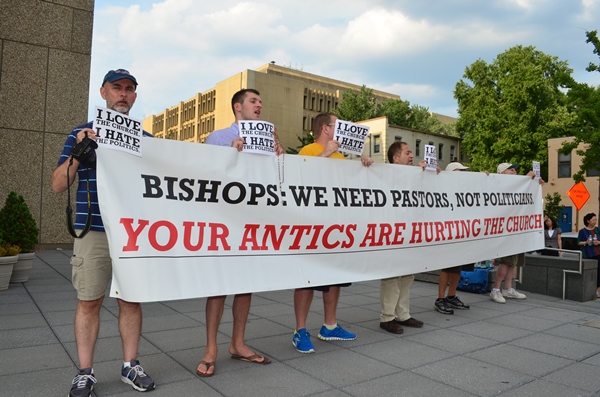
I take some real hope in that more and more Catholics are beginning to see the truth of the above banner.


One frequent commeter on the National Catholic Reporter I really really appreciate is AileenUSA.  I have taken the liberty of posting her entire response to the NCR article on the speech Archbishop Chaput gave at the recently concluded meeting of the Catholic Press Association.  Aileen simply nails my own thinking about the Fortnight for Freedom nonsense:

Submitted by AileenUSA (not verified) on Jun. 21, 2012.
This RCC teaparty tempest is so disingenuous.     Chaput makes a mockery of those who really have experienced religious persecution around the world — those who have had their homes,   churches,   synagogues and mosques bombed — those who have been imprisoned or executed along with their families.     No one is bothering Catholics in the U.S. or their individual private practice of their religion.     But Catholics are NOT allowed to establish their religious beliefs as some sort of gold standard for everyone else.     Chaput's prelate 'id' is showing big time.
.
1)   The Catholic Church receives billions of dollars in taxpayer subsidies for its various businesses   (hospitals,   universities,   charities)   without which they could not afford to keep their doors open,   but the Church doesn't want to play by the same rules that apply to everyone else at the government trough.     Playing by the same rules is not persecution.     It's fair.     You take Caesar's money,   you play by Caesar's rules.     The RCC yearly haul of government funds has been greater under Obama than under Bush!
.
2)   It's astonishing that Archbishop 'free market' Chaput wants to quibble over how contracts are awarded.     Really?     Exactly why should the RCC get special treatment to do as it pleases in making up its own rules for contract awards?     You want the contract,   then you comply with the rules of the entity awarding the contract.     If you want to make up your own special rules,   then cough up your own cash.     Chaput's definition of RC freedom is actually RC exceptionalism. (Bingo!)
.
3)   The First Amendment guarantees an individual's freedom to practice their own religion in their own lives   (if they believe contraception or sterilization are wrong,   then don't use that insurance benefit in your own life — that's your freedom).     But it prohibits any establishment of a particular religion that impinges on another individual's freedom of religion   (RC freedom doesn't extend to financial coercion of employee compensation or insurance restriction of someone else's religious freedom of choice whether or not to use contraception or sterilization).     One person's freedom of religion stops where another person's freedom of religion begins.     The RCC has used its government subsidized businesses to establish its own brand of religion and capital-T truth in the lives of anyone it employs or with whom it does business — its massive regional footprint of hospitals being 'exhibit A'.     Those who live within those massive regional healthcare systems (little Vatican colonies) are being forced to live in a healthcare theocracy under the control of a Catholic bishop.     If anything,   the RCC has been given way too much latitude in this venue,   and should have its theocratic endeavors and monopolies curtailed.
.
It was Chaput himself who dismissed JFK's speech on separation of church and state.     He believes that the RCC should be controlling government officials and government itself.     His pleas of religious freedom and this entire Fortnight/insurrection nonsense is partisan and theocratic to its core.     It's as bizarre as Santorum recently complaining that Egyptians had elected a Muslim version of himself.
http://www.religiondispatches.org/dispatches/haroonmoghul/6091/santorum_......
.
Also see:   Most of Obama's "Controversial" Birth Control Rule Was Law During Bush Years
http://m.motherjones.com/politics/2012/02/controversial-obama-birth-cont... 

*************************************************

The one good thing about this Fortnight for Freedom is it seems to be nothing more than a little tempest in the Tea Party tea pot.  If all the opening ceremonies could draw was 2000 people, with a significant percentage of those falling in the category of 'mandatory attendees',  then I'm not sure the weeks of pulpit and media pounding provided the desired results.  Which is, at least as far as I'm concerned, a somewhat hopeful result.
It may mean that rank and file Catholics are not following in lockstep without using their own God given brains, or that for once, a squeaky wheel is not being listened to, but allowed to go flat on it's own grating rhetoric.

What the USCCB really needs to be careful of is that their chutzpa is going to backfire on them and more and more people, both Catholics and non Catholics,  will start asking questions like Aileen points out in the above. Questions such as why Catholic hospitals are allowed to function as health care theocracies under the control of a bishop.  Or questions about why employees are expected to sign their rights away as employees just because they draw a paycheck from a Catholic institution--and in most cases Catholic institutions which take government money. Or why some dioceses are getting away with demanding loyalty oaths of all their employees such as is the case in Bishop Vasa's Diocese of Santa Rosa, CA.  America Magazine has a thought provoking essay by John Coleman SJ about this whole concept of loyalty oaths.  In Vasa's case his oath is truly remarkable in it's language and the totality of what it covers.  Here is a snippet on abortion:

 "I do not recognize the legitimacy of anyone's  claim to a moral right to form their own conscience on this matter. I am not pro-choice. I further attest that I am not affiliated with, nor supportive of any organization which supports, encourages, provides or otherwise endorses abortion or euthanasia."


That language is...is...well, it's over the top.  Who takes an oath that denies another person's legitimate right to form their own conscience on the matter of abortion or euthanasia?  This sentence is obviously intended to undercut the position of any pro choice politician and enhance Vasa's campaign to deny them communion. It also asks Catholics swear to deny a core teaching of Vatican II on the supremacy of personal conscience.  And then who knows for sure whether or not they are affiliated with an organization which supports, encourages, provides or otherwise endorses abortion or euthanasia?  Even the USCCB would have failed this one and according that failed USCCB,  even the Girl Scouts don't pass muster. 

Bishop Vasa is a very good example of what the forces who actually control the Vatican intend for US Catholics.  He is demanding Catholics exchange a form of Catholic fascism for their rights as American citizens.  The USCCB is pursuing the same path with their Fortnight for Freedom by defining themselves and their institutional conscience as somehow transcendant over, or the exception to, commonly accepted lines of demarcation between Church and State in the US.  It's really just unimaginable hubris and utterly demeaning to the faith of many Catholics.  

Unfortunately it's also a clear and present danger to American democracy for in reality the Vasa's of the Catholic bishops and the Carl Anderson's of the moneyed Catholic world are asking American Catholics to put Vatican prerogatives ahead of their duties as American citizens.   I don't really believe this has anything to do with religious freedom or abortion or contraception or sterilization.  I think it's just another avenue being used by really wealthy people to make sure they stay really wealthy people.  If it means keeping some of our Catholic bishops living really wealthy life styles than that's a small price to pay for their purported influence with 65 million American voters. I don't think 2000 faithful adherents is what these bishop backers had in mind.  In fact I think the real effect of the Fortnight for Freedom is swinging the other way, and that's a good thing for our democracy, if a not so good thing for a Catholic theocracy.