Friday, May 20, 2011

Archbishop Dolan Is Effusive In His Praise For The Social Justice Inherent In The Ryan Budget Bill

A photo op of Archbishop Dolan as a cheesehead.  A Caesar salad can't be far behind
The Catholic Church is weighing in on the contentious House budget debate.
The president of the U.S. Conference of Catholic Bishops sent Budget Committee Chairman Paul Ryan a letter yesterday commending his "continued attention" to Catholic social justice “in the current delicate budget considerations in Congress.”

The budget is not just about numbers,” Archbishop Timothy M. Dolan wrote in the letter. “It reflects the very values of our nation. As many religious leaders have commented, budgets are moral statements."

Last month, Ryan (R-Wis.) sent a letter to Dolan outlining how the church’s social teaching informed his budget.  (Probably not as much as Ayn Rand's teachings did.)

In the two-page letter, Dolan did not come out and expressly endorse the budget, insisting that he’s a pastor, “not a politician.”  (He's also terribly funny...Oh wait does he want me to take this statement seriously?)

But he praised Ryan’s attention to fiscal responsibility, the role of the family, the dignity of the person and human life and attention to the poor.

The letter also clearly disputes one of the chief rallying cries against the budget: That it would hurt the poor to benefit the rich.  (I guess you could say this, because in truth it kills the middle class to benefit the rich.  It's good for the poor in that it makes more of them.)

“In any transition that seeks to bring new proposals to current problems in order to build a better future, care must be taken that those currently in need not be left to suffer,” Dolan wrote. “I appreciate your assurance that your budget would be attentive to such considerations and would protect those at risk in the processes and programs of such a transition. While appreciating these assurances, our duty as pastors will motivate our close attention to the manner in which they become a reality.” (Hmmm,, seems Dolan is already assuring us Ryan's budget will become a reality.)

Ryan said in a statement that his budget “upholds the dignity of the human person and is especially attentive to the long-term concerns of the poor.” (As in you will be poor till you have the grace to die.)

“I hope Americans of every faith and political background will continue in constructive dialogue to address these great challenges in their economic and moral dimensions."

Dolan is the head of the U.S. Catholic Church and the archbishop of New York. Until 2009, Dolan served as archbishop of Milwaukee, near Ryan's Wisconsin district.

Read more: http://www.politico.com/news/stories/0511/55349.html#ixzz1MtsVK1f5

********************************************

Glad to know the USCCB, courtesy of it's President, seem to think the Ryan bill is not only a paragon of Catholic justice values, but that it's also a done deal.  Such a done deal that they want to assure us they will keep their eagle eyes on 'the manner in which they become a reality'.  I'm sure more than one bishop will be paid handsomely to do so.  I doubt we'll see too many august Episcopal bodies at food pantries.  Unless it's for a photo op.

Budgets are not just a hypothetical moral statement.  They quickly become our living reality.  The last ten years have been quite the living reality.  We've gotten to the point where if one wants to remain in the middle class one also has to opt for becoming part of the military class.  The last statistic I saw said just under 25% of the American populace derived their main source of their income from the Military Industrial Complex.  I doubt there is any better statistic to illustrate what our budget priorities have done to our culture.  For some reason though, we are never allowed to view tax money to the MIC as a form of government subsidy.  I wonder why that is?  If this continues Americans will have two main avenues of employment, the MIC and Walmart.

But what really punched my buttons was Dolan insisting he was all about being pastoral and not political.  Puhllleassse.  I wish the USCCB would stop treating the flock like illiterate morons.  Obviously our bishops think being pastoral necessitates being political.  I just wish they would stop the lies  about this and get honest. I wish they would cite the passages in the Gospels where Jesus tells his leaders to become agents for one political party in Caesar's government, because I sure as shit can't find any.  Then again I have to remember that Constantine couldn't find any either, but it didn't make any difference.  Too many of our bishops of the last 1700 years or so have been for sale to the agents of Caesar.  Apparently it's one of  Roman Catholicism's unchanging traditions.


Now I'm waiting for the letter from the USCCB which informs us all that we will be returning to the glorious days of no meat on Fridays as their Irish and British brethren have done.  I can surely see this happening because our fast food joints have suddenly gotten off the red meat kick and would probably like the increased sales for their fish fillets and Caesar salads.  Since we've been treated to photos of Dolan eating everything else, perhaps we'll get a photo op of Dolan eating a Caesar salad.  How appropriate would that be?


Tuesday, May 17, 2011

Pope Benedict Adds More Fuel To My Conspiracy Theory

I can't wait for Pope Benedict to drag this tradition out and dust it off  Just in case you can't tell, the bored pope in the chair is Paul VI.


The following is an excerpt from America and reports on an interview given by Cardinal Koch who is head of the Pontifical Council for Promoting Christian Unity.  In the interview Koch states beyond question that Benedict's intent is to reform the Novus Ordo into something more a long the lines of the TLM.  

Pope's 'reform of the reform' in liturgy to continue, cardinal says
Catholic News Service
By John Thavis

....Cardinal Koch said Pope Benedict thinks the post-Vatican II liturgical changes have brought "many positive fruits" but also problems, including a focus on purely practical matters and a neglect of the paschal mystery in the Eucharistic celebration. The cardinal said it was legitimate to ask whether liturgical innovators had intentionally gone beyond the council's stated intentions.

He said this explains why Pope Benedict has introduced a new reform movement, beginning with "Summorum Pontificum." The aim, he said, is to revisit Vatican II's teachings in liturgy and strengthen certain elements, including the Christological and sacrificial dimensions of the Mass. (This is about using the Mass to stress a theological leaning, which in my opinion is all about strengthening the cultic priesthood.)

Cardinal Koch said "Summorum Pontificum" is "only the beginning of this new liturgical movement."

"In fact, Pope Benedict knows well that, in the long term, we cannot stop at a coexistence between the ordinary form and the extraordinary form of the Roman rite, but that in the future the church naturally will once again need a common rite," he said. (We had a common form until Pope Benedict.)

"However, because a new liturgical reform cannot be decided theoretically, but requires a process of growth and purification, the pope for the moment is underlining above all that the two forms of the Roman rite can and should enrich each other," he said.

Cardinal Koch said those who oppose this new reform movement and see it as a step back from Vatican II lack a proper understanding of the post-Vatican II liturgical changes. As the pope has emphasized, Vatican II was not a break or rupture with tradition but part of an organic process of growth, he said.  (Maybe we just lack Benedicts' understanding and we all know we don't count.)

On the final day of the conference, participants attended a Mass celebrated according to the Tridentine rite at the Altar of the Chair in St. Peter's Basilica. Cardinal Walter Brandmuller presided over the liturgy. It was the first time in several decades that the old rite was celebrated at the altar. --CNS


**********************************************

Here we have it, the very thing Vat II Catholics feared.  I can remember more than one comment implying Vat II liberals were paranoid and that Benedict had no intention of seriously changing the NO,  and I can remember countless comments stating that those of us who saw this kind of reform as a step backwards lacked a proper understanding of the liturgical changes proposed by Vatican II.  This goes to show that if something is said long enough and often enough it becomes fact.  Notice I didn't write 'truth'. 

I wonder if that when all the reforming is done we wind up with a Mass that is very close to the one which we used shortly after Vatican II that, if memory serves me correctly, was a hodge podge of Latin and English where the priest maintained his back to the people, communion was on the knees and on the tongue and there was no 'sign of peace' to disturb one's personal navel gazing.  I think my small rural parish had this version of the Mass much longer than we should have because our Polish parish priest was not enamored with Vatican II changes and we laity didn't know any better.  I didn't think all that much of the changes this Mass represented, but then I never experienced how the 'new' Mass was actually supposed to be done until I went off to college.  Then I was blown away.

As far as strengthening the Christological and sacrificial dimensions of the Mass I've written a lot about how atonement Jesus is not the path that even begins to understand what Jesus came to teach because it places the emphasis on one act in His life and that's of course, the crucifixion.  That Jesus spent three years teaching, healing, and generally utterly changing people's lives and world view is lost in that translation. For that matter so is the Resurrection, which is the actual the reason for His life and the final culmination of His teachings. He was first and foremost about bringing the power of Spirit into matter.  That's what His teachings were all about.  He even left us the Holy Spirit to help in that process. He taught that the mind set humanity needed,   which connected one to that Spirit,  was compassion and love for others.  It was not a mindset about magic words stated by ordained males to confect--by the way I hate that word-- the Eucharist at an elaborate ritual.  To re emphasise this kind of spiritual thinking pretty much means the only time Spirit will be brought into matter is precisely at Benedict's reformed Masses by Benedict's priests. 

That is not how it worked in the early church.  Pentecost is not about magic words said by magically ordained men.  Pentecost is about bringing Spirit into matter to heal, convert, and reform ourselves and others and it was given to men and women equally to pass onto other men and women.  Jesus did not send the Holy Spirit to infuse His church so we could all go to Mass on Sunday and be good little passive powerless Catholics.  He sent the Spirit to fuel a new way of being a transcendent human-- in love with His father, our fellow man,  the world in which He graced us to live, and able to bridge the worlds of spirit and matter.  We were to bring Spirit into matter through our very lives.  Pentecost was such an in breaking of Spirit into matter that two thousand years later Benedict now has a global church to drive into the ground pursuing not Jesus's compassion and love based spiritual strategy, but man's power and control driven political strategy.  

One last thought.  It was really Pentecost that marks the start of the Church, and Pentecost effected both men and women.  They were all infused with the same Spirit.  One could say they were all ordained in quite a profound way. They all spread the Good News and all broke bread together.  Maybe it's time we face the fact that continuity was breached long long before Vatican II ever came on the seen.


Monday, May 16, 2011

I Engage In Some Good Old Traditional Conspiracy Theory

Lately I've been in a conspiracy hunting mode, so I've been spending a great deal of time thinking about the timing and content of some recent decisions and acts of the Vatican---and also some past decisions and acts of the Vatican because they are all of a piece.  I'm not liking the conclusions I'm arriving at, but do they ever lend themselves to a great conspiracy.   I am coming to the conclusion the Vatican is actively pushing to either foment a schism or to empty the pews in the West.  The goal of my conspiracy theory seems to be the Vatican needs to clean the Church in the first world of all but conservatives and traditionalists.  The rest of us are seriously being encouraged to take a hike.   The big question for my theory is what would be the purpose of such a strategy?  The best conspiracy theories always deal with secret groups of power brokers out to take over the world and so my theory says it has to do with global politics and how that fits into what this Vatican may consider a war for the hearts and minds of humanity. 

What fuels my conspiratorial thinking is a book I read about ten years ago,  Malachai Martin's "Keys of This Blood".  It was a truly fascinating epic about global politics in which Martin maintained that John Paul II saw himself engaged in a spiritual global war against secularism and materialism in both their forms--communism and capitalism.  Malachai wrote that JPII saw Roman Catholicism as the only other truly global player who could compete in a war for humanity's mind and soul.  It was JPII's mission to set Catholicism up in such a way that it could use both communism and capitalism to further it's own global agenda---think collaboration with Reagan and the CIA to fund Solidarity which was the domino that took down Eastern European Communism.

Martin implies that because Roman Catholicism  no longer has armies or military alliances to further it's own cause, the war has to be fought by other means and so information exchange became the Church's calling card. I would add financial dealings as well, given all the scandals, but I don't remember that Martin went into the possibilities in the financial world.  But as far as information went,  Catholicism had professed religious sworn to obedience in virtually every country and most villages through out the world.  Catholicism was in places neither of the other two players could get valid information---think about the current Vatican take over of Caritas Internationalis and the insistence of 'obedience first' in JPII/Benedict bishops, and then the Vatican has historically been the master of secrecy in how one does business.

In addition,  Martin maintained JPII strongly believed Catholicism had to be a tight ship answerable only to it's pope/general. The rowdy liberal Vatican II loving progressive wing and their subversive notions of collegiality had to be silenced, expelled, or legislated out of the way--think of the hundreds of decisions, major and minor which have come down the pipeline against the liberal wing in the last forty years. After all, no effective army has ever won a war by allowing it's troops to vote---think Bishop Morris's statements about how the Vatican kept turning his arguments about listening into giving laity a vote. (If you do enough of this kind of thinking you can see dots everywhere.)

At the time I read this book, I really thought Martin was a great writer, using current and historical events to draw a great fictional read--a la Dan Brown.  I thought of it as fiction, but now I'm not so sure at all.  My paranoid conspiracy theorizing had me thinking Martin was onto something.  This Vatican may actually be acting on the idea that they are engaged in a global political war to be the dominant player in the life of humanity and acting on truly gnostic concepts of worlds of good and evil at war with each other.  Think all the current spiritual warfare talk coming from very interesting quarters.

Martin wrote his book in 1990 and did not foresee a few obstacles for the Vatican.  First was the rise of a militant form Islam.  Second was the information explosion which has blown major holes in the power of secrecy to effect diplomacy.  This explosion has also severely crimped anyone's ability to keep the troops marching in lock step--as even the highly regimented Islamic and closed communist societies have found out.  Third, the concurrent explosions in the sciences of cosmology, physics, psychology, and biology are impossible for any one single entity or person to keep up with, and all have had a serious impact on how people view and discuss spirituality.  So although I can't say the Vatican has refused to deal with any of these fields, I can say they are hamstrung because they refuse to deal with some of them outside the margins of a natural law theology which was formulated nine hundred years ago. 


In my final analysis I have come to the conclusion this political gambit/war the JPII Vatican may have thought they were engaged in and winning, has changed radically,ut they don't seem capable of adjusting to these new realityes. b  Like other totalitarian political states, they don't seem to be able to adjust to the new realities.  Benedict can continue to foster Catholic identity for all he's worth, but he will find only his lock step bishops and a small percentage of laity will stay with him.  He can write off or chase out most the first world Catholic population, but if he lives long enough he will see it was the absolute wrong strategy.  He should have listened to at least some of what was being said because some of it was in the vanguard of understanding aspects and consequences of the social changes we now see.

When Martin wrote Keys of the Blood, John  Paul II had the kind of world paradigm operating in which he could play political games with the Church, and he did a lot of good in a lot of areas., but  Benedict no longer has the same world paradigm operating.  In less than twenty years, even the poorest of Southern continent countries will have moved well past the kind of Catholic Identity issues Benedict is constantly affirming.  The number of cell phones in these countries actually surpasses the per capita number in the West, and with a lot of those phones comes Internet access, and with that comes extreme difficulty in controlling the information flow.

In the end my conspiracy theory comes to naught, at least in my mind.  I'm just not so sure that the Vatican has done the same kind of end state analysis.  Some of the acts and decisions of the last two weeks would say they haven't.  The sad part of all of this is that the teachings of Jesus are still incredibly relevant and will become even more relevant.  I can't say the same thing for some of the doctrine, dogma, and organization of the Church, but I have no vested interest in the system, and that's the difference.

Saturday, May 14, 2011

Looking At The Boehner CUA Graduation Speech From A 'Different' Perspective

John Boehner, Speaker of the House, sheds tears for the poor for whom his party intends to shower with more 'blessings'.


I'm going to give a 'shout out' to a new blog that I find hysterical.  It's name is OMNIBUS CRAZYBUS.  The following post--- posted in it's entirety--- deals with the John Boehner graduation speaking engagement at Catholic University of America.  I haven't had the energy to deal with the Boehner issue because my snide cynical self says CUA was paid to bring in Boehner by a certain type of American Catholic overly fond of Dick Cheney.  In any event here's another take on the whole issue of Speaker Boehner and his problems with Catholic social justice types who might be overly fond of NY's Congressman Anthony Weiner.


Boehner, Champion of Social Justice Teaching


Posted at OMNIBUS CRAZYBUS   5-12-2011

It is such a relief to have a true Catholic Speaker of the House now serving our country and in the spotlight. But that does not mean that controversy has been completely quelled. As Mr. Boehner prepares for his commencement address and reception of the honorary doctorate from the Catholic University of America some Catholics are not as chipper as you would expect them to be. This is due to the simple fact that they do not truly understand the hierarchy in Catholic social teaching. Lemme explain.

Abortion is at the top of the list. In fact it is at the top, separated from the list completely in an all important list of one. It is the issue that trumps all other issues. It is like a giant tintinnabulum that overshadows all other teachings rendering them obsolete. All ordinances, encyclicals, bulls, catechisms, promulgations and Gospel exhortations bow down before the might of the issue of abortion. Pope Benedict himself said something similar to this before he was pope, though I do not have the exact quote at hand.

The Church, you see, is hierarchical. The Pope is head of the Church, Latin is the head of all languages, the man is the head of the woman and abortion is the head of morality. The body of Catholic moral teaching is a conglomerate of minor issues that are not essential to the true Catholic identity. A Catholic can, in good conscience, pry an illegal Mexican immigrant from his family and waterboard him in order to gather reconnaissance to bring down unions and end health care for the poor as long as he does not support abortion. Boehner understands this and implements it into his political life. He knows that Christ’s desire was for the poor to always be with us and that they are blessed who do not have access to health care. He realizes that taxes are stealing. He realizes that it is hard for a rich man to enter into the kingdom of heaven and that they need all of the help that they can get.

Some say that this is “cafeteria Catholicism”… well, maybe it is. But who can possibly choose everything the cafeteria has to offer anyways? If Catholicism is a cafeteria I prefer to chow down on the steak and potatoes of abortion rather than piddle around with the ketchup packets of social justice any day of the week, except Fridays of course.

****************************************

I'm not sure there's much I can add to the above, so I'm off to the cafeteria to steal some ketchup packets. 


Friday, May 13, 2011

The Vatican Officially Deputizes the Temple Police

I really hope younger readers don't think when the TLM was the only show in town it was this showy.  It wasn't.


The Vatican has issued a follow up instruction to Pope Benedict's 2007 letter Summorum Pontificum.  This was the letter which liberalized the use of the Latin Mass.  This latest Vatican instruction is taken by some traditionalists as Benedict putting the Latin Mass on the same footing as the Novus Ordo.  The following is an extract from the blog of Britains' Damien Thompson, a man not noted for being a progressive--at all.

The Vatican Instruction on how to apply Summorum Pontificum was published this morning and it’s good news for traditionalists. If bishops thought they had the power to block the return of the Tridentine Mass, they must abandon that fantasy. Universae Ecclesiae does not retreat from Benedict XVI’s liberation of the Traditional Mass. On the contrary, it entrenches it further into the life of the Church. A group – however small – is entitled to ask for (and receive) provision of the Extraordinary Form; and that group need not come from the local parish or even the diocese.  

Talk about giving a blank check to Latin loyalists and Temple Police.  I truly feel sorry for the first time in a very long time for some of our bishops.  I can just imagine how this is going to play out.  Here comes a new society dedicated to demanding a Latin Mass in every parish in every diocese because this letter apparently gives them the right to do so.  If Thompson and Fr. Zuhlsdorf are interpreting this instruction correctly, this will stomp all over the rights of bishops to run their own dioceses in their own way for their own people.   And the stomping can be done by a small group of people who don't even reside in a targeted diocese much less in a targeted parish.  Wow.


I think I'm beginning to understand why Benedict chose the day after the Beatification ceremony of JPII to announce the forced resignation of Bishop Morris.  As the traditionalists did unto Bishop Morris, they can now do unto every bishop every where.  JPII be praised, the precedent has been set.  The temple police have been officially deputized.  


I wish I could say I had no idea what Benedict thinks he's doing, but I know better.  He said it before he was pope.  He's worked on it for the last thirty years.  He is creating a smaller 'purer' church, but he truly does care that millions of us leave.  It is his goal.  His legacy will be a Roman Catholicism that is purged of modernism and secularism and relativism and ninety percent of it's faithful in first world countries.  It will also be notably lacking in compassion and pastoral sensitivity but hey, it will be fluent in a dead language.


In the meantime I will be trying to get my head around the thought that in a time when the Church is experiencing a serious shortage of priests, the Vatican's concern is pushing these poor over worked souls  into learning the Latin of the Tridentine Mass along with the Latinized English of the new translation of the Novus Ordo.  No wonder it was so important for the Vatican to put obedience over everything else when it came to the selection of bishops.  If we had more bishops with the personal integrity of a Morris, the newly deputized and mandated temple police wouldn't be effective.


I really hope this latest letter from the Vatican is the brick that makes the load too heavy for most of our bishops.  This is not just an instruction from the Vatican, nor is it really about the TLM.  No what it is,  is a direct attack on their own pastoral authority under the guise of the TLM.  In the meantime the tail continues to vigorously wag the dog.

Just a bit of post script:  If you take the link to Fr. Z's blog check out all the things he's now selling to, you know,  keep up the battle against progressives and modernists.  I especially laughed at the special plea not to support the NCR blog drive (NCFishwrap) but to send those donations to him.  His take on the Bishop Morris situation is quite fascinating.  I wonder if he needs all these different means to support his blog because Fr's Euteneur and Corapi are no longer around to compete for those traditionalist bucks.  Yes, these trad priests do eat their dead.  And to think Corapi and Zuhlsdorf were both ordained by JPII in the same ceremony. Can't wait till they take over the whole church.


Wednesday, May 11, 2011

JPII's Lasting Gift To Poland Will Be Democracy, Not JPII Catholicism

A great deal has happened in Poland since this photo was taken back in 1979.  The JPII revolution has not had much staying power in Poland----not the religious one that is.

I find the statistics from Poland very interesting, since one would think that if JPII was going to leave a last Catholic legacy it would be in Poland.  Unfortunately the statistics just don't favor that hypothesis.  The following in an extract from an article in the Ottawa Citizen.  The link is at the bottom of the extract.

.......But Poland's younger generation, which did not live through communism and is becoming less religious, likely viewed the ceremony through a less emotional lens.

"The pope is a human, flesh and blood person. I, as a young person, don't know why people will now pray to him,'' said Agnieszka Golabek, a 34-year-old woman who lives in Warsaw and is not a practising Catholic.

"From my point of view, maybe we don't have the right to call somebody holy. We should view good people as an example, but we shouldn't put them on a pedestal,'' said Golabek of the fact that, after the beatification, Catholics are able to pray for John Paul to intercede on their behalf.

While young Poles study Wojtyla at school and regard him as a generally good person, people like 34-year-old Dariusz Mazurkiewicz believe young people were "only mildly interested'' in the beatification ceremony, either because they cannot relate with the late pontiff or because they are "not looking for an authority in him.''

Such views are not isolated.

In a 2009 survey, some 48 per cent of respondents said Poles had become less religious over the past two decades. The local church is also finding it increasingly hard to enrol young priests. The number of candidates for seminaries has fallen from 1,145 in 2005 to 675 in 2010. (This is a forty percent decline since Benedict became Pope.)

Bishop Budzik, however, is hopeful that John Paul's teachings will continue to resonate with the young generation and that the beatification will inspire more Poles towards a deeper faith.

"It seems to me that our increasingly complicated reality and the uncertainty of the future ... will lead to a deeper reflection,'' he said. "And that for many -as well as for the young -the teachings of John Paul II will become a sign and road marker.'' (This is wishful thinking.)

Others note that the country's march towards modernism has made young people more secular and critical of the church's role in politics. While up to 95 per cent of Poles identify themselves as Roman Catholic, attendance at Mass has been steadily declining. These days, about half of Poles say they regularly attend services.

"They look at the pope with more distance and less emotion and less deep religious conviction than elderly people,'' said Zdzislaw Slowik, deputy head of the Secular Culture Society, a national council that studies the role of the church and secularism.

*****************************************

The line that intrigued me in this post was the one from Zdzislaw Slowik, when he says younger generations hold less deep religious convictions.  I think the operative words are religious convictions, and that is a problem for all mainstream religions, not just Catholicism.  Pope Benedict has chosen to blame secularism and moral relativism as if the two are cultural replacements for religious conviction.  I'm not totally convinced this is correct. The data seems to suggest that mainstream religions are not meeting the spiritual needs of today's laity.  This is not about secularism per se, but about the failure of religions to do what exactly what they exist to do--meet the spiritual needs of their people.

Catholicism has chosen to hold to the traditional status quo and blame lapsed Catholics and secular culture for the Church's own failures.  Catholic leadership is not alone in this scenario and given another twenty years, Catholic leaders will be joined by Islamic leaders.  Cultural shifts that used to take hundreds of years are now happening in less than twenty.  Poland, and other former Eastern bloc countries, demonstrate that fact.  Some bishops and some theologians are beginning to ask for the dialogue that should have continued after Vatican II.


Maybe the bigger question is can religions in their current form survive at all when humanity itself is passing beyond the historical religious conceptualization of humanity.  It's hard to sell a concept of humanity as sinful decadent worms when science is describing a different being.  This being is not just about brute animal survival, but seems to seek transcendent experience and is programmed to do so.  Transcendent experiences, those that take one beyond one's own lonely ego identity, are not limited to religious experiences.  Sometimes they can be had at such secular activities as sporting events.  Maybe part of that ability for sporting events to generate transcendent feelings happens because a person doesn't know what the outcome will be until the game is finished.  The time during which the game is played is an intense process leading to an unknown outcome.  Our lives should be lived exactly the same way--as a process leading to an unknown outcome, where giving the maximum effort  is the best one can do.


The trouble with our current Catholic leadership is instead of acting like the captains of a team and playing for all they are worth, they have chosen to declare themselves the referees in a game they have already determined most of us will lose.  It's not surprising younger generations don't want any part of that kind of game, and instead are looking for leaders who are player/coaches--and for a game which is continuously evolving towards an unknown future, not wallowing in it's traditional past.


As I'm writing this, I'm reflecting on the world of women's athletics.  Back in my day when I played on the first women's basketball team my alma mater ever put on a court I would look up in the stands and see a couple dozen people, mostly all family members and friends of players.  There weren't any fans of the team so to speak.  I never ever imagined, looking at those few people, I would ever see the women's NCAA bracket rival the men's in attendance and fanaticism.  That is cultural evolution on a grand scale, and it only took about twenty five years. Dads are just as wrapped up in their daughter's athletic events as they are their sons.  That is a vision which was way beyond my own father who did everything he could to discourage my participation in the fledgling world of women's athletics because he was convinced it was an utter waste of my time. Shortly before he died he told me that not encouraging me was the one thing he truly regretted in an otherwise fulfilling life.

I think about what the Vatican is doing now over the place of women in the Church and I think about my dad and his idea of my place in the world of athletics.  The world is going to move forward, and women will take their place in the spiritual sun and we can't imagine what that is going to generate.  I'd really hate to see Catholicism completely fade away because the Vatican wouldn't let go and wouldn't change.  That would be a real travesty, but if things don't change, it will happen.  Jesus's teachings and life will stand the test of time, I'm not so sure about what currently passes for Catholicism.  If Poland is any indication, it won't.


Monday, May 9, 2011

Some Thoughts On The Tail Wagging God's Rottweiler


I'm reading the comments to this America article about the sacking of Bishop Morris and in the very last comment is this:  The litmus test for a faithful Catholic is his obedience to Rome.  I have followed this particular commenter for quite awhile and she is a pretty average representative of the traditionalist or conservative view.  Except, she's wrong about what the traditionalist really believes a faithful Catholic actually is.  By their actual behavior, a real traditionalist is one who gets Rome to obey them. And that's what really gets me about the Bishop Morris story and a whole lot of other stories of the this kind.

All of the Temple Police type stories have the same thing in common.  A small group starts complaining that someone or some program does not meet their standards of Roman truth, they inundate the right people at the Vatican, the Vatican acts on these complaints and the TP's tell the rest of us about the importance of obedience to Rome.  It's a nice circular little game, and it hurts way way more people than it helps. This is classic tip of the tail wags the entire dog.

The other thing that really gets me is the vast majority of the Temple Police engage in what I call the arrogance of availability.  I seriously doubt many of them come from areas of the Catholic world in which they might see a priest once a month.  I suspect the vast majority have the ability to go to Mass every day if they so desire. Maybe in their own little personal Catholic world, the idea that there are hundreds of millions of Catholics who can't go to Mass every day just flat fails to compute.  In the real Catholic world there is one priest for every three thousand Catholics.  How can it not compute that there are not enough priests for every Catholic to enjoy the kind of personal Mass attendance, confession, spiritual advising, family attention, Eucharistic Adoration etc etc etc, that they seem to need and demand.  It never seems to me they demonstrate any comprehension that the kind of Catholicism they are desperate to protect doesn't exist for the vast majority of the world's Catholics.  But then I wonder is it really that all this just isn't computing, or is that they just don't give a damn as long as their soul is saved and saved in just the way they want it saved.

But surely the Vatican is aware of all these numbers, so why does Pope Benedict cater to the Temple Police types?  Why does he let the tail wag the dog.  Is it just money?  Is he too of the opinion the Church exists to save those vocal few in just the way they want to be saved because he's one of them? Does he let them dictate diocesan policy for the vast majority of their fellow parishioners because they give tons of lip service to the importance of obeying Rome?  Or is it because Benedict believes Jesus prefers circular logic?


In any event I feel compelled to point out that it is now against Catholic doctrine to discuss women's ordination--period.  Since that includes trads and other conservatives, they need to understand that speaking or writing in defense of the Church's position should also be considered heretical because the operative words are no discussion.  Doesn't have any qualifiers about for or against, Benedict just says no discussion of women priests. So a whole bunch of us of all stripes have violated that Vatican pronouncement.  The confessionals should be full of conservatives and Temple Police this weekend. Probably not too many progressives as we'll most likely be out looking for some outlawed communal penance service.


Sunday, May 8, 2011

The Road To Emmaus Goes Through The Diocese Of Toowoomba


The Gospel reading for today is the story of the two disciples on the road to Emmaus.  It's always been one of my favorites, partly because Jesus does sort of sneak up on one sometimes and then leaves you to deal with the consequences.  I was thinking this morning that if such an event happened in this day and age many of us might not return and tell our current cast of apostolic descendants.  Mostly because it would be a waste of time.  They would not be predisposed to listen.  I suspect our hypothetical two disciples today would have to take Jesus back in the flesh with them and even then, Jesus would have a very difficult time proving He was who said He was.  I doubt merely breaking some bread would do the trick. That's assuming any of them could get past the Swiss Guard.

Catholica Australia is currently running two statements from the leadership of the priests of Bishop Morris's Diocese of Toowoomba.  This one is a general reflection and this one is the specific time line of Bishop Morris's interaction with three Vatican Dicasteries and two popes.  The second gives a unique perspective on the last eighteen years in Roman Catholicism.  I came away convinced that doctrinal purity is nothing more than a window dressing for religious totalitarianism.  Which I guess is why I had the thoughts about the two disciples on the road to Emmaus and how little success they would have today.  Especially if one of them was a woman.

Saturday, May 7, 2011

My First Ever Video Upload And It's Worth Watching

The following video was created by a frequent contributor to Catholica Australia who goes by the moniker "oh yet we trust".  Kudos to him because this is both fun to watch and makes a powerful point.  Have a good Saturday one and all.  Here's the link to the CA post I 'borrowed' this from.  It's a link worth checking out because it has some more info on the Bishop Morris story.

Thursday, May 5, 2011

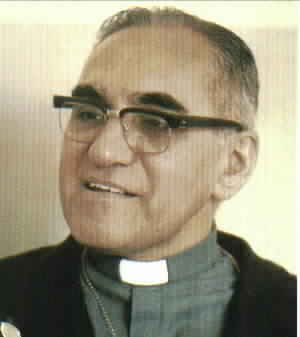
Why Is This Honest To God Martyr Not A Saint, Or A Blessed, Or A Venerable...Or Something

I wonder why Archbishop Oscar Romero has stalled on the canonization fast track.  Seems to me he is a legitimate Roman Catholic martyr----well maybe not.  Maybe he's a legitimate Christian Catholic martyr


When I was writing yesterday's post, I got to thinking about Archbishop Oscar Romero and just what is it about him that he has not been moved forward on the sainthood track.  I mean for God's sake, this was a man assassinated while he was saying Mass and precisely because he spoke out so strongly for El Salvadors' campesinos, indigenous, and poor. He was assassinated because he very courageously took on the very powers that kept his people oppressed while thwarting their hopes for bettering themselves.  

In the late 70's what was going on in El Salvador was no different in kind to what was going on in Poland---except for one thing.  Unlike with the Polish government, the Institutional Church was thoroughly in bed with the official and unofficial right wing government and their supporting US corporate and governmental interests. Well that last part was true of the Church in Poland too.  Which proves it's not OK to exploit your population if you espouse godless communism, but I guess it is OK if you espouse godly fascism.

The following is an article  about Archbishop Romero written by Fr. John Dear for the NCR on March 16, 2010.  I reprint it virtually in total because I know Fr. John would not be upset.  I've met him and there is no doubt in my mind that he's the real deal himself ---and the issue is to spread the word, not own it.


"I have often been threatened with death," Archbishop Oscar Romero told a Guatemalan reporter two weeks before his assassination, 30 years ago on March 24, 1980. "If they kill me, I shall arise in the Salvadoran people. If the threats come to be fulfilled, from this moment I offer my blood to God for the redemption and resurrection of El Salvador. Let my blood be a seed of freedom and the sign that hope will soon be reality."
Oscar Romero gave his life in the hope that peace and justice would one day become a reality. He lives on now in all those who carry on the nonviolent struggle for justice and peace. A beautiful new photo book and biography, Oscar Romero and the Communion of Saints, by Scott Wright, shows us what a holy life he lived, and just how much he gave.

Romero spent his years up until 1977 as a typical quiet, pious, conservative cleric. Indeed, as bishop, he sided with the greedy landlords, important power brokers, and violent death squads. When he became archbishop, the Jesuits at the Univeristy of Central America in San Salvador were crushed. They immediately wrote him off -- all but one, Rutilio Grande, who reached out to Romero in the weeks after his installation and urged him to learn from the poor and speak on their behalf.

Grande himself was a giant for social justice. He organized the rural poor in Aguilares, and paid for it with his life on March 12, 1977. Standing over Grande's dead body that night, Romero was transformed into one of the world's great champions for the poor and oppressed. From then on, he stood with the poor, and denounced every act of violence, injustice and war. He became a fiery prophet of justice and peace, "the voice of the voiceless," and in Jon Sobrino's words, "a new Jeremiah." For me, Romero was a stunning sign of God's active presence in the world, a living symbol of the struggle for justice and what the church could be.

The day after Grande's death, Romero preached a sermon that stunned El Salvador. With the force of Martin Luther King, Jr., Romero defended Grande, demanded social and economic justice for the poor, and called everyone to take up Grande's prophetic work. To protest the government's participation in the murders, Romero closed the parish school for three days and cancelled all Masses in the country the following week, except for one special Mass in the cathedral.

That act alone would have put Romero in the annals of history. Imagine if every Mass in the United States but one had been canceled in protest after the death of Dr. King! Over a hundred thousand people attended the cathedral Mass that Sunday and heard Romero's bold call for justice, disarmament and peace. Grande's life and death bore good fruit in the heart and soul of Romero. Suddenly, the nation had a towering figure in its midst.

Within months, priests, catechists and church workers were regularly targeted and assassinated, so Romero spoke out even more forcefully. He even criticized the president, which no Salvadoran bishop had ever done before, and few in the hemisphere ever did. As the U.S.-backed government death squads attacked villages and churches and massacred campesinos, Romero's truth-telling became a veritable subversive campaign of nonviolent civil disobedience.

Soon Romero was greeted with applause everywhere he went. Thousands wrote to him regularly, telling their stories, thanking him for his prophetic voice and sharing their new found courage. His Sunday homilies were broadcast nationwide on live radio. The country came to a standstill as he spoke. Everyone listened, even the death squads.

As Romero's stature grew and his leadership for justice and peace deepened, his simple faith and pious devotion remained steady, and gave him a foundation from which he could take on the forces of death. To protest the government's silence in the face of recent massacres, he refused to attend the inauguration of the new Salvadoran president. The church, he announced, is "not to be measured by the government's support but rather by its own authenticity, its evangelical spirit of prayer, trust, sincerity and justice, its opposition to abuses." While he embodied the prophetic role of the church, he also modeled that spirit of prayer, trust and sincerity in his everyday life.

As the arrests, torture, disappearances and murders continued, Romero made two radical decisions that were unprecedented. First, on Easter Monday 1978, he opened the seminary in downtown San Salvador to welcome any and all displaced victims of violence. Hundreds of homeless, hungry and brutalized people moved into the seminary, transforming the quiet religious retreat into a crowded, noisy shelter, make-shift hospital, and playground. (I remember helping out there for a few days in 1985, and trying to imagine what a similar Gospel action would look like in the United States. We have never experienced such an action by our church leaders.)

Next, he halted construction on the new cathedral in San Salvador. When the war is over, the hungry are fed, and the children are educated, then we can resume building our cathedral, he said. Both historic moves stunned the other bishops, cast judgment on the Salvadoran government, and lifted the peoples' spirits.

Meanwhile, Romero's preaching reached biblical heights. "Like a voice crying in the desert," he said, "we must continually say No to violence and Yes to peace." His August 1978 pastoral letter outlined the evils of "institutional violence" and repression, and advocated "the power of nonviolence that today has conspicuous students and followers." He wrote: "The counsel of the Gospel to turn the other cheek to an unjust aggressor, far from being passive or cowardly, shows great moral force that leaves the aggressor morally overcome and humiliated. The Christian always prefers peace to war."

Romero lived in a sparse, three-room hermitage on the grounds of a hospital run by a community of nuns. During his busy days, he traveled the country, met with hundreds of poor Salvadorans, presided at Mass, and met with local community leaders. He assisted everyone he could. Later, he said that one of his primary duties as archbishop had become not just challenging the U.S.-backed government and its death squads, but claiming the dead bodies of their victims, including priests, nuns and catechists.

On one of my visits, a Salvadoran told me how Romero would drive out to city garbage dumps to look among the trash for the discarded, tortured victims of the death squads on behalf of grieving relatives. "These days I walk the roads gathering up dead friends, listening to widows and orphans, and trying to spread hope," he said.

In particular, Romero took time every day to speak with dozens of people threatened by government death squads. People lined up at his office to ask for help and protection, to complain about harassment and death threats, and to find some support and guidance in their time of grief and struggle. Romero received and listened to everyone. His compassionate ear fueled his prophetic voice.

By late 1979 and early 1980, his Sunday sermons issued his strongest calls yet for conversion to justice and an end to the massacres. "To those who bear in their hands or in their conscience, the burden of bloodshed, of outrages, of the victimized, innocent or guilty, but still victimized in their human dignity, I say: Be converted. You cannot find God on the path of torture. God is found on the way of justice, conversion and truth."

When President Jimmy Carter announced in February 1980 that he was going to increase U.S. military aid to El Salvador by millions of dollars a day, Romero was shocked. He wrote a long public letter to Carter, asking the United States to cancel all military aid. Carter ignored Romero's plea, and sent the aid. (Between 1980 and 1992, the U.S. spent $6 billion to kill 75,000 poor Salvadorans.)

In the weeks afterwards, the killings increased. So did the death threats against Romero. He made a private retreat, prepared for his death, discovered an even deeper peace, and mounted the pulpit. During his March 23, 1980, Sunday sermon, Romero let loose and issued one of the greatest appeals for peace and disarmament in church history:
"I would like to make an appeal in a special way to the men of the army, to the police, to those in the barracks. Brothers, you are part of our own people. You kill your own campesino brothers and sisters. And before an order to kill that a man may give, the law of God must prevail that says: Thou shalt not kill! No soldier is obliged to obey an order against the law of God. No one has to fulfill an immoral law. It is time to recover your consciences and to obey your consciences rather than the orders of sin. The church, defender of the rights of God, of the law of God, of human dignity, the dignity of the person, cannot remain silent before such abomination. We want the government to take seriously that reforms are worth nothing when they come about stained with so much blood. In the name of God, and in the name of this suffering people whose laments rise to heaven each day more tumultuously, I beg you, I ask you, I order you in the name of God: Stop the repression!"
The next day, March 24, 1980, Romero presided over a small evening Mass in the chapel of the hospital compound where he lived, in honor of a beloved woman who had died a year before. He read from John's Gospel: "Unless the grain of wheat falls to the earth and dies, it remains only a grain. But if it dies, it bears much fruit "(12:23-26). Then he preached about the need to give our lives for others as Christ did. Just as he concluded, he was shot in the heart by a man standing in the back of the church. He fell behind the altar and collapsed at the foot of a huge crucifix depicting a bloody and bruised Christ. Romero's vestments, and the floor around him, were covered in blood. He gasped for breath and died in minutes.

I remember exactly where I was when I heard the news -- in my fraternity room at Duke University. I had just turned on the TV to watch the evening news. Only the month before, I had decided to apply to the Jesuits, to try to spend my life following Jesus. The shocking report of the death of this brave archbishop stunned me, inspired me and encouraged me to go through with my decision. Later that night, a peace vigil and prayer service was held on campus. My friend Paul Farmer, living next door to me, marks his conversion from that event. (Farmer would become a doctor and teacher at Harvard University and founder of Partners In Health, an international health and social justice organization.) Both of us were touched and changed by Romero's gift.
Romero's funeral became the largest demonstration in Salvadoran history, some say in the history of Latin America. The government was so afraid of the grieving people that they threw bombs into the crowd and opened fire, killing some 30 people and injuring hundreds more. The Mass of Resurrection was never completed and Romero was hastily buried.

Just recently, I learned from one of his biographies that Pope John Paul II had decided to remove Romero as Archbishop of San Salvador. In fact, he signed the removal order on the morning of March 24. In some ways, I'm grateful that Romero never lived to hear that dreadful news. His martyrdom became a spiritual explosion that continues to transform the church and the world.

Today, we remember Oscar Romero as a saint and a martyr, as a champion of the poor and prophet of justice. He calls us to live in solidarity with the poor and oppressed, to think with them, feel with them, walk with them, listen to them, serve them, stand with them, become one with them, and even die with them. In that preferential solidarity, he summons us to carry on his prophetic pursuit of justice and disarmament......

********************************************

At this time, Archbishop Romero is a Servant of God with his Beatification and Canonization progress stalled in the water.  Some say this is because there are questions about his connections with liberation theologians, others because of full investigation for Beatification would embarrass certain Salvadoran families and right wing politicians. And still others say his cause is too political and would be used by the wrong kind of Catholics to further their dissension with the "True Church".  In any event, the cause for Romero has come to a dead standstill under Pope Benedict.

In my mind it's most like the fact that Archbishop Romero was converted from an obedient Roman Catholic prelate into primarily a Christian Catholic who happened to be an Archbishop.  That's the kind of thing that doesn't exactly further one's ecclesiastical career--living or dead.

This is just a fun aside, but if readers have the time, go back and get a mental picture of some of our most ROMAN CATHOLIC bishops and cardinals, then picture them engaging in the acts I have in bold in the article.  It's pretty tough to picture some of them any where near a garbage dump, much less traipsing around on one looking for dead bodies because relatives can't take the risk.  Oh, and then there is that cathedral thing.