Wednesday, May 20, 2009

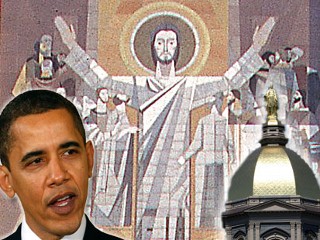
Shifting Stategies: Two 'Warriors' Respond To Obama At Notre Dame

Signs of different strategies coming from conservatives when it comes to Obama and abortion


Bishop Finn Interviewed on Notre Dame Commencement
by Bishop Robert W. Finn

Dialogue was the big theme of the Notre Dame commencement. Is it possible for the Church to dialogue on abortion?

There are many associated elements that have to do with taking care of women in distress, offering alternatives to abortion. We have to work together, discuss and study how best we can provide for the needs of women and families. How can we reduce the number of abortions? These are elements for dialogue. But the rightness or wrongness of abortion – this is an intrinsic evil. The direct taking of an innocent life can never be negotiated. (Except when it involves pre emptive strikes into sovereign nations.)

Dialogue is a means to an end. The purpose of dialogue has to be a change of heart. If I listen well and we each speak the truth, then the dialogue may have a chance of being productive. But I have to have some authentic principled goal in mind.

President Obama asked in his address, “Is it possible to join hands in common effort?” Can the Church join hands in common effort with the administration?

As a country we want to see an end to racial prejudice. We want a more secure peace in the world. We want sound economic justice for people. So we can’t give up on working with the administration.

But we’re fighting for our lives – literally. We are attempting to protect real unborn children by the thousands. We’re fighting for the right to exercise a rightly-formed conscientious difference with public policy. We shouldn’t underestimate the danger of dragging our feet in this effort, or taking a “wait and see” approach. If we are not ready to make a frontal attack on the protection of conscience rights, the overturning of Roe v’ Wade, and the primacy of authentic marriage, we will lose in these areas. I think the rug is already being pulled out from under us. If we sit back and allow ourselves to be lulled into a false sense of peace and cooperation in regards to these things, then we will lose these battles and, later, wonder why.
(No one's right to exercise a rightly-formed conscience is being threatened. The state does not force abortion on anyone, no one is forced into marriage of any kind or for that matter to perform either one.)

Without identifying any person or group, Notre Dame President Father John Jenkins in his introduction of the President warned against a tendency to “demonize each other”. Were the bishops who spoke in opposition to an honorary doctorate of law for President Obama “demonizing” him or Notre Dame? (Wow, Bishop Finn must have a short term memory problem. Wasn't he the one who called for Spiritual Warfare?)

I think the bishops (and many others) were pointing out the hurtful nature of the invitation. As I reread Fr. Jenkins’ remarks I found it fell into three parts. In the first part Fr. Jenkins himself uses a whole series of very, very hard words. He uses the words - division, pride, contempt, demonize, anger, distort, hateful, condemn, hostility. And one might wonder whether he uses these words as a kind of a caricature of the 60 to 70 bishops who have spoken out against his invitation. (Aren't you the one who used Satan more times than Jesus in your address to Kansas pro lifers?)

The center part is all about dialogue. He uses the word dialogue, I think, six times. And he quotes it from Pope Benedict, and he quotes it from Ex Corde Ecclesiae and he quotes from the Second Vatican Council.

And in the third part, he expresses his admiration for the President. So this seems to be the way he sets up the President’s talk for him – to speak in a very negative way about anyone who appears to be contrary to the decision they made, and then to stress the primacy of dialogue, and then offer his admiration of the President. Dialogue is important, but the question is fairly raised, “May we negotiate about things that are intrinsic evils?” and I think the answer is no.
The President also spoke against reducing those with differing views to caricature. Is that what these bishops have done with regard to the President’s actions on life? (Maybe not so much the bishops, but certainly a whole lot of other pro lifers.)

The bishops realize the very destructive decisions that President Obama promised to make concerning the life issues, and now has been making in connection with abortion and human embryonic stem cell research. This is serious business; it is about life and death. If in speaking out on these things, we are characterized as being angry or condemnatory – then so be it. Such actions are worthy of condemnation.

This is part of the scandal of Notre Dame’s invitation to the President - that it has the potential of confusing people concerning the Catholic teaching against abortion, and on the priority of abortion among other issues of public policy. (I don't think it confused anybody. All it did was expose the fact criminalizing abortion isn't the major issue some of our bishops want it to be. Preventing abortion is the bigger issue for the vast majority of Catholics.)

Was there an overriding message to the commencement proceedings that came through strongest?

I think the message of the day was this – that the President of Notre Dame said that they had invited the President of the United States and decided to honor him for the sake of dialogue. And then the President got up and said that the differences that we have on abortion – namely the Catholic Church’s staunch opposition to abortion and his staunch support of abortion were “irreconcilable.” And at that moment, it would seem to me that the dialogue came to a screeching halt. Father Jenkins’ expressed desire for dialogue, whether it was well-founded or justified, at that point got thrown back in his face. The President shut the door on dialogue by saying that there was not going to be any change in his position on abortion and he understood that there was not going to be any change in the Church’s position on abortion. To me, that was the lesson of the day. I am glad that Mr. Obama was so clear. (The irreconcilable difference on abortion is the issue of criminalization not abortion per se. Bishop Finn you are the one purposely confusing issues.)

And then, amazingly, everybody gave him a standing ovation. The perception unfortunately was that this was a completely acceptable position of his and, because he is a bright and talented man, this trumps the destructive decisions that he’s making day after day.
(Maybe because all those people understand there are different ways to address the abortion issue.)

Is President Obama’s call to work together in reducing unintended pregnancies a new way to find common ground?

I fear that the specific way that the President frames this in terms of “reducing unintended pregnancies” is through the promotion of Planned Parenthood and contraceptive services. The President has supported the Prevention First Act bill that’s going forward. This is not about abstinence education. This is about promoting contraception and giving Planned Parenthood a huge blank check. If Catholics don’t see a problem with this then I don’t think they understand the threat it represents to the meaning of marriage, to fidelity, to chastity, to the very sanctity of human life and intimate love. (Celibate Catholic bishops may 'see' a huge problem with this, but the vast majority of American Catholic laity do not.)


*******************************************************


So much for Bishop Finn's interesting take. Now for Deal Hudson's newest thoughts about Notre Dame. He's added a new page to his play book apparently courtesy of Randall Terry. In this blog entry Deal takes umbrage with the Vatican's take on this controversy as written by the editor of L'Osservatore Romano.


L'Osservatore Romano Needs a New Editor
by Deal W. Hudson 5/20/09

Something is seriously wrong at L'Osservatore Romano
, the Vatican newspaper. When it wrote glowingly of President Obama's first 100 days in office, everyone scratched their heads and wondered "What's going on?" (Not everybody Deal, just conservatives.)

The article stated there had been no radical changes in Obama's first 100 days -- "Obama does not seem to have confirmed the radical innovations that he had discussed."

There was no mention of the rescinding of the Mexico City Policy, the ending of the conscience protection for medical care workers, increased funding for abortion providers, pro-abortion appointments to key administration positions like the head of Health and Human Services. Most importantly, there was no mention of the widely-recognized White House strategy of approximating the effect of FOCA in a piecemeal fashion. (Maybe because this hasn't happened.)

Yesterday OR published an
article praising Obama at Notre Dame for seeking "common ground" on abortion. It's now clear that the paper needs a new editor. The article did not even mention the 79 U.S. bishops who openly criticized Notre Dame for giving Obama an honor at its recent commencement. One of those bishops was the president of the USCCB, Cardinal George of Chicago.
"The search for common ground seems to be the road chosen by the President of the United States, Barack Obama, to confront the sensitive abortion issue," L’Osservatore Romano
says.
And then this:
"Strong polemics have marked the weeks following the invitation to President Obama made by (ND) President, Fr. John Jenkins. And also yesterday, as was completely predictable, demonstrations were not missing."

Completely predictable? Why? Perhaps, because President Obama is the most pro-abortion president in the history of the United States and some Catholics found it offensive he was being honored by the best-known, best-loved Catholic University in the nation?

OR does not delve into this point of view or quote from any of the bishops who expressed it.
The damage will be done by the Associated Press
story being published around the country, giving the impression that the Vatican officially approves of both Notre Dame's decision and -- most tragically -- Obama's position on abortion.
OR has had a
new editor since September 2007: Giovanni Maria Vian. Prior to his appointment at OR, Vian had been a professor of the philology of ancient Christian literature at Rome's "La Sapienza" University and a regular writer for the newspaper of the Italian Bishops' Conference.
What OR publishes should not be considered the official position of the Vatican unless it is published under the name of the appropriate Vatican archbishop or cardinal. However, it is certainly natural for the public to view anything published in the "Vatican" newspaper as having the blessing of the Curia and the Holy Father himself.

It should be mentioned, as the Catholic News Agency
notes, that the same edition of OR contained an article criticizing Obama with quotes from Archbishop Chaput, which both the Associated Press and the USCCB"s news service did not mention.

Vian has already caused the Vatican to officially deny an article he published in OR about the need to reopen the Catholic position on brain death. In September 2008, the Vatican spokesman, Rev. Federico Lombardi, S.J., stated the article in OR "cannot be considered a position of the magisterium of the Church."

We need Rev. Lombardi to make a similar statement regarding Vian's positioning of Obama as a president seeking "common ground" on abortion. Vian evidently does not realize that Obama's idea of seeking "common ground" is to hold a conference call with his 28-year old head of the White House Office of Faith-Based and Neighborhood Partnerships, Joshua DuBois, and a handful of pro-life leaders to discuss the bogus promise of "abortion reduction." (How do you know it's bogus?)

If L'Osservatore Romano continues to treat Obama and his administration this way, the Catholic supporters of Obama will believe themselves completely vindicated, and understandably so.

I can only imagine how a good number of our bishops are feeling about OR and Giovanni Maria Vian this morning.

It is possible, of course, that Vian is simply misinformed. If so, that can be corrected, and Vian can begin publishing accurate information and commentary on the new administration. If not, the Vatican newspaper definitely needs new leadership.

I urge our readers to write to the Cardinal Secretary of State, Cardinal Tarcisio Bertone, and to indicate to him the great harm that is being done by these articles. (Deal, you make good money. Why don't you just fly to Rome and talk to Archbishop Burke? I'm sure he'll give you a video taped interview he will then deny when you use it.)

*****************************************************


It looks like Bishop Finn is a little upset his prophecy about Fr. Jenkins losing his job at Notre Dame will not come to fruition, as most of his observations are directed at Fr. Jenkins rather than President Obama. I also thought it was kind of juicy that he parsed Fr. Jenkins words in the exact same manner a lot of his speech to the Kansas pro life groups was parsed by progressive bloggers. I guess that proves that some messages are being heard by some bishops.

Deal Hudson on the other hand, goes after bigger fish, the editor of OR. Now the Vatican will be subjected to the Notre Dame treatment, with probably as much success. I suspect their sympathy for Fr. Jenkins and Notre Dame will go up another notch.

Here's a little shout out to conservatives about the Vatican position. Pope Benedict is about ready to offer his encyclical on social justice. I suspect it will have a lot more in it than abortion, stem cell research, and gay marriage. I suspect it will have a great deal to say which is in opposition to greed infested unregulated Capitalism and notions of 'pull yourself up by your bootstraps" individualism so favored by American conservatives. It might even acknowledge that one way to reduce actual abortions is to spread the wealth around and seriously make a commitment to take care of the least of us. Those least are always women and children.

Pope Benedict might actually believe the one leader who really understands these issues, because he lived through them, is Barack Obama. Perhaps Pope Benedict thinks it's a good idea to encourage Barack Obama to actually follow through on his rhetoric about these social justice issues because Obama's positions are pretty close to actual Catholic teaching. Maybe Benedict remembers that Obama was formed in his social activism by Catholic social justice teachers like Cardinal Bernardin.

Maybe the Vatican is beginning to believe the solution to abortion can not be found in criminalization, but precisely in the social justice teachings of Roman Catholicism. The light might be coming on in the Vatican. Maybe Benedict wonders if it's true that a hand held out will have more of an impact on the actual number of abortions than hands cuffed. What if the Vatican, knowing the legal battle is lost in the US, just wants to give President Obama a chance to test this social justice theory. What a novel and Christian concept and one that won't go down well with American Catholic conservatives.


Tuesday, May 19, 2009

Liberal Bishops Aren't So Enlightened When It Comes To Clerical Abuse


Archbishop Raymond Hunthausen testified Monday in Seattle in the civil trial against the Archdiocese of Seattle by two men molested by Patrick G. O'Donnell. O'Donnell was originally a priest of the Spokane diocese and was almost single handedly responsible for putting that diocese into bankruptcy. O'Donnell's story surely testifies to both the charm and charisma of narcissistic pedophiles and society's inability to deal with them.

According to Hunthausen, Bishop Topel, who headed the Spokane diocese at this particular time, transferred O'Donnell to Seattle, telling Archbishop Hunthausen he was there for graduate studies. There was apparently no reference to O'Donnell's penchant for altar boys, although in fact, the transfer coincided at exactly the same time a scandal in Spokane was about to erupt around O'Donnell. Someone in Hunthausen's chancellery assigned O'Donnell to a Seattle parish where he continued his predatory behavior.

In his own testimony O'Donnell admitted he maintained silence about his pedophilia and that as far as he knew, no one knew about it in Seattle. This is somewhat evidenced by the fact O'Donnell went on to receive a Phd from UW and licensing as a clinical psychologist in the State of Washington. His practice specialized in disturbed adolescent boys. Shock and awe. O'Donnell, like a lot of pedophiles, is really good at passing himself off as something other than what he really is, and because the statute of limitations has run out, he is not looking at jail time.

Archbishop Hunthausen used the same justification for his actions that Archbishop Weakland uses in his forthcoming book, and his deposition in June 2008, that they did what they were told by their psychiatric experts and their understanding of Canon Law. In both Weakland's and Hunthausen's cases, both Archbishops more or less stated they didn't really see the criminal aspects of this behavior until much later, both viewing it as a psychological and canonical problem. A problem that was treatable and when priests were given a clean bill of health, these priests were re assignable.

The problem is, even back in the 70's, the majority of the mental health community did not share the same point of view. I keep wondering who were these mental health professionals and clinics that these priests were sent to and did they specialize in self fulfilling prophecies for remuneration? You want them cured, we'll cure them, they're cured, here's our bill, kind of thing.

I guess what I'm saying is that at this time (1970's-2000) it seems everybody involved in clerical abuse, found the rose they were desperately seeking--except victims. Police and DA's found reasons not to prosecute, bishops found mental health professionals who would certify 'cures', parishes and parents looked the other way, and guys like O'Donnell went on praying and preying. It took the whole village failing for O'Donnell to go on and become a certified licensed psychologist for his preferred pedophile clientele. Looking back from today's perspective this is pretty mind boggling.

I'm going to be the first to admit that both Hunthausen and Weakland sound pretty lame. That's not a welcome admission, because I really value the liberal voice of both Archbishops, but the fact is, when it comes to protecting the Church and the clerical culture, there was no distinction between the left and the right. They found the same common ground at the expense of the children of their dioceses. The black clerical wall stayed true to its self image.

Bishop Geoffrey Robinson in his book "Confronting Power and Sex in the Catholic Church" maintains the real issue in clerical abuse is really clerical power. I think he's dead on right, because Archbishops Hunthausen and Weakland, for all their social justice liberal bent, caved on the clerical abuse issue, like everyone of their conservative contemporaries.

When such theologically disparate bishops act in concert on such a devastating issue as clerical child sexual abuse, it points to a fundamental problem with in the clerical culture itself. Clerical abuse is not just about a 'few' rotten apples, it's about a structurally rotten orchard.

Finally, today in Dublin, Ireland, the long awaited report on clerical abuse will be issued by the government. It is said to run some 3000 pages and involve hundreds of priests and tens of thousands of victims. It will be another blow to an already reeling Irish Church. It is said that a chain is only as strong as it weakest link. It maybe that Catholicism needs to admit the all male celibate clergy and it's absolute authority, is it's weakest link before the whole chain snaps.

Monday, May 18, 2009

A Great Day For ND, A Bad Day For Republican Catholicism


How does one know President Obama's commencement address was a bad day for Republican Catholicism? One only needs to read Deal Hudson's post today at Inside Catholic.com. Here's his first paragraph:

"The scandal of President Barack Obama receiving an honorary degree at Notre Dame yesterday pales in comparison with the ongoing scandal of Catholics in Congress. Of the 161 Catholics presently serving, only 26 have 100 percent pro-life voting records, while 28 have a zero percent rating. Sixty-five have less than a 20 percent pro-life rating and 75 have accepted donations from pro-abortion lobbying groups."

The rest of his post lists the offending members of congress and almost all of them are--surprise--democrats. So what if he got a few of the members mixed up as to whether their records reflected house or senate votes, or who they were and where they were from. He made his main point. Notre Dame was kind of an embarrassing failure so let's go after the real culprits, Catholic legislators who happen to be democrats.

There's a lot of great coverage and editorializing about Obama's speech. I was unable to see it live because I was involved in a sweat lodge ceremony, but that's the beauty of the Internet. I did get to see it. President Obama was Obama at his best, but it wasn't his take that grabbed me, it was the take of Notre Dame's valedictorian Brennan Bollman. In an interview with Huffington Post on Friday she discussed how the controversy was viewed by Notre Dame students.

"Bollman stressed that her peers do not view the president's overall values as inconsistent with Catholicism. In fact, Bollman says Obama is practicing Catholic values in his administration. Like Jesus, Bollman says, Obama is trying to invite "everyone to the table." And further in the interview she elaborates:

"Bollman stressed that even though the student body is overwhelmingly disconnected from the outside furor over Obama's visit, there is a healthy debate on campus. She explained that the debate is less about abortion and more about Obama's policies towards "advancing this human life" after it's born. Bollman, who voted for Obama, says she and many of her fellow students support the president because of the respect he has "given to human life through many of his policies."

The wisdom of the seniors of Notre Dame shines far brighter than the raucous rhetoric of some of their pastoral leadership. I have hope that the discussion may now turn towards the real issue, and that issue is not abortion, but unwanted pregnancies and finding ways and means to prevent them or encourage the acceptance of them. This is where common ground could be found.

Bill Lyndsey on his blog speaks about the extent and slant of the media coverage given to this controversy. As does mediamatters.org. Why would the mainstream media give so much coverage to this internecine Catholic controversy?

"Even though there were many strong indicators that these fringe groups did not represent anywhere near the center of American Catholic thinking on any issue, and had only minimal support on the Notre Dame campus, the mainstream media have done their usual shameful pimping job for the right all week long.

The mainstream media have given a voice to a handful of extremists who receive attention out of all proportion to their numbers, attention that their tactics and positions do not warrant. Information about the sordid pasts (and therefore dubious credibility and motives) of some of the protagonists of the protests against Obama's appearance at Notre Dame has been nowhere to be found in almost all mainstream media coverage of the protests this week." (Such as Randall Terry admitting he used the controversy to prop up the flagging fortunes of Operation Rescue.)

So much for the 'liberal' bias in press coverage. In this case the press coverage blatantly favored the minority and seemed to purposely skew their influence, and in the process severely undermined the true moral voice of American Catholicism. Notre Dame must be doing something right, because it seems their students didn't fall for all the hype about what it means to be a 'real Catholic'.

What this continued controversy over abortion is accomplishing is to blur the lines between a politician and his/her duties, and a bishop and his duties. The Church has never maintained that Church declared immoral acts must be criminalized by the state. Bishops make doctrinal decisions for their adherents while politicians are supposed to make reasoned prudential judgments for the common good of their societies. The scope, duties, and authority of both are quite different. Bishops are appointed to teach Catholics, politicians are elected to represent their constituents and promote the common good. The two are hardly synonymous in a culturally diverse secular state.

When political Republican activists like Deal Hudson try to make these two different responsibilities synonymous he can only do this by implying that the bishops have failed in their task to teach and that Catholic politicians who are pro choice are bad Catholics. Which he has certainly done. In American society he has a right to do so. Where I get irritated is when conservatives tell us the left does not have the same rights and that to exercise them is to be outside the Catholic church. Excuse me, we do have the same rights and exercising them only puts us at odds with the conservative definition of Catholicism, not the traditional definition of Catholicism. This is why the media's and the Catholic neo con's purposeful confusion of these differences stinks to high heaven. Politicians are not elected to represent their bishops, bishops are prohibited from seeking elected office in order to pastor, and the true Catholic moral voice encompasses much more than abortion and traditional marriage. There used to be a time all these boundaries were respected. Not anymore.

Brennan Bollman and the majority of the student body at Notre Dame haven't fallen for this purposeful confusion. President Obama is far closer to the true scope of Catholic social and moral teaching than any of his recent predecessors. I hope her voice is the last Catholic voice heard in this contrived mess because her take truly combines faith with reason. Pun intended.


Saturday, May 16, 2009

Who Really Is Catholic In Name Only?


Who Is a Real Catholic?

By David Gibson Sunday, May 17, 2009---Washington Post

All you need to know to diagnose the state of the Catholic Church in America today is that Pope Benedict XVI -- who has a knack for ticking off Muslims and Jews -- spent the past week wandering the Middle East, yet Catholics here barely noticed. They were too busy fighting over Barack Obama's appearance as commencement speaker at Notre Dame or arguing about the fate of a popular Miami priest known as "Father Oprah," who was caught on camera sharing a seaside embrace with his girlfriend. (I still maintain that this was absolutely intentional. The one message the right did not want heard was Pope Benedict's denunciation of state security as the barometer for moral judgement when it comes to the questionable activities of a nation/state.)

Is this what Catholicism in America has come to? Bickering about whether Notre Dame is really Catholic, or whether a priest can make out on the beach with his gal pal? Well, yes. And that should come as no surprise.

Since the emergence of Catholicism in the 19th century as a counterweight to the United States's reigning Protestant culture, American Catholics have struggled to balance their desire to assimilate into society with the fear of losing their faith in the nation's melting pot. These new controversies show that, in the Catholic saga, assimilation is winning.

That is because American Catholics -- and there are upwards of 65 million of us -- are going their own way on many matters of faith and especially on issues ranging from priestly celibacy to political candidates, and there seems to be little the bishops can do about it. If there is a true swing vote in the U.S. electorate today, it is the Catholic bloc. This disturbs conservative members of the faith, the self-styled "orthodox" who often dismiss such fickle folks as "cafeteria Catholics." In the vacuum left by the disappearing Catholic subculture, conservatives have made politics the eighth sacrament, with one's position on abortion and gay marriage becoming the litmus test of whether one is a "good Catholic," or a Catholic at all. (Interesting how neither of these litmus tests pertains to heterosexual males.)

This civil war, as the Catholic writer Peter Steinfels recently called it, between hard-liners and those seeking greater engagement, is one the church cannot win. A recent Pew survey showed that despite a generally greater "brand loyalty" than most faiths, Catholicism in America is bleeding out, to the point that nearly one in 10 Americans identifies as a former Catholic. For every one convert, four Catholics are leaving the church -- half of them to traditions like evangelicalism that they find more spiritually fulfilling. Without the inflow of millions of Latino immigrants in recent decades, American Catholicism would be in decline, and even still the church is shrinking in many areas.
The conflicting identities of American Catholics have deep roots. Beginning in the 1800s, American Catholics insulated themselves by building an alternate universe of schools to educate their children, hospitals to care for their sick, and cemeteries to bury their dead. They were forbidden to marry outside the fold, and stepping inside a Protestant church was considered hazardous to the soul's health. On the other hand, just as Catholics wanted to show Rome they could be every bit as Catholic as the pope, they also wanted to prove to their fellow citizens that they could be as red, white, and blue as any Connecticut Yankee. They fought in the nation's wars, labored in the country's factories, and turned out generations of college graduates who took their place among America's elite. And after the presidential candidacy of Al Smith was thwarted in 1928 thanks in part to anti-Catholic canards, the faithful helped power John F. Kennedy to the White House in 1960.

Of course, just as Catholics finally arrived, they almost immediately set to fighting among themselves with a bitterness that would make even the most fractious Baptists blush. The Second Vatican Council of the early 1960s brought contested reforms that coincided with the social upheavals of that decade, and in 1968, as women were rejoicing in the liberation of The Pill, Pope Paul VI issued his encyclical Humanae Vitae reaffirming the ban on artificial contraception. Some Catholics stormed off but others simply defected in place, feeling free to stay and disregard papal teaching. Then came Roe v. Wade, drawing Catholicism into the culture wars with a fury that seemed to peak during the 2008 election. (Some stormed off, but a huge percentage defected and stayed in place.)

But it didn't end on November 4. In March, when the University of Notre Dame invited President Obama to deliver its commencement address -- as it has done for presidents going back to Eisenhower -- conservative Catholics and a growing number of bishops (about 60 at last count, though still a minority of the nearly 290 active bishops in the United States) denounced the school and its president, Holy Cross Father John Jenkins, in the harshest terms. Bishop Thomas G. Doran of Rockford, Ill., had perhaps the sharpest (and most insider) of jabs, calling Jenkins's invitation "truly obscene" and suggesting that he rename the school "Northwestern Indiana Humanist University."

As such purple rhetoric was flying about on the Notre Dame affair, American Catholics suddenly faced a more sordid one: A tabloid published shots of popular Cuban American priest Alberto Cutié -- a multimedia star among U.S. Hispanics -- in risqué poses on the beach with a woman who turns out to be his girlfriend of two years. Nothing draws media flies like a sex scandal, especially one involving a man of the cloth, but a funny thing happened on the way to Father Cutié's disgrace: He did not slink away in shame but instead proclaimed, with Luther-like dignity, that he wasn't worried what the hierarchy thought. "What worries me most is how God views me. The institution, the church, is something else." (How true, the institution, the church, is surely something else.)

Cutié is now reportedly considering whether to marry his girlfriend, and has said he thinks priestly celibacy should be optional. What's more, 78 percent of Miami-area Catholics said they had a favorable impression of him, and 81 percent backed his call for a married priesthood, according to a Miami Herald poll. (Which should give the hierarchy some idea on just how 'traditional' Hispanic Catholics are about certain issues.)

That willingness of American Catholics to break ranks with such long-held tenets is evident in surveys on a number of issues, including church teachings regarding celibacy and birth control. But for conservative Catholics, "opposition to abortion is the signpost at the intersection of Catholicism and American public life," as Jody Bottum, who recently succeeded the late Father Richard John Neuhaus as editor of the theocon journal First Things, wrote recently in the Weekly Standard. To Bottum, Notre Dame's president and others who could engage a pro-abortion rights politician like Obama "lack the cultural marker that would make them Catholic in the minds of other Catholics."

While those "other Catholics" are a distinct minority, they have adopted the tactics of hard-line activists. For example, when Obama visited Georgetown University last month to deliver a major economic policy speech, his set-up crew covered up a religious symbol behind the podium to make the setting conform to a non-religious standard. The move was immediately cited as proof that Obama was anti-Catholic -- the speech's references to the Sermon on the Mount notwithstanding.

These activists have also exploited -- or worked with -- bishops whose views match their own. And they can get away with it because the do-it-yourself trend in Catholicism is also infecting the hierarchy, with bishops openly contradicting each other on such fundamental issues as one's suitability to receive Communion, in terms that might have once been reserved for the church's archenemies. (This do it yourself pastoring is further eroded by the fact personal pastoral issues are now made glaringly public.)

And this is perhaps the greatest irony: Conservative Catholics are proving to be the greatest assimilationists, with their efforts to decertify fellow Catholics mimicking a sectarian and divisive culture that classic Catholicism has always rejected. (The surest sign of this is the insistence on using state security concerns to justify acts by the US which are most certainly in conflict with the moral and social justice teachings of Traditional Catholicism. This is the real TRUTH.)

A recent courageous editorial in the national Jesuit weekly America (which has at times felt the wrath of Rome) cited the dangers that the Notre Dame furor has revealed: "For today's sectarians, it is not adherence to the church's doctrine on the evil of abortion that counts for orthodoxy, but adherence to a particular political program . . . They scorn Augustine's inclusive, forgiving, big-church Catholics . . . [and] threaten the unity of the Catholic Church in the United States."

This priority on unity is the principle that most American Catholics still live by, and it makes them accept Father Cutié, girlfriend and all, and welcome Obama to the iconic campus in South Bend. As the conservative Catholic legal scholar and Reagan administration lawyer Douglas Kmiec put it in Slate earlier this year, "Beyond life issues, an audaciously hope-filled Democrat like Obama is a Catholic natural." (But not a Calvinistic leaning sexually obsessed red blooded American natural.)

When he speaks at Notre Dame, Barack Obama -- an African-American Protestant with a Muslim father -- may enunciate a vision that resonates more genuinely with American Catholics than the pronouncements of the church's high-decibel spokesmen. This state of affairs can emerge only in a church that is compromising its historic self-definition as the biggest of tents.

A century ago, the church was deeply divided over Pope Pius X's campaign against "Modernism," which was a catchall for anything Rome deemed suspicious. When Pius died, the conclave of 1914 elected Benedict XV, who immediately issued an encyclical calling on Catholics "to appease dissension and strife" so that "no one should consider himself entitled to affix on those who merely do not agree with his ideas the stigma of disloyalty to faith."

"There is no need of adding any qualifying terms to the profession of Catholicism," Benedict XV concluded. "It is quite enough for each one to proclaim 'Christian is my name and Catholic my surname.'"

If the Catholic Church had a bumper sticker, that could be it. And it means that the real dilemma for American Catholics today is not whether Notre Dame is Catholic, but whether we are.


********************************************************


David Gibson has hit on some important points in this article. One point he makes needs special consideration. American Catholicism was it's own sub culture. We did use our own hospitals, go to our own schools, get buried in our own cemeteries. Going to a Protestant church was a ticket on the train to hell. Almost all of this had to do with immigrants coming from an almost universal Catholic culture in Europe. To be sure there were national differences, but in many respects Catholicism represented one's home away from one's birth home. This is why the changes wrought by Vatican II were far harder on first and second generation Catholics than they were on their children. For those first generations, Vatican II seemed to truncate the universality of the Church. It too became foreign.

I can truthfully say this current conservative version of real Catholicism is completely foreign to me. But I find it more sinister in it's foreignness. There are trends with in it which were never apparent before the neo con converts got a hold of the megaphone. Supposed sins used to be private. They were between a person and his confessor. There were no 'temple police' who took it upon themselves to trot to Rome to 'correct' a pastor or a bishop. That was unthinkable. One didn't have to wear 'Catholic' on their forehead. Everyone knew it from what school you went to or what mortuary you used. In many respects this Catholic identity exhibited a fortress mentality, but it was mainly defensive. Now it's offensive, engaging in 'pre emptive strikes'.

This held true especially for sexual issues. No one talked about using birth control and no one asked. If you really bought the Church's sexual teachings you knew you were on your way to hell. The sexual teachings were virtually impossible to follow. Biology wouldn't cooperate. We knew all the rules in the world wouldn't change that, something seen operating in the Father Cutie story. He's a guy. He's human. He has a biological imperative that will never compute Vatican directives on chastity. Catholics used to know this and cut each other a ton of slack. The same kind of slack that the clergy cut each other, as can definitely be seen operating in the sexual abuse crisis. The problem with the abuse crisis is the clergy didn't know where to draw the line. Men never seem to when it's a power issue. It's one thing when sex is between consenting adults, it's quite another when it's forced on children.

The thing is, lay Catholics weren't a whole lot better when it came to childhood sexual abuse or domestic violence. It took secular society to bring these issues out of their closets, and that took the women's movement. Women were the ones who pushed the domestic violence and sexual abuse issues. Men behaving badly, enabled by silence and queasy respect for privacy, was no longer tolerated.

And maybe this is why abortion and gay sex have become the culture warriors issues. For culture warriors abortion is not about a woman's right to choose or her right to privacy, it's about intrinsic evil. A form of murder beyond any other form of murder including beating your wife to death. It's about maintaining and preaching that the life of a non viable fetus is more important in a moral sense, than the life of it's mother--even if that mother is a nine year old incestuous rape victim. Oh yea and by the way, so is most every form of birth control an abortifacient, even when it's not. Does your husband have HIV? Too bad, his right to procreative sex trumps your life.

Adultery, domestic abuse, and heterosexual rape are bad, but not as bad as those objectively disordered intrinsically evil gay men, who also happen to all be pedophiles, and gay marriage is the biggest threat to world peace since, well, forever. And oh by the way, no priesthood for them because heterosexual priests don't commit child sexual abuse.

So, what do I think about the big Catholic identity issues? I think they are all about immature heterosexual males having apoplexy because secular society finally grew up enough to demand some accountability for males behaving badly in the 'private' domain. No more free pass. Does it surprise me that this charge is being led by mostly Southern Evangelical converts? Hardly, the attractions are the all male priesthood and exclusively male authority structure. The Church's stance on homosexuality, which has conveniently come to the forefront since the abuse scandal of 2003, and it's attitude towards women, stressing motherhood only after virginity--apparently still the ultimate male fantasy.

The culture wars are neither Christian nor Catholic, and in fact violate Catholic moral tradition. They are the unconscious products of immature and insecure males and their female counterparts. This insecurity leads directly to a sense of elitism and is furthered by mixing a narrow definition of religious orthodoxy with political nationalism. Keep American Catholicism wrapped up in abortion and gay sex, and people will ignore the other Republican male power agenda which is defining the morality of the state strictly on their national security terms.

True Catholicism is global in it's perspective, not national. The culture warriors would have us forget that. The Vatican has not. Neither has Notre Dame and neither have the majority of our bishops. Eventually the Vatican will have to take another look at it's sexual and gender fixations. Maybe the current politically motivated fractured state of American Catholicism will spur wiser heads to take a second look at who's really benefiting from the culture wars, because the real beneficiaries are not particularly Christian much less Catholic, but they are mostly very wealthy, mostly white, mostly male, and mostly Republican.
mjk b

Friday, May 15, 2009

Pope Benedict Sums Up His Trip To The Middle East

Pope Benedict's note left at the Wailing Wall.


TEL AVIV 15 MAY 2009


Mr President,Mr Prime Minister,Your Excellencies, Ladies and Gentlemen,

As I prepare to return to Rome, may I share with you some of the powerful impressions that my pilgrimage to the Holy Land has left with me. I had fruitful discussions with the civil authorities both in Israel and in the Palestinian Territories, and I witnessed the great efforts that both governments are making to secure people’s well-being. I have met the leaders of the Catholic Church in the Holy Land, and I rejoice to see the way that they work together in caring for the Lord’s flock. I have also had the opportunity to meet the leaders of the various Christian Churches and ecclesial communities as well as the leaders of other religions in the Holy Land. This land is indeed a fertile ground for ecumenism and inter-religious dialogue, and I pray that the rich variety of religious witness in the region will bear fruit in a growing mutual understanding and respect.

Mr President, you and I planted an olive tree at your residence on the day that I arrived in Israel. The olive tree, as you know, is an image used by Saint Paul to describe the very close relations between Christians and Jews. Paul describes in his Letter to the Romans how the Church of the Gentiles is like a wild olive shoot, grafted onto the cultivated olive tree which is the People of the Covenant (cf. 11:17-24). We are nourished from the same spiritual roots. We meet as brothers, brothers who at times in our history have had a tense relationship, but now are firmly committed to building bridges of lasting friendship.

The ceremony at the Presidential Palace was followed by one of the most solemn moments of my stay in Israel – my visit to the Holocaust Memorial at Yad Vashem, where I met some of the survivors who suffered the evils of the Shoah. Those deeply moving encounters brought back memories of my visit three years ago to the death camp at Auschwitz, where so many Jews - mothers, fathers, husbands, wives, brothers, sisters, friends - were brutally exterminated under a godless regime that propagated an ideology of anti-Semitism and hatred. That appalling chapter of history must never be forgotten or denied. On the contrary, those dark memories should strengthen our determination to draw closer to one another as branches of the same olive tree, nourished from the same roots and united in brotherly love.

Mr President, I thank you for the warmth of your hospitality, which is greatly appreciated, and I wish to put on record that I came to visit this country as a friend of the Israelis, just as I am a friend of the Palestinian people. Friends enjoy spending time in one another’s company, and they find it deeply distressing to see one another suffer. No friend of the Israelis and the Palestinians can fail to be saddened by the continuing tension between your two peoples. No friend can fail to weep at the suffering and loss of life that both peoples have endured over the last six decades.

Allow me to make this appeal to all the people of these lands: No more bloodshed! No more fighting! No more terrorism! No more war! Instead let us break the vicious circle of violence. Let there be lasting peace based on justice, let there be genuine reconciliation and healing. Let it be universally recognized that the State of Israel has the right to exist, and to enjoy peace and security within internationally agreed borders. Let it be likewise acknowledged that the Palestinian people have a right to a sovereign independent homeland, to live with dignity and to travel freely. Let the two-state solution become a reality, not remain a dream. And let peace spread outwards from these lands, let them serve as a “light to the nations” (Is 42:6), bringing hope to the many other regions that are affected by conflict.

One of the saddest sights for me during my visit to these lands was the wall. As I passed alongside it, I prayed for a future in which the peoples of the Holy Land can live together in peace and harmony without the need for such instruments of security and separation, but rather respecting and trusting one another, and renouncing all forms of violence and aggression. Mr President, I know how hard it will be to achieve that goal. I know how difficult is your task, and that of the Palestinian Authority. But I assure you that my prayers and the prayers of Catholics across the world are with you as you continue your efforts to build a just and lasting peace in this region.

It remains only for me to express my heartfelt thanks to all who have contributed in so many ways to my visit. To the Government, the organizers, the volunteers, the media, to all who have provided hospitality to me and those accompanying me, I am deeply grateful. Please be assured that you are remembered with affection in my prayers. To all of you, I say: thank you, and may God be with you. Shalom!


******************************************************


In the entire time that Pope Benedict was in the Middle East, he had one over arching message: "No more bloodshed, no more fighting, no more terrorism, no more war. Instead, let us break the vicious cycle of violence."

In this trip Pope Benedict stayed on point, in spite of the attempts from hard line Muslims and Jews to divert his message. By the time the Pope left for Rome these nay sayers were drowned out by the vast majority of people who heard Benedict speak the words they hold in the deepest places in their hearts. No more war, no more violence, no more terrorism, no more deaths of their sons and daughters.

I was very interested in what the outcome would be of the meeting between Benedict and Israeli Prime Minister Benjamin Netanyahu. According to the London Times Netanyahu wanted a very vocal condemnation of Iran. He didn't precisely get that. What he got was a general condemnation of antisemitism, and a lot more of what he didn't want and didn't address--more support for the two state solution. This is a solution which Netanyahu does not support publicly, but somewhat tepidly privately. He's on record as stating the best solution is to rebuild Palestine from the ground up and 'defer' the statehood question.

In the meantime his position is hand in glove with his Christian Zionist Evangelical supporters such as John Hagee, Michael D. Evans, and Joel Rosenberg. All three of these guys have written End Time books in which they for see Iran as a nuclear power initiating the Rapture. They want the Rapture. They want Netanyahu in power. They have been his best American buddies for a long time.

In the meantime, the Prime Minister was getting a very pointed message from the Obama administration concerning a pre emptive Israeli strike on Iran. This is the same message that Israel also received from the Bush administration at the end of last year. Netanyahu is scheduled to meet with President Obama next Monday. Apparently the administration felt it was important to get their message to the Netanyahu government before his visit. I wonder too, whether it wasn't important to get that message to Israel exactly while Benedict was there.

Benedict hammered on the two state solution and refused to single out Iran. Those are messages Prime Minister Netanyahu may need to hear as his ear has been too focused on American Evangelicals. The Evangelicals may be the loudest players in the American Christian world, but they do not speak for the totality of the Christendom. As much as Evangelicals may secretly hate Roman Catholicism, the church is still by far, the world's biggest voice for Christianity. When the Pope speaks the world listens---as the Pope has sometimes found out to his dismay. Not this time though. This time he spoke to the hopes of people of the Middle East and those of us who share this planet with them. They are not the hopes of American Evangelical Christian Zionists and the New Apostolic Reformation.

I sometimes wonder if our outspoken 'abortion only' bishops have any idea of the real agenda of their fellow Evangelical culture warriors. Catholicism does not now and really never has supported notions of the Rapture or Dispensationalism. In Catholic teaching the millennium of the reign of Christ is now. It started with the Resurrection. It continues until Jesus comes again. What the Evangelicals are up to is setting up their own time frame for their Rapture and they are using Iran and Israel to accomplish this.

In the case of the Middle East, it's critical that President Obama and Pope Benedict are on the same page. Iran is facing presidential elections on June 12 and even President Amadenijhad, should he be re elected, can't continue to set Iran against the entire world. This is especially true if the world's religious leaders are unified in their condemnation of religious extremism, a message that was sent from Jordan and stated forcefully by the Pope.

It's too bad that certain voices kept American Catholics focused on Notre Dame because Pope Benedict's trip to the Middle East was, in my opinion, the finest moment of his papacy. I just hope American Catholics understand that the Notre Dame controversy was contrived and kept going to undercut President Obama and silence Pope Benedict's message in the Middle East. The only people who really benefit from that are the Rapturists, Benjamin Netanyahu, and Amadenijhad.

Thursday, May 14, 2009

Randall Terry And Muting The Catholic Moral Voice

Randall Terry, another one of the ubiquitous Evangelical 'converts' to Catholicism


Randall Terry as pro-life face
by Michael Sean Winters on May. 14, 2009

A majority of the bishops in the United States have made no public statement about the University of Notre Dame’s decision to invite President Barack Obama to give the commencement address on Sunday. Many, I suspect, simply feel it is not their place to comment on such an event happening outside their diocese. Others may view such protests, correctly I think, as making the church look like an adjunct of the Republican Party. But, here is something all bishops should be prepared to speak about.

Randall Terry is already flying a plane over the campus with the picture of an aborted fetus, evidently not recognizing that turning the dead child into a prop falls short of what the church teaches about human dignity. Alas, Terry will exploit anyone and anything in his crude crusade. Sunday, like it or not, he will be the face of the pro-life movement in the media. The students who are graduating after four years of effort will see their big day turned into a circus.

The bishops, at least the leadership of the US Conference of Catholic Bishops, should send out one of their own to say, “We regret the protests that disrupted Notre Dame’s graduation. We believe that respect for life demands respect for those with whom we disagree.” It would be nice, but perhaps expecting too much, to have the bishops also acknowledge that by coming to Notre Dame the president was not courting controversy but was, instead, honoring a distinguished Catholic institution, and to thank him for the honor.

The church thinks in centuries, but media coverage fits within a 24-hour news cycle. The bishops need to have a statement ready to go. Otherwise, Terry will be the face of the pro-life movement and the bishops will have no one but themselves to blame for that fact.


*********************************************************


Personally, I can't wait for this Sunday to come and go. True, I am somewhat tired of the whole thing, but it really angers me that in the excessive intensive coverage of Notre Dame, the American Catholic world has seemingly missed out on Benedict's trip to the Holy Land. He said some truly important things. I'll have my own take on this after Benedict meets with Benjamin Netanyahu. I would love to be a fly on the wall for that meeting.

In the meantime, Michael Sean Winters brings up an important point. Should the bishops allow Randall Terry to be the face of the pro life movement, they have effectively conceded the abortion debate to immature emotionalism rather than reason. They will have in effect stated we have no believable rational argument for the position that a full human person exists from the moment of conception. Mindlessly and repetitively bashing Obama and Notre Dame, pushing red painted dolls in baby carriages, and flying banners of dead fetuses are not appeals to reason.

On his flight back to Rome, Archbishop Burke, gave an interview to National Review on line. When asked about Catholics who voted for Obama he had this to say:

The archbishop responded that if a Catholic "knowingly and deliberately" votes for a person who is in favor of "the most grievous violations of the natural moral law," then he has "formally cooperated in a grave evil and must confess his serious sin.

"Since President Obama clearly announced, during the election campaign, his anti-life and anti-family agenda, a Catholic who knew his agenda regarding, for example, procured abortion, embryonic-stem-cell research, and same-sex marriage, could not have voted for him with a clear conscience."

There is no doubt any longer, in Archbishop Burke's view it was a mortal sin to vote for President Obama. Burke believes the more moral Catholic choice was to vote for McCain/Palin, who number amongst their prime supporters people whose goal is to over throw Catholicism because they see it as the whore of Babylon. They also know it's social justice teachings directly oppose their agenda of saving the world for Jesus and running it themselves.
This particular group had a very vested interest in muting anything having to do with the Pope's message in the Holy Land--especially his call for a Palestinian homeland. In their eschatology, Israel must not cede any land to the Palestinians as it is in direct conflict with their understanding of the End Times.

These 'cultural warriors' have very effectively used abortion, gay marriage, and the ordination of women to split and mute the social justice voice of the Episcopalian, Presbyterian, Lutheran, and Methodist churches. All four of these denominations are thoroughly engaged in internal navel gazing. The only mainstream religion which stands in the way is Catholicism. Any Catholic who truly thinks the culture wars are about abortion and gay marriage has been thoroughly duped. The culture wars are about silencing religious voices who speak to social justice issues, especially voices who talk about equitable wealth distribution and the importance of the feminine perspective in global affairs.

Every time the Archbishop Burke's of our Catholic world attack other Catholics, they are effectively working for the New Apostolic Reformation and doing their work of silencing Catholicism. They have very successfully used the Notre Dame controversy to mute the voice of Pope Benedict at a critical time for his Papacy. Burke et al have helped in this process immensely.

It's not that the Vatican hasn't tried to respond. Again this week L'Osservatore Romano reissued their moderate take on President Obama's first hundred days. This is unprecedented. It was reissued right after Archbishop Burke's address to the National Catholic Prayer Breakfast. Do you suppose their was a message there?

In his article in the Washington Post, Anthony Stevens-Arroyo had this to say about our current Episcopal leadership:

I am not alone in thinking that bishops who rule by threat and condemnation erode their pastoral effectiveness. Just as general public has turned off the old Republican Party styles, much of Catholic America isn't listening to the segment of bishops who are following the old playbook. Their stridency lacks a Christ-like message.

It not only lacks a Christ like message, it's gnostic and Apocalyptic and it plays into the goals of the New Apostolic Reformation. Archbishop Burke may think he's defending the rights of the unborn, but what he's really doing is actively participating in the purposeful internal destruction of American Catholicism.

Should our 380 some bishops who have not condemned Notre Dame, not come out with a statement about the Randall Terry's and the Alan Keye's of the pro life movement, they too have ceded their authority to forces who wish to see the destruction of the comprehensive Catholic moral voice in world affairs. It won't be just millions of unborn who decry this, it will be billions of born.


In doing some research for this article I came across a particularly relevant piece concerning Randall Terry and Fr. Pavone, leader of Priests For Life. Those who think I may be slightly off base with the motives of the New Apostolic Reformation may find this information disturbing.
Finally, here is Fr. Jenkin's letter to Notre Dame graduates. Not surprisingly there is no vitriol or condemnation.

Wednesday, May 13, 2009

Forwarding An Email To The Blogosphere

My monitor finally melted down today, so I was unable to post. Actually, unable to even tell I was on my computer. Now that I'm finally up and at 'em, I offer the following observation. It was sent to me an email from one of the dedicated followers of this blog. I really would like to thank all the dedicated followers of this blog.

Same Sex Cheeseburgers

by Rabbi Brian Wed Jun 27, 2007


Same Sex Marriage as a Bacon-Double Cheeseburger.

Many Americans will not eat pork. Many Americans site biblical injunctions as their reasoning for not eating pork. And, many Americans will not eat pork for other religious or health reasons as well.

Nonetheless, in America the sale of bacon is still legal.

Similarly, there are Americans who interpret the biblical prohibition against boiling a kid in its mother's milk as meaning that they should not consume milk and meat in the same meal. But it is still legal for Americans who enjoy milkshakes with their cheeseburgers to do so..

The Bible is not and must not be the basis upon which laws of this country are made. The basis of the laws of this country are to be found in the Constitution and the Bill of Rights, as well as the hearts of our elected and appointed representatives.

Why shouldn't we use the Bible as a basis for our laws? Because our society is thousands of years more complex than that of Biblical days. Because the Bible tolerates slavery, the slaying of disobedient children, and ownership of women. Moreover, countries in which religious doctrine is used as the basis of law have been governments that the United States of America has historically opposed.

Consequently, any citation of the Bible with regard to the civil law of marriage especially with regard to same-sex marriage, is moot.

Simply put: much like those who believe that God doesn't want them to eat dairy and meat simultaneously abstain from eating bacon-double cheeseburgers, if you disapprove of homosexual unions, don't enter into one.

With love,
Rabbi Brian


************************************************************


That's the problem with secular democratic societies. They have to take into consideration the thoughts and feelings of everyone. In order not to step on one group of people they need to emphasise free choice and free will. It's up to those who disagree with gay marriage not to enter into one. Believe it or not, there are gays out there who do not believe in gay marriage and won't enter into one. And then there are hundreds of thousands of straights who do believe in traditional marriage and enter into those vows and then break them. Hence our divorce statistics. The moral of the story: Marriage is about far more than sexual acts, and even though well meaning people are making real commitments in the present moment, the future still holds many situations in which the vowers are not prepared and the vows don't hold.

Gay marriage is coming. The Church can fight this in every democracy in the world but they will still lose. They can not expect anyone to believe gay marriage adversely affects straight marriage, when straight marriage has failed on it's own for decades. I"ll take Rabbi Brian one step further. If you can't seriously commit to traditional marriage--of any sort--than don't do it, and please, don't have children. They pay a big price. I know this from personal experience.

Tuesday, May 12, 2009

Clerical Pilgrims In A Pilgrim Church


Proceeds from Weakland memoir to benefit charity
By Annysa Johnson of the Journal Sentinel Posted: May. 11, 2009

Retired Archbishop Rembert G. Weakland said Monday that he plans to donate the proceeds from sales of his forthcoming memoir to the Catholic Community Foundation, a local organization that funds programs in southeastern Wisconsin.

The memoir, "A Pilgrim in a Pilgrim Church," is due out in June. In it, the retired archbishop writes openly about his homosexuality and his failure to oversee pedophile priests, according to Publisher's Weekly, which called it "a moving personal confession."

"I was very careful and concerned that the book not become a Jerry Springer, to satisfy people's prurient curiosity or anything of this sort," Weakland told The Associated Press. "At the same time, I tried to be as honest as I can."

Weakland resigned abruptly in 2002 after it was revealed that he had paid $450,000 in archdiocesan funds to a former Marquette University theology student who accused him of date rape in 1979. In 1998, the man, Paul Marcoux, attempted to extort $1 million from Weakland in exchange for a love note the archbishop had written years earlier, according to court records.

A spokesman for the archdiocese said Monday that it is unlikely to seek restitution of the funds paid out by Weakland from the book's profits because they were repaid previously by the retired archbishop and a group of supporters. (Why not just come out and say we have no need to seek restitution because it's already been paid back?)

Weakland, 82, declined to discuss the book with the Journal Sentinel, which has extensively covered his personal scandal and his alleged role in covering up sex abuse by other priests, now the subject of civil lawsuits.

But he told The Associated Press that he wrote about his sexual orientation because he wanted to be candid about "how this came to life in my own self, how I suppressed it, how it resurrected again."

The archbishop said he considered waiting to publish the book posthumously, but decided against it.

"What I felt was that people who loved me as bishop here, when they read the book will continue to love me. The people who found it difficult, I hope will be helped a little bit by the book," he told the AP.

Weakland is a key witness in a series of civil fraud cases brought against the Milwaukee Archdiocese by victims of alleged clergy sex abuse. In a deposition released in November, he admitted that he transferred priests with a history of sexual misconduct back into churches without alerting parishioners and did not report alleged abuses to police.

He dismissed that testimony while speaking with the AP, saying that "any deposition is just a part of a whole picture and that picture has not been painted yet. And anybody can take out of that any sentence they want.

"I try to deal with this, I hope in an honest way, admitting my weaknesses in not being able to see this earlier, but at the same time doing what I could (to) confront it," the AP quoted him as saying.

Weakland said he wrote in the memoir that he was unprepared for "how lonely it is" to be a bishop and how difficult it can be to get the "feedback and support you need," the AP reported.
Weakland told the AP that Christians needed to speak more openly about gays in the priesthood without the "hysteria" that often characterizes the debate.

Weakland, a Benedictine monk known during his tenure in Milwaukee as an outspoken liberal in the American Catholic Church, plans to move to St. Mary's Abbey in Morristown, N.J., this summer.


************************************************************


I think before I write any commentary on this story, I will reprint a Salon article which deals with Archbishop Weakland's 'abuse' victim. I think it's important to refresh in people's minds this aspect of the Archbishop's story.

The witch hunt against Archbishop Weakland
By Margaret Spillane and Bruce Shapiro, May 25, 2002

Anyone tuning in to ABC's "Good Morning America" Friday began the day with a sickening tale: What host Charles Gibson called "serious new allegations of sexual misconduct in the Catholic church." Unlike the Boston Globe's months of investigative reporting involving Cardinal Bernard Law, the misconduct reported by the network's correspondent Brian Ross did not involve pedophilia. Instead, Ross reported that one of the country's most respected and reform-minded Catholic leaders, Archbishop Rembert Weakland of Milwaukee, stood accused of attacking a male graduate student nearly a quarter-century ago, and paying $450,000 in hush money in 1998.

ABC reported that Paul Marcoux, now 54 years old, charged that around 1980, "he was sexually assaulted by the archbishop when he went to him seeking advice on entering the priesthood." Marcoux himself was even more explicit: "He was sitting next to me and then started to try to kiss me and continued to force himself on me and pulled down my trousers, attempted to fondle me. Think of it in terms of date rape." The story was incendiary. Within hours, Archbishop Weakland -- the leading voice within the American Catholic hierarchy for democratization, acceptance of gays and other social-justice reforms -- had accelerated his planned retirement. It seemed the logical next chapter in a season of church scandal.

But who was really the victim this time? A close look at the Weakland case suggests a story far different from ABC's simple "date rape" report -- and an accuser with far less credibility than suggested on "Good Morning America" and in subsequent national media reports. Indeed, the real story behind Weakland's resignation suggests that the hard work of documenting the church's coverup of clerical pedophilia risks being derailed by personal vendettas and gay-bashing.

The story really begins with what ABC's viewers -- and later readers of the New York Times, which put Paul Marcoux's charges on the front page -- were never told. They did not hear, for instance, that questions have arisen about accuser Marcoux's credibility. One small but telling example: Marcoux recently told Milwaukee reporters that he did "undergraduate work" at Boston College, the prestigious Jesuit institution. But a call to the B.C. registrar's office reveals that Marcoux's "undergraduate work" consisted of a single summer class taken in 1975.

Reporters for the Milwaukee Journal Sentinel found similar problems with Marcoux's credibility. "Marcoux sometimes exaggerates," the paper reported in Friday's editions. It quoted an e-mail message from him describing his "friendship" with a California academic who has written about victims of abuse. But the professor said Marcoux "was never anything more than a vague acquaintance." So unreliable was Marcoux -- reneging on agreements to document his charges -- that the Journal Sentinel, which had been working on the story for weeks, had killed the story until Marcoux appeared on ABC.

ABC's viewers did not learn, either, that whatever happened between Weakland and Marcoux, the two enjoyed a lengthy and intimate relationship. A long and agonized 1980 letter by Weakland to Marcoux describes a planned vacation on Nantucket, a trip to Boston, and conflict over Marcoux's involvement with another man named Don. In the letter -- excerpted by the New York Times but most revealing and moving if read in full on the Journal Sentinel or Times Web sites -- Weakland describes his decision to turn away from Marcoux and back to celibacy as "the greatest renunciations" in his life as a priest. In the letter, the archbishop cautions Marcoux against pursuing a plan to combine psychodrama therapy and religious counseling. The distress evident in Weakland's efforts to be fair and tolerant toward Marcoux's ideas -- even giving the younger man his entire personal savings of $14,000 -- reflects his apprehension about finding himself bankrolling a pop-therapy scheme dressed in clerical robes. (This would not be a good mix at all. Although now that I think about it, it's kind of what ex gay groups like Courage tend to employ.)

ABC viewers also never learned that Marcoux spent decades in perpetual financial crisis: He was an inveterate houseguest of the sort that makes Kato Kaelin look like a standard-bearer for the Protestant work ethic. Archbishop Weakland's anguished letter in 1980 worries explicitly and deeply about Marcoux's repeated demands for money and his inability to manage his own finances: "Your anger was evident that I couldn't play the great patron ... In all truth I do not see how you could possibly earn the kind of money you foresee, enough to live in the style you are accustomed to ... I am baffled by your handling of money."

This is no one-time lovers' quarrel. The Journal Sentinel reported that 22 years later the same problems were evident: Marcoux had stayed with a succession of friends for years, and his own sister told the paper that in four years' time he had burned through the entire out-of-court settlement from Weakland. What emerges is not the tale of a victim but the story of a sponge.

Weakland, who had already submitted to a planned mandatory retirement, decided to step aside and apologize -- not for his relationship with Marcoux, but for eventually settling his personal affairs at the expense of the archdiocese. Weakland says he will not breach the settlement's confidentiality agreement. So whatever happened in private between Weakland and Marcoux, the public outcome is clear. The country and the Catholic Church have lost a consistently dignified and passionate activist for women's equality within the church and for economic equality in the nation. What Marcoux may have gained is a matter of speculation. But the public reality is that Archbishop Weakland was blackmailed, and ultimately punished, for being gay.

What's clear is that the meticulous reporting of sexual abuse by the Boston Globe -- swinging a wrecking ball through a wall of silence behind which the cries of the innocent were smothered lest they interfere with business as usual -- is in danger of giving way to sweeping persecution of gay priests. The Marcoux affair, and the slipshod reporting of his accusations by ABC, suggest it's open season. (This turned out to be absolutely prophetic.)


*****************************************************

Archbishop Weakland was essentially the gay version of Fr. Kutie, and unlike some other bishops I could name, say Fabian Bruskewitz, Weakland has at least given a sworn deposition for trial lawyers in the diocese of Milwaukee, in which he admitted he failed in his pastoral duties when it came to abusive priests. Whatever else one might say about Rembert Weakland, he does take his lumps without equivocating.

In many respects the Roman Catholic Church practices it's own version of 'don't ask don't tell' when it comes to the priesthood. I thought it was pretty disingenuous to go after gays in the seminary, but fail to address the gay issue in the ordained priesthood. The reason for this is pretty obvious, they can't. They would lose about half of their clergy and an equally significant part of the bishopric.

Fr. Geoff Farrow, the California gay priest who came out against prop 8, (and paid the price for it) corroborates this point on his blog today:

"If every priest and bishop in America who is gay were to stand in the pulpit this Sunday and state that in so many words to their congregations, it would be IMPOSSIBLE for Rome to continue to attempt to oppress LGBT people.

It would also force the hierarchy to take seriously its responsibility to offer practical spiritual guidance to its lesbian and gay members. It would mark the beginning of the end for hate crimes that victimize both LGBT people and their loved ones.

Will this happen anytime soon? It is happening, one priest, and one archbishop at a time and it scares the hell out of Rome."

The fact is, if this actually happened, it wouldn't just be the numbers, it would also be the names of those gay clergy. I imagine the 'outing' of Archbishop Weakland caused a great deal of angst in some of his fellow bishops. Probably as much as the abuse crisis itself.

A lot of reasons have been put forth for the number of gays in the clergy. I wish someone would do a study on just why gay men are attracted to the priesthood. Most of the gay priests I've known did not enter the priesthood as some kind of perfect closet or for the oft cited reasons of gaining access to the mythical "lavender mafia". They entered the priesthood because they felt called to service. A number of them saw in the person of Jesus a man who exhibited the same kinds of compassionate qualities they saw in themselves. Archbishop Weakland's letter to Paul Marcoux eloquently expresses this compassion.

In this sexually hyped up competitive society, Jesus would not pass muster as a gung ho male. That's why I find it interesting that the American Church is actively promoting and seeking red blooded American gung ho males. Ultimately this is all about keeping the feminine out of Roman Catholicism, and one should never forget, that it's about keeping the male determined mostly enculturated feminine out of the church. Or as I wrote yesterday, it's about maintaining a rather Old Covenant view of masculinity as the Sacramental sign of the more feminine New Covenant. Males ranting and raving is not terribly convincing when one is attempting to portray the forgiving, compassionate, and loving Christ.

Fr. Kutie is a great physical example of this greatly desired type of priest, but he at heart, is a Jesus priest. He is doing his best to be honest and compassionate towards his romantic interest and his Church. He may come to the same conclusion that Archbishop Weakland did and "make the greatest renunciation" of his life. It's kind of a paradox I guess, that in the name of the God of love, you must renounce love. That's the issue people miss when it comes to celibacy and/or gays, it's not about renouncing sex, it's the anguish of renouncing love.

Archbishop Rembert Weakland meant a great deal to the progressive social justice wing of the Church. Very much in the same way Fr. Kutie has meant a great deal to the under served Hispanic population. There are parallels in their two stories. They are and were great gifts to the ordained clergy and the Church as a whole. In the final analysis they are both pilgrims in a pilgrim church. To forget that about our clergy, whether gay or straight, is a grave error. It may be time we let priests be fully human so they can more easily grow into what it means to be Christ like.

One last observation. In view of the Church's decision to fight recently passed gay marriage laws, I found another of Fr. Geoff Farrow's comments to be insightful. He said for a healthy gay priest to function in today's climate was sort of like being a Jew working for the Gestapo. One can take that as hyperbole, or one can take it as a true statement of the kind of cognitive dissonance gay priests now experience in the Church. On the other hand, Fr. Kutie probably feels the Catholic Gestapo are every where.