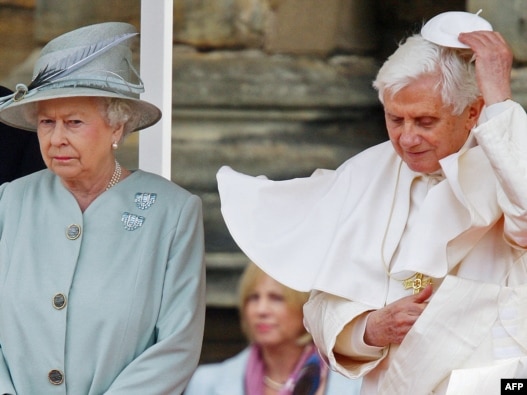
Saturday, September 18, 2010

More Apologies Which Don't Include Any Real Action

There comes a point when apologies have to be followed by meaningful restitution, otherwise you might just as well apologize to Satan.

At a Mass at Westminster Cathedral, Pope Benedict has just spoken these words in his homily -- some of the strongest yet expressed on clerical sex abuse.
Austen Ivereigh - America Magazine - 9/18/2010

“Here too I think of the immense suffering caused by the abuse of children, especially within the Church and by her ministers. Above all I express my deep sorrow to the innocent victims of these unspeakable crimes, along with my hope that the power of Christ’s grace, his sacrifice of reconciliation, will bring deep healing and peace to their lives. I also acknowledge, with you, the shame and the humiliation which all of us have suffered because of these sins; and I invite you to offer it to the Lord with trust that this chastisement will contribute to the healing of the victims, the purification of the Church and the renewal of the age-old commitment to the education and care of young people. I express my gratitude for the efforts being made to address this problem responsibly, and I ask all of you to show your concern for the victims and solidarity
with your priests.”

************************************************

Pope Benedict also met with five victims at the Papal Nuncio's and Catholic officials in charge of Child Protection policies for the English Church.  While this was going on an estimated 20,000 protesters, twice the expected number, marched in protest over the Church's refusal to hold bishops accountable for their part in covering up the abuse scandal, gay rights, and absolutist positions on condoms, abortion, and birth control.
It surprises me not at all that Benedict would meet with victims precisely as the big demonstration rolled through London.  Coverage from the major Catholic publications has so far ignored the existence of the protest march in favor of covering Benedict's meeting with abuse victims.

John Allen did report the following:
Conservative politician and media personality Ann Widdecombe, a convert from Anglicanism to Catholicism, said the protesters were “melting away” as popular enthusiasm is growing. Yet Terry Sanderson, president of the National Secular Society, predicted that after Sunday “this trip will be completely forgotten,” because the vast majority of the British as “totally indifferent” to the pope’s presence and message."  I hate to be nit picky, but 20,000 people do not just melt away--but they can be officially ignored by a trad Anglican convert who has a reason to promote her own agenda.

This marks the fourth occasion Benedict has addressed the abuse crisis while on this trip.  In none of these statements is there the slightest indication he actually intends to do a thing about the hierarchical system or the members of that system that engaged in covering up the abuse and/or transferring pedophiles to other parishes.  Not surprising then that SNAP and other organizations dedicated to abuse victims are not impressed.  Very few people are fooled after two years of such apologies and no concrete actions to back up the words.  It is beyond obvious that Benedict has absolutely no intention of dealing with the hierarchy or the clerical system which produced and hid this entire mess.  He will not touch the 'perfect society' of the clerical caste, no matter how imperfect or down right evil it has proven itself to be.  The apologies sound hollow and repetitive because they are hollow and repetitive.

John Allen has at least got this part right: 

The box Benedict is in would appear to be this: If he stops talking about the crisis, he would likely be accused of ducking the question or artificially pretending that the problem is solved. If he keeps issuing roughly the same apology, he’ll aggravate his enemies and may frustrate a growing share of his allies.


That would seem to leave the pope with two options. Either he must figure out something new to say, or he has to supplement his words with actions – some new policy, some new spiritual initiative, or some new gesture of accountability, which would lend his words new significance.  (Policies which don't get at the core root problems in clericalism will not suffice, spiritual initiatives will not suffice, gestures thrown at accountability will not suffice, only serious reform will have any lasting significance.)


Otherwise, the risk is that something that was initially hailed as an important moment in solving the sexual abuse crisis could become, with time, another force keeping it alive."

Papal apologies work when they are backed by real change.  JPII demonstrated that on a number of occasions.  Benedict is demonstrating repeated apologies without change eventually get annoying to some and embarrassing to others.  As long as he will not consider holding bishops accountable and changing the hierarchical system itself,  he should either tell the truth about this, or just stay silent.  While he's at it, he could also ruminate on the fact that as long as the Church refuses to act on the evil in it's own clerical society, it has zero credibility pointing out the evils in other less 'perfect' societies.  As Benedict is so fond of pointing out, evil is not relative.

Friday, September 17, 2010

Atheists, Nazis, And The Perfect Society


The Queen Mother with the Holy Father.  Not exactly a traditionally complimentary relationship


British humanists are angered with certain assertions Pope Benedict made yesterday about Nazism and atheism.  Benedict appears to have a very relativistic view as to the true history of the rise of Nazi Germany and the Holy See's part in legitimizing the Third Reich:

"Even in our own lifetimes we can recall how Britain and her leaders stood against a Nazi tyranny that wished to eradicate God from society and denied our common humanity to many, especially the Jews, who were thought unfit to live. (As were many other categories of 'sub humans', including gays and gypsies, who are still being persecuted by segments of traditionally Catholic Europe.)  


"As we reflect on the sobering lessons of atheist extremism of the 20th century, let us never forget how the exclusion of God, religion and virtue from public life leads ultimately to a truncated vision of man and of society and thus a reductive vision of a person and his destiny."

***************************************************

How can Pope Benedict overlook the fact that one of the first 'nation states' to recognize and legitimize Hitler's government was the Holy See?  How does he, a German who lived through this period, pretend Hitler came to power as if the Institutional Church opposed him?  Perhaps Benedict is counting on the fact most people aren't familiar with the Church's history with Germany during this period.  I'm not one of those people.  America Magazine ran an article by Robert A Krieg on this topic back in 2003.  It is well worth reading in it's entirety as it deals with a number of concepts which can give some history to all this 'dictatorship of relativism' which Benedict is so worried about.  It's the the very sort of thing his predecessors helped to create in Nazi Germany.  The article also shines some light on how the exact same hierarchical attitudes are still operating the abuse crisis of today.  The following extract deals with the immediate ramifications for Catholicism after the concordat between the Holy See and The Third Reich was ratified by both Hitler and Pius XI in September of 1933:

The Holy See’s concessions included the concordat’s requirement that clergy not engage in political activities and not hold political offices. Bishops were required to swear an oath of loyalty to the Reich and its legally constituted government. The bishops would sponsor only those lay organizations dedicated to charitable works and to social activities of a religious nature. Although it was agreed that a list would specify which organizations were protected under the concordat, this list was never completed. In addition, diocesan newspapers and church-affiliated publishers were left vulnerable to the state’s interference and suppression, because the concordat did not explicitly protect them.  (The concordat also resulted in the suppression of the Catholic Center Party which removed the last real opposition to the Nazi party.  For more interesting reading google Fr. Ludwig Kaas.)

The Concordat of 1933 embodied a problematic theology of the church, for it implicitly reduced the church to an organization concerned solely about a private, otherworldly realm unrelated to the social and political aspects of human life. It devalued the fuller reality of the church expressed in German Catholicism’s rich tradition of social and political activism, as realized in the Kolping Society, the programs of Mainz’s Bishop Wilhelm Ketteler (d. 1877) and the Catholic Center Party. As a result, it lost sight of Leo XIII’s Rerum Novarum (1891) and Pius XI’s Quadragesimo Anno (1931). Moreover, it cast ambiguity upon the church’s civil autonomy by requiring the bishops’ oath of loyalty to the Reich. 
The concordat was also flawed in its timing and implementation. Cardinal Pacelli signed the agreement too early in the regime’s history, for this treaty gave Hitler the international respectability he craved. The signing of the concordat also demoralized German Catholics, who had stood with their bishops in opposing National Socialism from the early 1920’s until March 28, 1933. On that date the bishops, relying on Hitler’s solemn pledge to make “the two churches [Catholic and Protestant] the cornerstone of our work of national renewal,” rescinded their bans against membership in the Nazi Party. Pius XI and Pacelli may have operated in the best interests of the church as an institution, but they implicitly diminished the church as an advocate of human rights and justice. Here was one of the ill effects of the ecclesiology of perfect society. The metaphor of the church as a medieval castle or a Gothic cathedral so dominated Catholic thought that it lessened the role of the church as a proponent of universal human values as embodied in natural law....

Analyzing the Concordat of 1933, the Rev. John Jay Hughes has rightly observed that “[t]oo much reliance was placed on diplomatic protests; and too little was done to acquaint rank and file Catholics in Germany with the existence and content of these protests and to mobilize them in support of church rights.” Fueling this inadequate implementation of the concordat was the theology of the church as a hierarchical institution. “The fundamental cause of this failure was theological: the view of the church as consisting of a more or less passive laity, an obedient body of pastoral clergy, and a hierarchy that directed and led both laity and clergy, making all decisions in lonely and splendid isolation.”

Kreig places great emphasis on the theology of the time which saw the Church as a perfect society.  As Fr. Hughes states, the institutional view this theology generates is hierarchical with a passive laity, obedient clergy, and a hierarchy that directed and led everyone else from it's lonely and splendid isolation. Their direction was supposed to lead everyone to the personal sanctity and holiness needed to enter the private Catholic heaven.  Vatican II was supposed to have done away with all this nonsense in it's theology of the Church as the People of God. 

I believe one of the driving motivations in the 'reform of the reform' movement, is the return of this theological notion of the Church as the perfect society.  It is the fundamental basis of all the 'new movements' as is perfectly illustrated in the cultic dysfunction in the Legion of Christ and other imitators.  It can also be seen in it's universal application in the hierarchical response to the clerical sexual abuse crisis--protect the instituion at all costs, even if that cost includes it's very reason for existence.  This is why Benedict routinely apologizes from the apex of his splendid isolation, while nothing changes down below him in the institutional aspect of the 'Perfect Society'.  I sometimes wonder if he really believes his papal apologies will magically blind us to the fact he is refusing to deal with the structures, personalities,  and attitudes which created the scandal.

I understand why British humanists are up in arms about these quotes.  These quotes should be challenged, and not just by secular atheists and agnostic humanists, but by Catholics who care about the true history of the Institution.  The theology of the perfect society is far far from perfect.  It's damaging to the laity, the clergy, and the isolated leaders who feel compelled to make one disastrous decision after another in order to protect themselves and their position in this perfect society. It actually promotes a theology of relativism with all things being relative to the hierarchy.  Hence the totality of the German Catholic Church and it's influence in the German culture could be negotiated away in order to protect some of the autonomy of the bishops and the Holy See.   Millions of people died while Catholic bishops wrote secret memos back and forth with the Vatican, their official silence giving the impression the Nazi's were all right by them. 

And yet after this history,  Benedict repeatedly states gay marriage is the biggest threat to civilization.  Maybe in his theological illusion of the mythical perfect clerical culture, but hardly to civilization in the real world. In the real world the Vatican illusion of the perfect society has proven to be the far bigger threat to civilization.  In too many respects it still is.

Thursday, September 16, 2010

The Irish Lowerarchy Are Finding Their Voices-- And They Are Not Singing "Irish Eyes Are Smiling"


Perhaps the start of a path for conversion is happening in Ireland.  I don't know though that this is the kind of conversion Benedict was thinking about.

Hundreds turnout for priests' meeting

GENEVIEVE CARBERY- Irish Times - 9-15-201-

Challenging the role of women in the church and the treatment of priests falsely accused of abuse are among the objectives which were outlined at the inaugural meeting of the Association of Irish Priests today

Some 300 priests turned out for the meeting of the association which aims to provide a “voice” for clergy. Organisers had expected between 50 to 70 priests to attend the meeting at the parish centre in Portlaoise, Co Laois and had to change venue to accommodate the interest.

The high turnout showed that the association had “touched a nerve “ and that there was a “voice needed” by the Irish clergy, one of the founders Fr Brendan Hoban said.

The association will be very proactive and will have spokesmen on issues that arise in the church and society, Fr Hoban said.

He outlined the aims and objectives which he said are based on the teachings of the second Vatican council. They received overwhelming support at the meeting.

The role of women in the church is of concern to the organisation and is “in need of a change” Fr Hoban said.

The organisation will campaign for the rights of priests who have been wrongly accused of child sexual abuse and have not been support by their diocese and priests who have been left in “limbo situations” where their right to natural justice is denied, he said.

Other issues which the association will highlight are the involvement of lay people in the church and the opposition among priests to a new English translation of the Mass. It will also campaign for a church which is not governed by a clerical elite but recognised the equality of all members.

The association will be seeking discussions with Apostolic visitors from the Vatican that are due to visit Ireland.

The low morale among priests due to the difficult times for the church was also addressed at the meeting. “Authority is diminishing, vocations are in free-fall, practice is declining, the age-level of priests is increasing all the time and priests find themselves under growing pressure, “ Fr Hoban said

“At the moment priests feel they have no voice and feel they are not understood,” (That might be because bishops are too busy playing CYA games with the Vatican and their individual priests make good footballs.)

The association has said it is not anti-bishop but pro-priests however it is not a union and will not represent or be supported by all priests.

The organisation aims to have a representative in each diocese to canvas support and hopes to have a “sizeable percentage” of some 4000 Irish priests as members, Fr Hoban said.

Many of Ireland’s best known priests backed the association in the initial publication of its aims earlier this month including Iggy O’Donovan, Peter McVerry, Sean Healy, Colm Kilcoyne, Brian Darcy, Donal Dorr.


*******************************************

It maybe that this particular group represents the one reform group that Benedict will take very seriously. This is as opposed to the groups of reformers and dissenters he will face in Britain.  I don't think British humanists and atheists are going to have quite the impact this group of priests from Ireland will have on the Vatican.  A year from now we may find out that this initial group of 300 priests is just the minuscule tip of the proverbial iceberg. 

Priests have a vested interest in the Church which far surpasses most of us a laity.  Since the vast majority of them have the greater part of their experience in Vatican II theology and notions of ecclesiology I've often thought it must be very difficult for them to watch and have to participate in the Vatican's notion of the 'reform of the reform'.  There for I don't find it surprising at all that one of their stated concerns is the new English translation of the Novus Ordo.  They know this represents far more than a symbolic tweaking of translations.  It is a very direct statement about the resurgence of Vatican authority and centralization, and it's aimed at them as much as it is at the laity.  The new translation is the gravestone on any notions of collegiality and subsidiarity. The lowerarchy has as much influence in the shape of the Church as the laity--as in none.  They also have the additional burden of towing the line to keep a roof over their heads. For many of them this must truly be a burden on their conscience.

I could have written on the Pope's touchdown in Edinburgh and his statements on the trip over about the abuse crisis, but I think this story is just as important,  I don't want it to get lost in all the other papal hoopla.  We've heard papal apologies before and nothing on the governance level has changed.  There is no apology Benedict can give which will mask the truth about apologies spoken by Belgium's Bishop Guy Harpigni of Tournai.  "“We did not dare. If you officially apologise, then you are acknowledging moral and legal responsibility. Then there are people who ask for money and we don't know what lawyers and the courts will do about that," he said.

In the conflict between mission and money, money has won far too many times to count. "We did not dare."
Well these 300 priests in Ireland have dared to act on their concerns about the mission of the Church.  That is truly refreshing.  They have stated they are not anti-bishop and I can believe it.  There is no reason to be anti-bishop when the bishops themselves are masters at that. 

If these men can stay the course and continue to find their voices, they might just find there will be a lot of smiling Irish eyes--standing right beside them.

Wednesday, September 15, 2010

The Brits Debate Celibacy


Last night on the BBC they conducted a debate over the issue of celibacy in the Church.  The following extract is from a new blog written by Tina Beattie, the Director of the Digby Stuart Research Center For Catholic Studies.  The extract records Tina's personal contributions to the debate as a member of the side advocating for a change in the celibacy doctrine.  Tina brings up a couple of points I had never given much consideration, but in retrospect think need to be seriously considered.

"I pointed out that we already have married priests in the Roman Catholic Church thanks to the influx of Anglicans. The bishop (Malcolm McMahon) tried to defend that on the basis of exceptions, but having referred to celibacy in ontological terms, that wasn't a very persuasive defence. And I did wonder, if there can be ontological exceptions for Anglicans, why not for women? It's all very unsatisfactory, and seems unfair to faithful Roman Catholic celibate priests who long to marry but are forbidden to do so.


I agreed to take part in this debate because of the word 'compulsory'. I think celibacy is a gift and a vocation with huge advantages for the Church. It enables men and women to work in situations of extreme hardship and danger - which is why the Catholic Church is usually still there when all other NGOs and aid agencies have fled. It also gives a potent witness to an alternative way of life, in an age when so many in society simply take it for granted that abundant high-performance sexual activity is as essential to our human well-being as eating and drinking. But when celibacy and priesthood are forced into the same vocation, and when the institutional Church is governed by an exclusively male celibate hierarchy, we should not be surprised that the Church is every bit as obsessed with sex as secular society is. (Opposite sides of the same sexually obsessive coin--this does not imply one is right and one is wrong. Both are out of a balance and ignore the concept of love in sexual relationships.)

However, like Frank Skinner, in the end I'd rather see celibate women priests than married priests. The Church would need to be much more radically transformed in its attitudes to women for priests' wives to be anything other than glorified housekeepers, and with present teachings on contraception presbyteries would soon be overflowing with babies. Married priests might simply prop up the status quo with all its patriarchal and misogynistic tendencies. Maybe what we need is a much wider understanding of different models of priesthood and different models of celibacy, without an essential link between the two.

*******************************************

I had not actually considered just how the birth control issue might play out in rectories with a married priesthood.  It's easy to imagine how a married couple might have to spend a bit of energy defending the sacramentality of their marriage if children didn't appear on a regular basis.  Not a mission I particularly would want to engage in as part of priestly ministry.  I wonder if married deacons experience much of this kind of scrutiny?

I strongly agree with Dr. Beattie's final thought that celibacy and the priesthood have to be freed of the linkage between the two.  I would state this a little more broadly and say that sexuality and the priesthood have to be freed of such linkage.  I don't mean to suggest that candidates for the priesthood needn't have a mature understanding of sexual expression.  I see it more in the sense that candidates for the priesthood should be mature across the board with sexuality one aspect of that maturity, and spiritual maturity being the primary criterion--irrespective of gender.  Spiritual maturity implies the inclusion of sexual maturity as one can't be truly spiritually mature if one operates out of an immature mentality towards sex.

The sex abuse crisis certainly points out how one can attain religious leadership while being essentially immature in a whole host of areas--sexuality only one of such areas.  In my own life the people who have had the most impact on my spiritual development have all had one thing in common, and it's not celibacy or chastity or heterosexual orientation.  It's compassion and empathy, or to put it differently, they have demonstrated and engaged in the 'art' of relationship.  This doesn't mean that they were great enablers of immorality and sin, but that they created an accepting environment in which dysfunctional areas of living could be explored and healed.  The emphasis was not on changing behavior, but in healing the underlying reasons for the behavior. Once healing occurs, behavior has to change.

I can remember back in my younger days when a priest I hugely respected said that celibacy and chastity are not bad ideas at all, but the way they were taught and implemented were just crap. He said no one seems to wonder if Jesus had other reasons for practicing celibacy other than purity laws.  He thought Jesus chose celibacy because Jesus realized one doesn't have a sexual relationship in a vacuum of two people. No relationship has consequences for just two people.  If Jesus and Mary Magdalene, for instance, had had a sexual relationship the effects on the Apostles would most likely have been explosive.  In this priest's mind Jesus made a deliberate choice to practice a celibate life precisely so that the consequences of such a singular relationship would not effect His teaching mission or undercut the necessary relationship with His disciples.  Jesus couldn't afford the jealousy such a relationship might engender in others.  Peter comes to mind.

Had Jesus begun his teaching career at fifty nine instead of twenty nine, things might have been a little different.  The fires of passion being banked to some extent, family responsibilities over and done with, and most men not particularly interested in the old wife of an old rabbi.  For whatever reason, Jesus opted for a different path.  This has never meant the Church had to opt for the same path.  Most young men, Apostles included, are not chemically built for celibacy, nor are they usually relationally mature enough to make celibacy a healthy kind of relational choice.  In the end celibacy is not so much a sexual choice, as it is a relational choice.  It's a choice that's best served in maturity not youth. 

I personally believe that celibacy/chastity should not be available as a consecrated vow until later in life for any religious state.  If they are not integrated parts of the personality there will be problems.  Mature integration is not usually accomplished through youthful denial. Recognizing that might be a good place to start this conversation.

Tuesday, September 14, 2010

John Paul II Was Haunted By A 'Catolic' Dream


I came across a fascinating tale of a dream of JPII's on the website Catholic Concern for Animals by JR Hyland.  The dream was about a homeless mother cat and her kittens.  The story was originally related in one of the two hundred some interviews JPII granted author Anton Gronowicz for his biographical book on John Paul entitled "God's Broker".  The interviews took place shortly after JPII's election to the papacy and the book was published in 1984.  It's a pretty straightforward dream, loaded with lessons for JPII and perhaps lessons for us as well--and some of those lessons might be about about JPII......

"The dream took place in 1969 the night before the Pope, known then as Cardinal Karol Wojtyla, was to visit New York City for the first time. It was late summer and he had been touring Canada. He spoke of the beauty of its fields and forests and how he had wished for more time to walk in woods vibrant with color and with his "ears filled with the songs and voices of animals."

In the midst of this discussion of Canada, the Pope abruptly changed the subject and said: "The night before my departure from Canada to New York, which I had never seen, I had a strange dream." But his dream was not of beautiful forests, warm with the summer sun. It was of a crowded city, frigid with the cold of a northern winter. And although he had never been there, his dream captured the way Manhattan looks and feels, after a major snow storm.

"It was a terribly severe winter in New York, the city was completely covered with snow. Inhabitants were well-off and warmly dressed, and walking slowly along roads because cars, due to mountains of snow, could not be operated. I was happy that I could walk on top of the snow on avenues of white.

"All my physical effort was spent on walking. To this day, pictures of huge apartment houses on both sides of the avenue are instilled in my mind, and the doormen quickly closing and opening entrance doors as though trying to prevent humanity and warmth from escaping.

"On top of the snow, I noticed a brown cat emerge from a side street and walk on the snow. I looked closer, and to my surprise, saw that this big cat was being followed by six small brown-and- white kittens, all of them following the big brown cat in a perfect line. The mother cat looked back from time to time to see if her babies were there, but her main concern was to reach the entrance door. I presumed she was trying to find warmth for herself and her children, but as soon as she reached the door, a man in a well-pressed uniform, jumped at her with a broom and chased them away. I followed this procession and prepared to deliver a speech to the doorman. I opened my mouth and tried to complain, 'Where is your proverbial American generosity? Where is your American good heart and fair play? Let them in. Let them in!!

"I tried to speak, but the words would not come out. Maybe I was afraid of the doorman with the broom. I started searching my cassock pockets for a piece of bread, found some crumbs and put them on my palms, calling: 'Kitty, kitty, kitty.' But the words would not come from my supposedly intelligent mouth. Instead, the wind blew the crumbs from my palm and I said, 'what can I do? I can't speak to the cats. I can't speak to the doorman. But there are many hungry birds. They might pick up the crumbs.'

"Again, I walked after the cats, now with a pain in my chest, feeling tremendous cold. On the left I saw a church building and thought, 'There we will find help.' I heard singing and again, the idea occurred to me that it must be a Catholic church. The music grew louder, as though trying to convince God that they were praying to Him.

The mother cat jumped in front of me and climbed the stairs, followed by her kittens. I raised my head and saw a tall Jesuit priest chasing the cats off the steps. But as I was about to shout at the Jesuit 'I am a cardinal!' and give an order to accept the cats, the mother cat and her offspring ran behind the church, because from there came the appetizing aroma of food. Probably there was a kitchen there. But a second Jesuit appeared at the kitchen door and scared the cats away. They returned to the avenue and started walking north.

"They walked on the same side of the avenue as the Jesuit church and I followed. Then they reached an imposing red brick church. An Anglican bishop appeared and said to the cats, 'My dear animal children, please go immediately to the animal shelter. There is food for you there. We Anglican clergy donate lots of money to the animal shelter, every year, at Christmas time.'

"The mother cat and her kittens didn't even meow. They knew the authoritative voice of the Anglican bishop. They walked uptown and gradually the luxurious buildings disappeared, together with the doormen, and we saw drab dilapidated apartments.

"As they walked and the buildings grew shabbier and dirty, a door was opened, not by a doorman but by an old wrinkled woman in a cotton dress. [She saw the cats] and shouted 'Oh, little mother,' and when she opened her mouth I saw she had few teeth. She gently ushered the mother cat and kittens inside, who jumped happily about because the warmth of the house embraced them."

The narrative ended as the cats found a safe haven with the woman who had little enough, herself. When the Pope concluded his dream the author to whom he related it did not make any comment on what had been said. But he did write that "I had never seen such a sad expression on the face of this man." Considering that this was the same man who had related the horrors of his young manhood, under Nazi occupation, the author's remark shows the deep impact this dream had on the Pope.

If the Pontiff offered a commentary on his dream, Anton Gronowicz does not share it with the reader. But we are told that John Paul began to recite the prayer of St. Francis of Assisi."

**********************************************

There are a number of schools of thought as to what dreams are and what the symbolism represents.  What I find fascinating about this dream of John Paul's is that it maintains a continuity in time and place.  It could very well be a real story, and not a dream.  This aspect may be the reason that it seems to have so effected JPII so strongly. Dreams like this are hard to dismiss, precisely because they follow our normal waking experience of reality.

There are some aspects of this dream that I found very fascinating, such as the portrayal of the Jesuit priests, the Anglican Vicar, and JPII's own inability to either feed the cats himself or open his mouth to use his influence as a Cardinal to change anything for the better.  The dream doesn't paint a very flattering picture of the clergy as effective servants for the least amongst us--no better than an apartment doorman.  The dream ends with the least of humanity giving hospitality to the least amongst us.  It's easy for me to see where JPII's face displayed great sadness.  His own dream portrayed the clerical caste, of which he was a high ranking member, as either indifferent, compartmentalized in their charity, or in his case, impotent to effect change. 

The most obvious interpretation might be JPII"s dream is a kind of modern version of the Nativity story.  There is no room at any inn for this mother and her kittens until they find a 'toothless hag' who willingly takes them in because she recognizes a 'little mother' and the stray family all live happily in the warmth of her home.

A wrinkled toothless hag is hardly the first picture for Mother Church that would come to many people's minds, but it did to JPII's mind.  Of course, real Christian love has nothing to do with outward appearance, and everything to do with inward warmth.  I can't help but wonder if JPII ever understood the core meaning of his dream and what it might have portended for his papacy.  I think he probably did get the gist of the dream but as he himself experienced in the dream,  he couldn't act on or articulate this particular understanding about the Christian Church.  As he experiences in the dream:  "But the words would not come from my supposedly intelligent mouth."

Monday, September 13, 2010

When An Event Admission Ticket Is Not An Event Admission Ticket

Thought I'd do my small part to help organizers defray the cost of Benedict's visit by advertising some sample souvenirs.  For a thoughtful review of these and others, try this link

Seriously, there are times I don't know whether to laugh or cry--because there are times when Church leaders, in giving the appearance of adhering to Church doctrine, appear very manipulative, more like con artists than spiritual leaders.  This tendency has been amply demonstrated by our clerical higher ups in the abuse crisis, but now Archbishop Vincent Nichols has given us another demonstration of double speak.  His task was to prove that setting an admission price for papal events in Britain did not violate simony statutes, especially setting a flat fee for admittance to Papal Masses.  From RTE Ireland:

Those wanting to see Pope Benedict XVI during his visit to Britain this week have been asked to make a 'financial contribution' to attend masses to help make up a shortfall in funding.

When they go to the events, they will also be urged to buy t-shirts, baseball caps and tea cups commemorating the visit, as the Catholic Church's marketing arm swings into action.

The Church is asking for £25 (€30) per head to attend the open-air mass in Birmingham on September 19, the final day of the visit. (This is about $39 US.)

The contribution is slightly lower for the mass in Glasgow on Thursday, at £20, and entry to the prayer vigil in London on Saturday is £5.

All the prices include transport to the venues and a 'pilgrim pack' -- a bag containing a CD and a booklet about the visit.

While asking for payment to attend a papal mass is believed to be unprecedented, the Catholic Church has denied it amounts to an entrance fee.

'Those contributions only cover the costs of the transport and the security provisions,' said Archbishop of Westminster Vincent Nichols, the head of the Catholic Church in England.

'It includes their travel so it's not as if it is a payment to go to mass.' (I suppose that technically one could pay for a ticket whose end destination is a papal mass, and not go to the mass.  There for selling 'travel packages' explicitly to papal masses is not technically simony, even though it gives a very definite appearance of violating the spirit of the doctrine.)
The funding of the first ever state visit by a pope to Britain is expected to cost around £20m and has attracted controversy as taxpayers are footing £10 to £12m of the bill.

That leaves a £10m shortfall for the Catholic Churches in England, Scotland and Wales to pick up, of which £6m has already been raised through a public appeal for funds.

The 'financial contributions' to attend the masses will make up the rest.

More than three quarters of Britons are against meeting even half the cost of the visit, according to a poll by public theology think tank Theos this month.

********************************************

Irish laity are not snapping up their allotment of travel packages.  Of 2500 'financial contributions' slated for the Irish for Pope Benedict's mass in Bellahouston Park, Glasgow, 2000 remain.  Where as 300,000 attended JPII"s mass at this venue in 1982, organizers estimate 80,000 for Benedict.  Perhaps Benedict will see this upturn in apathy as proof that his desire for a leaner church is well on it's way.  That would probably be easier for him to accept than the alternatives, that he is not JPII, that the abuse crisis really has had a profound effect on Catholic participation, and that Benedict's Catholic world view is rapidly losing ground in the advancement of secular notions of individual human rights--especially in the democratic anglo world, but also in Latin American countries.

One could wonder if thirty plus years of the restorationist agenda has been particularly good for the People of God.  It doesn't seem to have been to good for the People of God as defined by Vatican II theology.  With the beatification of Cardinal Newman as the centerpiece of this trip, there has been a great deal of writing about Newman and his influence on the Church.  To be honest, I don't actually recognize much of the Cardinal Newman of Vatican II in the analysis of Cardinal Newman coming from Benedict and the Vatican.  I would have to agree with John Cornwell's take, that the theologian whose writing was so much a part of Vatican II thinking would have to be 'restored' as much as Vatican II itself.

One of the more interesting things I learned in reading Cornwell's article is the reason for the extensive decomposition of Newman's body: 

"On a wet October day in 2008, an assortment of priests and grave-diggers arrived at the cemetery in Rednal, armed with shovels and a mechanical digger. They planned to transfer Newman’s remains to a tomb back at his church in Birmingham. Nothing was found except the brass name-plate and a few bits of rotten wood. A solution to the mystery was discovered in the archives of the Birmingham Post. A journalist at the burial reported that, on Newman’s orders, the grave was filled with compost to hasten decomposition."

It does seem that Newman was not interested in the Church finding and restoring his physical remains.  Perhaps on some level he knew that there was nothing he could do about his ideas, so he asserted his only control about those ideas through his burial--side by side with his beloved companion with no relics left to be manipulated for the 'sainthood industry'. Newman's final message seems to be about the supremacy of the love in his life, and this was not to be overshadowed by the veneration or manipulation of his ideas or his physical body.  Truly a message from the grave, but probably not one we will hear from Pope Benedict. 

In the meantime Vatican organizers are most likely concerned with other messages.  After all there are all those 'financial contributions' and 'travel arrangements' yet to be sold.  

Thursday, September 9, 2010

A Clerical Call For More Catholic Babies To Save European Culture From Islamic Babies

Seriously, this is an actual game.  Doesn't appear to be one I personally would want to play.  I've done my diaper duty.

Catholic priest urges European Christians to fight off Islam by having babies
BY Meena Hartenstein  NY DAILY NEWS - Wednesday, September 8th 2010

A prominent Catholic priest wants European Christians to fight off Islam with a unique weapon: babies.

Father Piero Gheddo, an Italian missionary priest, said Wednesday he believes a declining birth rate among Europeans combined with a rising tide of Muslim immigrants could mean that Islam will soon dominate Europe.

"Certainly from a demographic point of view, as it is clear to everyone that Italians are decreasing by 120,000 or 130,000 persons a year because of abortion and broken families; while among the more than 200,000 legal immigrants a year in Italy, more than half are Muslims and Muslim families, which have a much higher level of growth," he said, according to Rome's Catholic news service Zenit News Agency.

Gheddo's solution? Christians need to start having more children. (Except for him and his fellow clergy.)

"The fact is that, as a people, we are becoming ever more pagan and the religious vacuum is inevitably filled by other proposals and religious forces," he said. "If we consider ourselves a Christian country, we should return to the practice of Christian life, which would also solve the problem of empty cradles." (I love his use of 'we'.  The truth is a large number of Italians would not consider themselves part of his 'we'.

Father Gheddo is a well-respected member of the Vatican's Pontificial Institute for Foreign Missionaires.

His comments were made in response to Libyan chief of state Moammar Khadafy, who said this week that Europe should convert to Islam.

Khadafy, on an official visit to Italy, laced his speech with controversial remarks, such as, "Tomorrow Europe might no longer be European, and even black, as there are millions who want to come in."

"We don't know if Europe will remain an advanced and united continent or if it will be destroyed, as happened with the barbarian invasions," Khadafy added, before handing out free copies of the Koran.

Incensed that Muslims could one day outnumber Christians in Europe, Gheddo vowed to bring more attention to the issue. (Could be European Muslims will be secularized long before Islam is able to take over the Continent. A likely fact Khadafy ignores as well.)

The media hasn't "seriously taken into consideration how to respond to this challenge of Islam," he said, "which sooner or later will conquer the majority in Europe."

Gheddo intends to change that.  (Easy for him to say as he can be all talk and no walk.)

"The challenge must be taken seriously," he said.

*********************************************

It's hard to take this particular challenge seriously when it's being issued by a man who can't be part of his desired solution.  At least not officially, that is. It's exactly the same situation Catholic lay reformers are in when it comes to the priesthood.  We can talk all we want, but by definition will not be a deciding part of any solutions.  It's a frustrating place to be.

I couldn't help but notice that Fr. Gheddo places the blame for the demographic problems he sees in Italy on abortion and broken families.  I suspect economic factors,  birth control, and the reluctance of Italian males to enter into marriage has more to do with his perceived state of affairs.  I see very little reason that the same kinds of factors won't impact Islamic immigrants.  Secularizing tendencies, like higher levels of education for women, effect all religious denominations.  Even the most reactionary.  Perhaps most fundamentally the most reactionary.

Fr Gheddo, whether he intends to admit this or not, is making the case that Islam has more power over it's adherents than Catholicism.  I wonder how true that will be when adherents of Islam find themselves in truly open secular societies.  Even truly theocratic states like Iran are finding it harder and harder to keep secular ideas from 'infecting' their people and changing their cultures.  Especially in the younger generations who have taken like ducks to water to the global revolution in communication technologies.  Especially younger women.

I truly wonder if Fr. Gheddo's real concern is not Islamic immigration but the changing status of women in western culture.  One of the real changes is that women are making decisions about children on the ability to raise them, not just have them.  Children are no longer seen as 'random' gifts from God, but a serious personal responsibility.  One that calls for serious consideration about all kinds of factors which impact families and family size.  Women in the west have been empowered to have the primary voice in how many children they will have and when they will have those children.  Motherhood and parenting is no longer a random crap shoot at the behest of male sexual need.  Parental complementarity, as opposed to gender complementarity, is a much broader concept in which parental roles and responsibilities are shared across the board. It's incomprehensible to me that Islam will prove any better at stopping this trend than Christianity has, because the truth is this trend towards the empowerment of women actually frees and empowers men in as many ways as it does women---that is if men are willing to see it and willing to value their daughters as much as sons.

There were two other articles I read this morning that are worth  pointing out.  The first is on Michael Bayly's Wild Reed.  It deals with the incredible man/boy subculture with in the Taliban in Afghanistan.  This is a culture which stones homosexuals by religious law.  The rationale used by men who engage in man/boy sexual partnerships is that it's not homosexuality because they are not in love with their boys.  I guess that makes this religiously sanctioned sexual exploitation of young boys. And it's based in pathological levels of misogyny.

The other article is on Bilgrimage and deals with Focus On The Family's keynote convention speaker, Newt Gingrich.  Perhaps Newt's talk will explain his concepts about how repeated practice makes monogamous traditional heterosexual marriage better--at least for traditional powerful men like himself.

Wednesday, September 8, 2010

Benedict Advocates Repentance And Conversion--Not Structural Change


Pope Benedict has a great idea here except for a few problems.  Pedophiles don't repent and their bishop enablers have exempted themselves from any accountability, which more or less negates any notion of complete repentance or any kind of conversion. This is even more egregious in cases in which bishops themselves are abusers. Benedict completely ignores the idea that real repentance might mandate structural change.  The following is from the Sydney Herald

Pope Benedict XVI says repentance is more effective than structural change within the Church to counter sexual abuse by priests.


Using an indirect historical analogy, the pope on Wednesday recalled the words of XII century Saint Hildegard, according to whom "a true renewal of the ecclesiastic community is the result less of structural changes than of a sincere spirit of repentance and an active path towards conversion."

Saint Hildergard at the time was fighting the criticism by German sects "proposing a radical reform of the Church in order to fight abuses by clergy," Benedict told 7,000 pilgrims at his weekly general audience.

The pontiff said Hildergard's was "a message that we should never forget."

***********************************************

Maybe Hildergard's is a message that needs some modification since eight hundred years later the Church is still dealing with the same abusive problems.  Sometimes good old fashioned structural changes can facilitate true repentance.  Often times these structural changes also reduce one's ability to abuse with impunity or disabuse one of the notion they are not accountable to anyone other than themselves.  Come to think of it, isn't Benedict the same Pope who is demanding structural changes for the Legionaries and suggested Maciel restructure himself into a monastery?

Actually, I'm not sure structural changes would actually accomplish much if they weren't accompanied by a completely different mindset.  As it stands now the Church is in love with the idea of the victim/abuser dynamic.  It's pervasive in much of it's theology and spirituality.  It leads to the kind of mentality that blames victims for being complicit in their own victimization, or tells them to offer up their suffering for the good of their abuser, or demands they forgive their unrepentant abuser for the good of their own soul.  There's a bit of truth in the last statement, but it's a long road for any victim to reach that point of forgiveness.  The larger truth is forgiveness of this sort is too often seen by the abuser as a free pass and short circuits true repentance and conversion.  This is sometimes called receiving cheap grace.  Real grace is not cheap.  I am not personally predisposed to offering Benedict much cheap grace.

This victim/abuser dynamic can also be described by the terms prey/predator. The operative emotional consequence for people exposed to this dynamic is fear.  The Church has a long traditional history of evoking fear in it's adherents.  Victimizing and preying on catechized lay fear has also proven to be very lucrative. This is why I'm quite sure Benedict is not going to advocate change in the cultural structure.  We'll just have to trust an intrinsically predatory hierarchical structure will change it's stripes and repent and convert. He wants us to believe this clerical lion will lay down with it's lay lambs.  Right. 

Tuesday, September 7, 2010

What Does The Future Hold?

Homer Simpson is not a representative of the next stage of human evolution.


The Progressive Catholic Voice has a new post about a trip to interview Hans Kung taken by organizers of the American Catholic Conference.  ACC is organizing a national meeting of reform minded Catholics to be held in Detroit in June of 2011.  The following short excerpt gives Dr. Kung's view of the future of Catholicism.

In a relaxed atmosphere, Dr. Küng expressed his views about the future of the Church. As he sees it, the institution we know will die soon, to be replaced by communities following the gospel of Jesus, with informal liturgies and a sacramentality related to life in community. He is very devoted to developing relationships between Christianity and non-Christian religions, the attempt to discover a global ethical commonality, and ultimately, a global understanding of God. What he sees emerging is a spirituality related to the human condition and stages of life, to replace institutionalized rigidity.

Dr. Kung is describing a vastly different Catholicism from the one currently in place.  I find his take on the future to be the highest probability for Catholics in many global locations if only because the priest shortage leaves very little alternative.  His idea of communities with informal liturgies was successfully demonstrated in Brazil in the idea of Base Communities, and then as successfully suppressed by the Vatican under JPII. I imagine that of all the headaches the Vatican curia currently faces, the rise of successful community based Evangelical communities in South America may be higher on the list than the Vatican is willing to express. At the rate Evangelicals are eating into the Catholic population, Catholicism could be a minority religion in less than fifty years.  It seems to me this is a very heavy price for maintaining the doctrine of our current sacramental priesthood.

Dr Kung also mentions the importance of developing a global understanding of God with a global ethical commonality.  This idea will have just as profound an impact on traditional notions of Catholicism as the idea of locally based sacramental communities. This influence can already be seen in theological trends coming from India and the Orient with their different understandings of spirituality and emphasis on both/and thinking.  It can also be seen in the American continents with the influence of Indigenous understandings of cosmology, liturgical and sacramental practices, and shamanism.  The push for these global understandings are not coming from the top down, but from the bottom up.  As such they are a direct threat to any hierarchical religious structure based in static dogmatism.

There is also another idea contained in the above trends which is not always explicitly mentioned but is definitely implied.  This is the idea that we are on the brink of another leap in human consciousness and human capability.  A leap perhaps as important as the one evidenced in the evolution of self awareness and the concomitant ability to think in context of past and future which allowed for a different relationship with time and material reality.  It could very well be that this evolution in consciousness is the reason homo sapiens is the sole representative species of humanity.  The next step, according to some future thinkers, is homo transcendent. 

The advent of homo transcendent is not just an idea being tossed around in spiritual circles, it's also being tossed around by scientists studying human consciousness, theoretical physics, and neurophysiology.  Rather than scoffing at the tales of Mayan shamans or a Padre Pio they are asking serious questions about the neural mechanisms which might be involved.  They may not yet have definitive answers, but there is a growing amount of research which indicates mystical experiences are directly related to unique patterns of neural activity.  Something is happening in the brains of some people and it's recordable.  Oh yea and in some cases that something produces changes in material reality and/or accesses unique information.

This brings up all kinds of other questions.  Some of them having to do with the kinds of information accessed and the kinds of manifested events.  For instance Padre Pio had very different experiences in the mystical realm than an Indigenous shaman even though both manifest similar abilities. It seems that we can only understand the mystical realms via the world view we have entrained in our brains.  Padre Pio had a stated and confirmed desire to become a 'perfect victim soul' and his experience confirmed this understanding, complete with physical demonic attacks.  An Indigenous shaman has a very different world view and would see these kind of attacks as a product of unexamined fears drawing this reality to the dreamer.  This is why the shamanic tradition has a training process that takes decades.  One of the main thrusts of the training is to clean up and protect the ego from disintegrating through the fear generated by mind bending alternate realities.  In a sense one point of the extensive training is to foster a kind of super sanity. 

Padre Pio, in the monastic tradition experienced a similar kind of notion, except in his case it was not evolving a form of super sanity, but super sanctity.  In the difference between those two words, sanity and sanctity, lies the potential for a great deal of tussle over the spiritual future of Christianity in general and Catholicism in particular.  More to come.

Monday, September 6, 2010

The Weary Traveler Is Finally All Rested


I hope everyone is having a restful labor day.  I for one can certainly use a restful labor day.  Last week was enough labor for me to last at least the next month.  But in the end, I am safely moved and have my latest abode pretty well shaped up.  Even the three cats have settled in,  having survived two days of continuous driving courtesy of loopy pills from a kindly vet.  I thank God for kindly vets.  I also thank God for the US Postal Service.  I was shocked that all twelve boxes I shipped parcel post arrived before I did, and even though the boxes showed some wear and tear, the contents did not.  All in all it was a busy but successful week.

I've spent the past two days catching up on all the things I missed in the Catholic world, and there is quite a bit I could write about, but I will save those thoughts for later.  For now I want to relate two personal stories.  The first happened the day before I left for Montana when I was packing up the last of my boxes to ship.  The youngest of my cats bopped through the bedroom window to share her latest catch with me.  It turned out to be a humming bird.  This was the second such gift she had managed to catch.  The first she had brought three months previously and it did not survive the giving.  At the time I had this sinking feeling because humming birds represent joy in many Native cultures.  It did turn out that next three months were not full of joy for yours truly.  So being brought another apparently dead humming bird, right before I am to embark on another stage in my life, did not inspire a lot of confidence.

I managed to retrieve the humming bird which lay comatose in my hand and proceeded to take it to the front of the house with the intent to bury it.  Along the way I get the distinct message that maybe I shouldn't be so quick to bury it.  So I do a little intentional energy work and as I'm doing so the beak begins to open and close with the rhythm of my hands.  I straighten out it's feathers and place it gently on the ground where it cheeps once and then zooms off, apparently none the worse for wear.  In my head I hear the comment "Joy resurrected."  It seemed to be a very good omen. Not to my cat though.

The next day as I began my drive back to Montana I did my standard meditation for a safe journey.  In this meditation I visualize a cone of protective energy around my vehicle.  This time I hear: "That's pretty selfish".
I'm seriously stopped in my tracks. What?, I ask.  The response comes back that I could, if I wasn't being so selfish, extend the cone of protection out to about a fifty mile radius and include everyone sharing the road with me.  I'm like, I can do that?  The answer came back "No, but we can through you.  We can use you and your vehicle as the center point and extend the cone out to more or less that radius."  Since I didn't have any particularly good reason to deny the request I agreed.  My version of a protective cone includes no accidents and no breakdowns.  In the two days and over twelve hundred miles, I saw no accidents and no breakdowns, and I thought a lot about this particular interaction.

While I was driving through Denver I was hyper alert for accidents or breakdowns because statistics would indicate it was this time on the road where I would see accidents or breakdowns.  I saw none and blew through Denver without even having to slow down.  So I'm thinking to myself if this whole thing is actually true it would be quite a gift for a lot of unsuspecting drivers.  At which point the same voice says: "Imagine what this 'trick' of ours would be worth to an auto insurance company?  They might pay good money to make sure people with this kind of connection were always on the road in high traffic areas---that's just a practical observation."

Again I found my own musings brought to a halt by this observation.  I can't say that I would ever have conceived of the effects this kind of thing would have on insurance companies.  But it wasn't this practical application that contained the real lesson of this exercise.  It was the spiritual.  It was brought to my attention that this gift was extended to everyone who shared the road with me.  Given the roads I was driving encompassed one of the major drug routes it meant the gift was extended to criminals, drug runners, abusers, drunks, druggies, the generally irresponsible, Protestants, Natives, Jews, Moslems, true Catholics, lapsed Catholics, and all and sundry without exception.  Without exception. Just as Jesus fed the multitudes without exception or extended healing to all without exception, these kinds of gifts were meant to be given without exception--or merit or judgment.  Just given. Period.

I am not intending to state that this scenario was actually in effect.  One of my personal maxims is that one can not extrapolate from a data of point of one. All I know is that on this one trip I saw no accidents and no breakdowns and had a really fascinating mile eating mental conversation with some interesting ramifications.

Tomorrow I want to address some aspects of Catholic mysticism and some statements from Catholic mystics which do not necessarily fall into the usual categories of doom and destruction and hell and damnation.  In researching some recent visionaries I came across this quote from Padre Pio as recorded by his fellow Capuchins: 

Question: Padre, some claim that there are creatures of God on other planets, too.


Answer: "What else? Do you think they don’t exist and that God’s omnipotence is limited to this small planet Earth? What else? Do you think there are no other beings who love the Lord?"

Question: Padre, I think the Earth is nothing compared to other planets and stars.

Answer: "Exactly! Yes, and we Earthlings are nothing, too. The Lord certainly did not limit His glory to this small Earth. On other planets other beings exist who did not sin and fall as we did." (Maybe they didn't have quite the same free choice dynamic we do.)


One wonders if in Pio's 'travels' he didn't make some serious connections with other intelligent beings, or if he came to a different conclusion about the nature of angels and other 'supernatural' beings.