Thursday, December 18, 2008

When Certain Voices Speak, Rome Listens--

Fr. John McCloskey III, and Fr. Richard McBrien. (I think the expression in the eyes of these men say all there is to say about whose voice is heard in the Vatican and whose is not.)


The following is from 2003 Boston Globe, and is an analysis of the American conservative wing of the US Catholic Church. For those who have been reading this blog for awhile you will see familiar names pop up. This is no accident. The article centers on Fr. C. John McCloskey III, an ex stock broker Baptist, turned Roman Catholic Opus Dei priest. He is frequently seen on EWTN and any other main stream media outlet he can find. He, like so many other of his ex Baptist Catholic brethren, are on a mission and they have found a willing home in the JP II church. It's been edited for length.


A powerful faction of religious and political conservatives is waging a latter-day counter reformation, battling widespread efforts to liberalize the American Catholic Church. And it has the clout and the connections to succeed. The Boston Globe/November 2, 2003 By Charles P. Pierce


There is a glow to the priest when he talks. Something lights him up inside, and its intensity is increased by the mild way he says what he's saying. The words, harsh and unyielding, seem not so much a departure from the mainstream as they do a living refutation that there is any mainstream at all, not one to which the priest has to pay any mind, anyway.


He is talking about a futuristic essay he wrote that rosily describes the aftermath of a "relatively bloodless" civil war that resulted in a Catholic Church purified of all dissent and the religious dismemberment of the United States of America. (One of the resulting entities from the relatively bloodless battle is a combination of states which function under a Catholic theocracy. The essay is long in case your tempted to use the link.)


"There's two questions there," says the Rev. C. John McCloskey 3d, smiling. "One is, Do I think it would be better that way? No. Do I think it's possible? Do I think it's possible for someone who believes in the sanctity of marriage, the sanctity of life, the sanctity of family, over a period of time to choose to survive with people who think it's OK to kill women and children or for -- quote -- homosexual couples to exist and be recognized?


"No, I don't think that's possible," he says. "I don't know how it's going to work itself out, but I know it's not possible, and my hope and prayer is that it does not end in violence. But, unfortunately, in the past, these types of things have tended to end this way. "If American Catholics feel that's troubling, let them. I don't feel it's troubling at all."


If it sounds like a call from an Old Testament desert, that's not where the 49-year-old McCloskey operates. He's the priest of the power corridor, right there on K Street in Washington, where you can look out the windows of his Catholic Information Center and see the sharpies flocking on the sidewalk, organizing the complicated subleasing of various parts of the national treasure.

In keeping with his surroundings, McCloskey has lobbied for his vision. He grew up in Washington, D.C., and until the late 1970s was a successful trader with Merrill Lynch. However, in 1981, he joined the priesthood through the ultraconservative Opus Dei Society. He was ordained by Cardinal Roger Etchegaray, an influential Vatican troubleshooter.


Ironically, while he defends traditional prerogatives of the institutional church, McCloskey has discomfited parts of it, including conservative Catholics, as surely as has any renegade Dutch theologian. In 1990, for example, after a stormy five-year tenure at Princeton University, McCloskey was dismissed as an associate chaplain after students and faculty petitioned for his removal. They claimed that McCloskey violated academic freedom by counseling against taking courses taught by professors whom McCloskey deemed "anti-Christian," which McCloskey argued was part of his pastoral role. Advising Catholic parents shopping for a college for their children, he later wrote, "If you encounter words and phrases like 'values,' 'openness,' 'just society,' 'search,' 'diversity,' and 'professional preparation,' move on."


Since returning to Washington to run the Catholic Information Center for Opus Dei, McCloskey has taken his mission onto Meet the Press and to CNN. He's preached it in USA Today and in The New York Times. More famously, he has brought into Catholicism several members of the conservative elite. McCloskey personally baptized Judge Robert Bork, political pundits Robert Novak and Lawrence Kudlow, publisher Alfred Regnery, financier Lewis Lehrman, and US Senator Sam Brownback of Kansas, whose baptismal sponsor was another senator, Rick Santorum of Pennsylvania. In 2000, McCloskey baptized Mark Belnick, the embattled top lawyer at Tyco International, who responded by donating $2 million to a Catholic college and to an antiabortion group. (Who apparently used Tom Monaghan's Legatus group for connections to the Vatican Bank in which he laundered a large chunk of his ill gotten Tyco gains. Baptism is mandatory for access to these groups of new crusaders. See Tony Blair, and don't be surprised if GWB joins his brother Jeb in converting.)


McCloskey makes no apologies for his role as the apostle to the punditocracy. (One of the volunteers at the Catholic Information Center is Linda Poindexter, a former Episcopal priest and the wife of Iran-contra figure and Bush administration official John Poindexter.) He has written that the Gospel was most successfully preached not to the poor but rather to the educated middle and upper classes. (One of the core beliefs of Opus Dei.)


"I don't talk politics with them," he says. "It just so happens that they're Catholics, and I have to be informed about key issues in order to talk to them, because they're not just issues to these people -- they're a matter of natural law; they're a matter of divine revelation and things of that sort. I don't tell them how to vote on this issue or that issue. Ever. But if it seemed to me to be a moral question as to what the material cooperation with evil is on this bill or the other, I might be able to give them some guidance."


McCloskey has no use for the borrowed language of political polling: He thinks that 52 percent or that 80 percent or that 70 percent should just leave the church, because they've left already.


"There's a name for Catholics who dissent from church teachings," he says. "They're called Protestants.


"As someone who's really a Catholic -- and if you asked me, I'd say I consider myself a Catholic -- it's something that you hope doesn't interfere with your citizenship, but that's reality. What I'm saying is, a lot of Catholics who were totally faithful to the church started to assimilate, but the assimilation was not simply in terms of 'I'm a Catholic, and I'm also an American.' It was also giving in to the Protestant secular ethos of the United States of America."


McCloskey says he speaks to a dwindling band of "the faithful" -- a "righteous remnant," as the theologians call it. If some of that remnant happen to be judges and newspaper columnists and senators and corporate lawyers, McCloskey doesn't judge them for that, not even when he discusses a famous 1996 issue of the conservative Catholic magazine First Things -- one to which Bork, among others, contributed his thoughts. That issue examined, as it said, "possible responses to laws that cannot be obeyed by conscientious citizens ranging from non-compliance . . . to morally justified revolution." "It embraced," McCloskey says, brighter than the afternoon, "the whole question of the legitimacy of the regime. As a Catholic, what do you obey? What do you not obey? For a serious Catholic who believes in things according to faith, these are serious questions." And he's sure about them, so sure that he sits there and shines, brighter than the day, talking about the godly way things can fall all apart.


In his unobtrusive little bookstore in the nation's capital, John McCloskey is the hot, unyielding eye of a gathering storm. He is not the mainstream, not even among the conservative Catholics who are waging their secular influence in a way they never have before, but he's the logical end to what they all believe. During the almost two years since the clergy sexual abuse scandal broke in Boston, most of the attention has been drawn to groups like Boston-based Voice of the Faithful that sprang up in response to the grim stories that seemed to be breaking almost daily. Outraged laity took to the streets and rose up in the pews, withholding contributions, demanding meetings with bishops whose authority seemed to be evaporating by the hour.
Obscured by all of this was the presence of an influential, deeply connected, and well-financed faction -- a counterreformation, to borrow a useful term from Roman Catholic history -- that was determined not only to prevent the scandal from being used as a Trojan horse for all manner of church reform but also to use its efforts within the church to affect the politics and culture outside of it.


The conservative opposition is tied in to the elites of Washington, D.C. -- McCloskey's high-profile catechumens are hardly the only example -- and its magazines and think tanks are funded by the same foundations that have been the fountainhead of movement conservatism over the past three decades. And just as the clergy sexual abuse scandal energized the reformers, it energized the traditionalists. (Always the same names, and the same money, and the same very wealthy people, who seem to be converting to Catholicism as as the last best place to see their particular brand of culture preached---and it ain't democracy.)


"That's where the leadership and the power of the church are right now, no question," says the Rev. Richard McBrien, a theologian at the University of Notre Dame. "These people have direct access to the papacy." (McBrien is referring to JPII, but it's jsut as true under Benedict, as evidenced by his retreat at an Opus Dei facility when in Australia.)


The history of American Catholicism has been one of a constant tension concerning the degree to which Americans can be Catholics and Catholics can be Americans. (In 1899, Pope Leo XIII even warned vaguely of a new heresy called "Americanism.") In 1960, when John F. Kennedy broke down the barriers that long had prevented a Catholic from becoming president, he was running against more than entrenched bigotry and Richard M. Nixon.


Two years after Kennedy's election, Pope John XXIII called the Second Vatican Council. Vatican II is now a towering historical event, representing for some the ongoing spirit of reform in the church and for others a kind of theological breeder reactor, constantly on the edge of going out of control. While favoring the latter view, Pope John Paul II, who has led the Catholic Church since 1978, also has reinterpreted the events of the council in such a way that they support his traditionalist view of the church. And conservative Catholics, for whom this pope is as big an icon as Vatican II was for an earlier generation, moved from having been opposed to the council and wary of the changes it had wrought to arguing that they were its truest heirs. (Next to being instrumental in toppling communism, this was JPII's neatest political move, but then he had a lot of help.)


Over his lengthy pontificate, John Paul II has allied himself with the traditionalist side of every ongoing dispute within the church. He's done so in his 2,400 public speeches and in his 14 encyclicals and in the fact that he has named 130 of the 135 cardinals who will vote on his eventual successor. He's even done so in the 477 saints he's canonized, more than the combined total of his 17 immediate predecessors. These latter-day saints include Jose Maria Escriva de Balaguer, the Spanish founder of the Opus Dei movement. (He also stopped the CDF from progressing on pedophilia charges against the founder of that other bastion of Catholic conservatism--the Legionnaires--Fr. Marcial Maciel. Conservative Catholicism owes much to the Catholic Church in Franco's Spain.)


Opus Dei, an influential lay order with an estimated 80,000 members in 80 countries, is both a particular favorite of the pope's and an example of another way in which he has managed to put his personal stamp on every part of the church -- in this case, the laity. The society has been controversial, and its secretive nature and its ability to ally itself with centers of power both inside and outside the church have turned Opus Dei into a potent force.


In 1982, the pope raised the stature of Opus Dei by declaring it to be a personal prelature, which placed the society outside the episcopal hierarchy of the church and made it accountable only to the Vatican itself. He's also lent his support to similar if less well-known organizations, including the liturgically traditionalist Neocatechumenate movement and the Comunione y Liberazione, an Italian traditionalist movement with close ties to that country's political right.


In the United States, Catholic laymen like Tom Monaghan, the millionaire founder of Domino's Pizza, have taken active roles in promoting conservative Catholicism both within and without the church. Monaghan has bankrolled institutions of traditionalist Catholicism for more than a decade.


Distressed by what he saw as doctrinal deviation at the larger Catholic colleges, Monaghan founded his own -- Ave Maria University in Naples, Florida, which joined Magdalen College in New Hampshire and Christendom College in Virginia as new traditionalist Catholic colleges. Monaghan also founded Legatus, a national network of traditionalist Catholics that is open only to top business leaders. (Top business leaders as defined by net personal or corporate worth, title, and number of employees. Joe the Plumber need not apply.)


The activity on the American Catholic right has been so vigorous that it has come to the attention of the various foundations that fund conservative causes generally in this country and to politicians as well. For example, papal biographer George Weigel works as a senior fellow at the Ethics and Public Policy Center in Washington, a think tank where Elliot Abrams once worked between his involvement in the Iran-contra scandal and his current employment in the Bush administration.


So when Weigel tells a Legatus gathering near Boston that "liberal Catholicism is out of gas intellectually. They haven't had a new idea in 20 or 30 years," it is not an accident that he sounds much like Ronald Reagan talking about the death of the New Deal or Newt Gingrich discussing the exhaustion of the cultural revolution of the 1960s.


Within the hierarchical church, at least, the reformist view of Vatican II seemed to be effectively marginalized. The American laity, however, had long seen Vatican II as a refutation of the anti-democratic pronouncements of all the old popes. They were liberated. They dissented, never more loudly than in the past two years, when they demanded accountability from their bishops over the issues of the sexual abuse scandal.


These were not arcane doctrinal disputes. They were grotesque secular crimes. As the dust settled, some groups began talking about the "opportunity" that the scandal presented to reform within the church. But when the organizations began to move, they found a shrewd and highly organized conservative front waiting for them, one long established within the church and wired into the centers of power not only in Rome but in Washington, too.


There's an old Washington joke about various clubs around town: At the University Club, you need money and no brains, at the Cosmos Club, you need brains and no money, and at the Metropolitan Club, you don't need either one. The Cosmos Club is a fusty relic of a Washington straight out of an Allen Drury novel, with black-and-white photos of Nobel Prize winners smiling down off its walls. Up the broad staircases, in a room with great wooden doors, the bishops have come to listen at a private meeting of conservative Catholics. Just as former Reagan speechwriter Peggy Noonan is finishing a stemwinder on openness in the church, the skulking press is asked to leave the club.

How this meeting came about is significant. Back in July, Bishop Wilton Gregory, the president of the United States Conference of Catholic Bishops, had attended a meeting in Washington with several influential lay people who voiced their concerns to him and a handful of other bishops regarding lingering issues of the clergy sexual abuse scandal. Almost immediately, the conservative network reacted strongly to what it termed a "secret meeting" between the bishops and "dissenters" and organized its own meeting at the Cosmos Club in September, which Gregory and the other bishops could hardly refuse to attend. Ironically, the conservatives were being more forceful in their invitation than deference to episcopal authority might previously have allowed. (Apparently enough money justifies lack of deference, and also reminds sycophants whose hand feeds them.)


"Bishop Gregory has decided not to comment about either meeting," Monsignor Francis Maniscalco, the spokesman for the conference of bishops, said later. "He's not sure if he could remain as judicious as he should be."


The meeting at the Cosmos Club was a perfect amalgam of conservative Catholicism and conservative politics, both being addressed on parallel tracks. Besides Noonan, the gathering included Frank Hanna 3d, an Atlanta millionaire who was one of the founders of Newt Gingrich's GOPAC political operation and who, according to the Federal Election Commission, also has contributed heavily to Republican candidates all over the country. Robert George, a member of the President's Council on Bioethics and a leading opponent of stem-cell research, also was at the meeting. George had been appointed to the council at the last minute by the first President Bush, and he served as a conservative gadfly on the panel throughout the Clinton years. Among other things, George regularly compares the abortion pill RU-486 to the Zyklon B gas used by the Nazis in concentration camps during World War II.


Central to the September meeting was Deal Hudson, the publisher of Crisis magazine, a journal of conservative Catholic thought. Hudson is a former Baptist minister who says he left that faith "because I was too liberal. That's what they told me. Because I loved music and the movies and I asked philosophical questions." Hudson converted to Catholicism in 1984, when he was 32. In 1995, he took over at Crisis.


In one of his first issues, Hudson wrote a prescient piece about a possible alliance between evangelical Protestants and conservative Catholics. That same year, however, an outreach attempt by the largely Protestant Christian Coalition failed famously when, among other things, Catholic bishops raised, well, hell about political literature that the coalition had distributed outside Catholic churches. By 1999, however, the Christian Coalition had fallen into disarray, and, looking elsewhere for religious conservatives, the George W. Bush campaign hired Hudson to help peel off some of the Catholic vote.


In the 2000 general election, for the first time, Republicans courted Catholic conservatives as Catholics rather than simply as conservatives. In fact, it was the attempt to develop a style of religious conservatism palatable to Catholic voters that was the basis for "compassionate conservatism," the catchphrase of the Bush campaign.


On the surface and despite Hudson's best efforts, Al Gore still outpointed Bush among Catholics, 49 percent to 47 percent. Hudson saw an opportunity when he looked deeper into the numbers. Bush had won the support of 55 percent of practicing Catholics -- the ones most likely to attend Mass once a week. John McCloskey's righteous remnant seemed to be moving toward a common political ground at least with conservative Protestants, with whom they have marked theological differences, particularly regarding the pope.


Not long after he was elected, President Bush met with a group of prominent conservative Catholic lay people -- including Hudson and Monaghan -- to enlist their support for his various "faith-based" initiatives. On March 22, 2001, the president spoke at the dedication of the Pope John Paul II Cultural Center in Washington. Bush also met privately with several American bishops, including Cardinal Bernard Law, who a month later endorsed what he said was the president's dedication to building a nation that was "unambiguously prolife."


Indeed, the Bush campaign was the first real attempt to reconnect conservative Catholics with the religious right. As Robert George told The Washington Post in April 2001, "In 1960, John Kennedy went from Washington down to Texas to assure Protestant preachers that he would not obey the pope. In 2001, George Bush came from Texas up to Washington to assure . . . Catholic bishops that he would."


Conservative Catholics, then, have begun to flex their muscles publicly as Catholics who are conservatives, and not vice versa.


Consequently, when the sexual abuse scandal exploded, Catholic conservatives were not only organized within the church, they were uniquely situated outside the church to frame the public discussion of the scandal. The meeting in Washington at the Cosmos Club was a perfect demonstration of both. It was a seamless blend of conservative political thought and conservative Catholic doctrine, particularly on the volatile issues regarding sex and reproductive choice.


The group, according to George, had come together "to give support to the bishops in their efforts to teach what the church believes on these issues." He made it quite clear that this includes the bishops regaining their lost authority to discipline Catholic politicians who try to finesse the church's positions on issues like abortion and gay marriage. George, for example, objected to the inclusion of former Clinton administration chief of staff Leon Panetta to the board appointed by the bishops to monitor the church's response to the sex abuse scandal, on the grounds that Panetta is insufficiently faithful to Catholic teachings on a number of issues, especially abortion. (For those who don't know, this original lay board, including Robert Bennet virtually all quit in frustration with the knee jerk authoritarian response of most Bishops, who treated these powerful professionals like upstart children. However, this past election did prove that many bishops are still listening to certain wealthy voices.)

In a sense, every Catholic builds his own cafeteria now. Even John McCloskey has said that he would leave the church if, by some chance, a future pope were to change the church's stand on, say, birth control or abortion. The American church still consists of a vast middle caught between two bitterly opposed wings. The reformists are an amorphous gathering of professional types who see the crisis in the church as a failure of a management model (male clericalism); on the other side is a disciplined cadre that sees itself as responding to a spiritual crisis (decline of athoritarian patriarchy) in the church that has its roots in a spiritual crisis in the culture. The battle now is clearly for the control of the aftermath.


"My own view is that [the conservatives] are a very well organized minority viewpoint," says Peggy Steinfels, a liberal Catholic writer and former editor of Commonweal, a review edited by Catholic lay people. "They have a counterpart movement in Rome eager to rein in what they see as a runaway Catholic Church in the United States."


The influence of the Catholic conservatives within the church depends vitally on the patronage of the episcopate that has its source in Rome. However, in the United States, the conservatives have succeeded in injecting their ecclesiastical politics into the secular realm more effectively than the likes of Voice of the Faithful ever will. The end to clerical celibacy is never going to be an issue in the New Hampshire primary but opposition to gay marriages will be.


Deal Hudson does not like John McCloskey. Before saying anything about him, and nothing that's good, Hudson turns off a reporter's tape recorder. After all, if one is trying to simultaneously renew the universal church and build a conservative Catholic political movement out of the ashes of scandal, it does not help to have someone baptizing leading political conservatives while waxing affably about the religious dissolution of the country.


For his part, McCloskey is adamant and unapologetic. "I love the United States of America," he says. "I would hope, rather than violence, if there was to be a difference in the way that people look at the fundamental issues, that they would separate peacefully rather than impose their views on the others. It's not my ideal. I'm just trying to explain it to you. Really, I'm being quite honest and sincere."


McCloskey is the cold stone at the heart of all the paradoxes about American Catholicism. His positions are the sharp, logical end of what Hudson believes about Voice of the Faithful and of all the philosophical filigree with which Robert George surrounds his opinions about Leon Panetta. McCloskey is the id of everything that was discussed at the Cosmos Club. He is the gleaming rock on which it's built. (McCloskey is no different than any other traditionalst clergmen who supported every rightwing dictatorship in Latin America, and that includes Mother Theresa's and JPII's fawning over Augusto Pinochet and Papa Doc Duvalier. Fr. Roy Bourgeios will be excommunicated as much for his protests against the School of the Americas as he will his support for women's ordination. The latter is more of an excuse for the enemies engendered with his SOA work.)

***************************************************************


A commenter asked me the following question: "Why does the laity allow their voices to be muffled?" The answer is two fold. Conservative voices, backed by wealth, and organized under traditional authoritarian theology, are loud and powerful and they are heard. When progressive voices seek to be heard they run into this incredible wall of organized tyranny.


Of all that is in the above article, the one thing that really struck me is the meeting of conservatives with bishops at the Cosmos club. I imagine Wilton Gregory was slightly overwhelmed with the message those bishops got there. Such as you ARE going to teach these aspects of your own dogma, because we need it for our own political and economic purposes. Abortion, yes; traditional marriage, yes; stem cell research, yes; sexual complimentarity, yes; social justice, no; ecology, no; just war theory, no; economic justice, no; third world lending practices, no; nuclear disarmament, no; and on and on and on. If you think this isn't so, just compare the teaching papers of the USCCB in the early eighties to what they write now.


The last thing these conservatives want is for the USCCB to appear to be anything other than slaves of specific dogma and doctrine because these folks need that enslavement to those particular doctrine for their own purposes.


I'll give you a taste of another Baptist convert who is a hot commodity on the lecture/concert trails in traditional Catholic circles. His name is Sean Forrest. He's considered one of the best of the new breed of lay evangelical speakers. He was invited to speak at the 2006 Boston Catholic Men's gathering of which some 5000 men attended. Here he gave his interpretation of sexual complimentarity as a Boston Herald report described the event:


"Men are the 'natural' heads of their families and should persuade their wives to give up birth control, quit their jobs and home-school their children, a keynote speaker at the annual Boston Catholic Men's Conference said yesterday. 'The first thing we have to do is get you off the birth control,' Sean Forrest instructed his audience of 5,000 men to tell their wives.


"Next, the youth minister and contemporary Catholic musician told his audience at the Boston Convention and Exhibition Center that it should 'devise a plan to get them to stay home with the kids.' 'They want that strength and security from you,' he said, drawing a standing ovation at the close of his speech. 'They might resent it at first...[but] that is the natural position for a man: to lead your family to Christ.'


Sean also suggested his fellow men buy a book dealing with how parents can avoid raising gay children. Sean, by the way, is not known for his educational level, even from his best fans. I guess this doesn't matter given his standing ovation.


If the real men behind the traditional conservative movement continue to influence, buy, and brow beat our hierarchy and the Vatican as they have in the recent past, we'd best all get ready for heavy doses of Fr. McCloskey and Sean Forrest. I have the choice to leave their version of Catholicism, but leaving their version of America is a different story.

Wednesday, December 17, 2008

Women Priests, Breaking Male Sacrificial Tradition


Women religious raise their voices to "Break the Silence" on women's ordination


WASHINGTON, DC - Today, over 100 women religious go public in their support of women's ordination and Roy Bourgeois, the Maryknoll priest who was informed by the Vatican that he would be excommunicated if he did not recant his support of women's ordination within 30 days. He did not recant, and no further communication has been received. In collaboration with the campaign spearheaded by the Women's Ordination Conference (WOC), titled "Break the Silence. Shatter the Stained-Glass Ceiling." the National Coalition of American Nuns wrote the letter addressed to the Congregation for the Doctrine of the Faith. The 113 signatures add to the over 200 women religious that signed two petitions in conjunction with the "Break the Silence" campaign since November 11, when WOC opened the first petition.


"Catholic women religious are among the most prophetic people within our Church," stated Aisha Taylor, executive director of WOC. "The Vatican has intentionally created an atmosphere of fear and intimidation, and the women who signed the letter and our petitions add their voices to the thousands of WOC members who, for over 30 years, have called for women's full inclusion in the Roman Catholic Church. Many of the signers have been members of WOC since the first conference in 1975." (The sexual abuse crisis has given the Vatican and it's diocesan leadership a lot of practice with fear and intimidation.)


Among the signers are Sr. Joan Chittister, OSB, who defied the Vatican in 2001 and spoke at the first Women's Ordination Worldwide conference in Dublin; Sr. Theresa Kane, RSM, who made national headlines when she publicly requested, with Pope John Paul II sitting near-by, that he ordain women; Sr. Ivone Gebara, CND, one of Latin Americas leading theologians.


Bourgeois' threat of excommunication is the second attempt this year in silencing the voice of women and men religious who prophetically stand in support of women's justice and equality in the church. On June 26, Sr. Louise Lears, a Sister of Charity who dedicated her entire life to serving the Church, was penalized by Archbishop Raymond Burke of St. Louis for attending the ordination of two Roman Catholic women.


The Pontifical Biblical Commission found in 1976 that there is no scriptural reason to prohibit the ordination of women. The Bible describes how women were prominent leaders in Jesus' ministry and early Christianity. In all four gospels, Mary Magdalene was the primary witness to the central event of Christianity-Christ's resurrection. (This is true, but male clericalism derives it's power not from the central event of the resurrection, but from ancient notions of annointed priests sacrificing to appease unseen gods.)


"It is long overdue for the Vatican to respond to the church's need for an inclusive clergy, which embraces women--all of whom are created equal and can be called by God to serve as priests in an accountable and inclusive Catholic Church," Taylor concluded.

Founded in 1975, the Women's Ordination Conference is the oldest and largest national organization in the world that works solely to ordain women as priests, deacons and bishops into an inclusive and accountable Roman Catholic church. WOC represents the 63 percent of US Catholics, and millions of Catholics around the world,that support women's ordination. WOC also promotes new perspectives on ordination that call for more accountability and less separation between the clergy and laity. For more information, visit http://www.blogger.com/ The NCAN letter follows. (And that is the problem. Traditional theology about the priesthood has done everything in it's power to increase the separation between the clergy and laity.)


NATIONAL COALITION OF AMERICAN NUNS
FOUNDED TO STUDY AND SPEAK OUT ON ISSUES OF JUSTICE IN CHURCH AND SOCIETY12434 Klinger St., Detroit, MI 48212, 313-891-2192
Via FAX: 06.69.88.34.09
December 12, 2008


Cardinal William Joseph Levada

Congregation for the Doctrine of Faith

Piazza del S. Uffizio 1100193 Roma, Italy


Dear Cardinal Levada:


The Vatican's threatened excommunication of Fr. Roy Bourgeois because of his belief in the priestly ordination of women has diminished our Church.


As women religious who love our Church and who have served the People of God for decades, we support our brother Roy. As a Maryknoll priest for 36 years, he has followed the Gospel of Jesus in his ministry for peace and justice by speaking out against the war in Iraq and against the torture of countless human beings, aided and abetted by the U.S. government's School of the Americas. He has been a prophetic voice for thousands in our society.


Roy is now a prophetic voice in our church because of his support for women's equality in all Church ministries. Excommunications depend not on edicts or laws, but on compliance. We do not believe Roy is outside the community and we embrace him wholeheartedly. Like Roy, we know women who testify that they are called to priesthood. We know that Jesus did not discriminate in calling both women and men to ministry. And we know that our church needs the gifts of everyone called.


So we join Fr. Roy Bourgeois and the majority of U.S. Catholics, who believe that women are called to priestly ordination in the Catholic Church. We look forward to the day when Catholic women, following in the footsteps of Mary Magdalene who announced the Resurrection to the male Apostles, will minister as full equals in our church.


Sincerely yours,


*******************************************************************


Looks like Fr. Roy is starting to rally some troops. Now if only like minded priests and bishops would show the same courage. Perhaps then the Vatican would be inclined to take a serious look at something other than the maintenance of the current status quo.


This morning I read an impassioned plea from one bishop in Ireland for more young men to enter the priesthood, and then he qualified it to any single man. He went on the explain that parishes would be closing or combining as the current priest shortage made it impossible to provide Mass as in the past. He said laity would have to begin to take more of a role in the administration and ministry in their parishes. He also said that this might be the silver lining in the cloud of priestly shortage.


I thought that was kind of an interesting statement, since the laity is supposed to have been given permission for that very same thing over forty years ago. But to counter that is this statement from Cardinal Arinze: Cardinal Arinze warned that priests “should not try to introduce a sort of secular democracy that is not in accord with the divine nature of the hierarchical institution of the Church. The virtue of humility is one thing, it’s another thing to seek to clericalize the laity or laicize the clergy. The Church has nothing to gain by this, and everything to lose with similar initiatives.”


The truth is the Church has a lot to gain by opening up the priesthood to married men and women, but elite clericalism has 'everything to lose with similar initiatives'.


Fr. Tom Doyle and colleague Marianne Benkert have an extensive analysis of clericalism, how it developed, and why it is so devastating to clerical abuse victims and their families. The history of the priesthood and the theology behind it makes this analysis worth the time it takes to read.

What struck me though, is this paragraph in which Benkert speaks of the pervasiveness and power of the influence of clericalism's notion of the Divine priesthood:


"Nowhere is this more prominent than in the area of sexuality, where every sexual thought, word and action outside of marriage is considered mortally sinful. The Catholic cleric by virtue of ordination publicly proclaims his commitment to celibacy. The Church teaches this sacrifice of sexual activity offers greater freedom to serve the people of God. This gives the cleric an aura and trust that is not duplicated in any other situation. Any sexual abuse by a cleric then takes on a special significance as historian Mayke De Jong says it was from sexual purity that the priesthood was believed to have derived its power.

To be truthful, I had never ever looked at the fact that the Church's sexual teachings could be considered nothing more than an adjunct to prop up the power of it's priesthood as sacred, holy, and set aside from the laity. I never looked at it I suppose, because it is so obvious as to be entirely missed. The Catholic obsession with sexuality is mandated by the very nature of it's priestly theology. This is no different than the virginity of priesthoods mandated by various Roman and Greek divinity cults. These cults also believed the efficacy of their priesthood was directly proportional to the virginity of their priesthood. No wonder the concept of married and female priests is more of an anathema to clerics like Cardinal Arinze than the fact the Church harbors pedophiles.


If the 'power' of the priesthood is based in notions of sexual purity and abstinence, then it only makes sense that any other sexual activity be permissible only if it's linked to the power of fertility, and most specifically the male end of fertility.


One also can't leave out the fact that in the Roman culture in which the Trentan notion of priesthood actually found it's genesis, the penis was used as a symbol of power--a charm to ward off evil. It was frequently worn around necks as a talisman. In this milieu it would make sense that one would sacrifice sexual power for spiritual power. The official sacrificer must officially sacrifice something in order to obtain official power.


I'm glad that over 100 professed women have come out in support of Fr. Roy, but have serious doubts that the same kind of support will be found in the ranks of his fellow clergy. The women have little to lose in the way of power within the clerical system, and the men have everything. I guess we'll see just how many are willing to place their own power on a different sacrificial altar. I suspect there won't be many, and those will be retired from active ministry. Until the Cardinal Arinze's of the world retire, and the light of reason illuminates the clerical myth, that's to be expected. In the meantime we can expect more and more ranting on the sexual sins of the laity and the importance of the traditional priesthood. Apparently they need each other.


Tuesday, December 16, 2008

Coyote Lessons And Zelda Wind Waker


I hate Coyote lessons. Coyote lessons are experiences orchestrated by the other side which are designed to use humor and usually a good dose of humiliation to make you take a look at some hidden trait or unexamined attitude. They can come at any time and from anywhere.
This last one of mine has happened around the video game The Legend of Zelda: Wind Waker. I bought the game a couple of years ago because I thought the title was Wind Walker, which is my Native name, so when I got it home and realized my mistake I kind of lost interest. I wasn't until this past couple of weeks that I decided I would play the game for real.
So my daughter and I have spent every single night the last two weeks figuring out how to progress through the game. This is something she and I have done since the very first Zelda game came out in the mid 80's. We've been at this now for almost twenty years, and have developed a pretty good system for beating the game.
Finally after some 60 or 70 hours we get to the final battle where Link the Wind Waker saves Zelda and defeats Gannon. Except this time, Link doesn't fight Gannon on his own. He has to defeat Gannon with Zelda, and Zelda has this crazy scheme where she shoots the magic Light arrows at Link's shield and he deflects them at Gannon.
Defeating Gannon is not in my hands, it is in Zelda's hands, a character I don't control. I must react to her while not getting smashed to death by Gannon. I have no idea when she will shoot her arrows. After being slaughtered a good dozen times, getting more and more frustrated I started another game. My daughter starts laughing. She asks me if all of a sudden getting to the end battle is the same as winning the end battle. She then suggests I have one of our 'adopted' sons finish the battle as maybe I'm getting too old to have the necessary eye hand coordination.
I don't find her humor particularly funny, as I am feeling quite perturbed with this dastardly turn of events where I the hero am completely at the mercy of some twit.
Completely oblivious to my attitude towards Zelda the twit, yesterday I proceed to write those sentences about Michael serving Mary and all that stuff about complimentarity and fighting the Spirit of Domination.
Suddenly I see glaring similarities in the photo I used yesterday and the end game scenario in Wind Waker. I'm not liking the implications.
I have to give up my need to control and dominate the game and become Michael to Zelda's Mary. Refusal to take up my proper station is why I keep getting slaughtered. Something that would never happen to Michael.
In my mindless beserker attacks I never see Zelda shooting her arrows. I am never in position to deflect them. I am never in position to win the battle. I have too big a need to control the outcome myself. I hear Michael laughing in my mind telling me quite succinctly that in reality Zelda should get rid of Link the twit. Link quite obviously has unexamined control issues. I also hear the howl of a coyote.
I hate these coyote lessons. They hit way too close to home.

Monday, December 15, 2008


It's always fascinating to me how similar ideas seem to come up simultaneously in posts amongst people who have otherwise limited connections. I found the following post on the National Catholic Reporter website this morning. It's written by a fellow NCR blogger, Sylvester Steffen, whose blog site is called the Second Enlightenment.


Sylvester is a brilliant, compassionate man whose writing is always worth reading. In this post he makes the same point a commenter did on this blog yesterday. Patriarchy has advanced on the exploitation, domination, and abuse of all things feminine. In the case of Catholicism Sylvester makes the point that our sacramental system has become divorced from the truth which gives it any power at all. It's become representational, rather than natural. Another way to put this is our sacramental system is in our heads, not our hearts, a product of mental abstraction and not concrete realism. It is not one with nature, but separate and 'above' nature. It is too left brained and imbued with the Spirit of Domination:


A persisting “heresy” (choice) of Roman Catholicism, of Christianity in general, has been to institutionalize and over-emphasize representational reality and alienate the community of believers from natural reality, thereby enabling the waste, sacrilege, of Natural Sacrament.

In his presentation before the Theology of Land Conference (Collegeville, MN, 1985), Walter Brueggemann enunciated the critical wrongdoing of Western Christian culture, namely, the sanctioned exploitation (rape) of land and women, and the inseparable connection of land and women: (I would say sanctified, not just sanctioned.)


“Adam, that is, mankind, has a partner and mate, adamah, land. Humankind and land are thus linked in a covenantal relationship, analogous to the covenantal relationship between man and woman …unfortunately, in our society we have terribly distorted relationships between man and woman, between adam and adamah, distortions that combine promiscuity and domination.… Likely, we shall not correct one of these deadly distortions unless we correct them both”. [Bernard Evans & Gregory Cusack, Editors, “The Theology of Land”, 1987, The Liturgical Press,

In the ecclesiology of Roman Catholicism, Representational Sacrament has been theologized and emphasized to the point that the faith required of the faithful values Representational Sacrament (liturgy) above the reality of Natural Sacrament.


“Reality” endures in Natural Sacrament (the Naturalis Sacramentum Ordinis) which is sacred by reason of divine instance, i.e., the presence of divinity as expressed in natural prevision and provision, and celebrated in understanding Divine Providence. Grace and authenticity come from fidelity to nature, to female reality, the ground-state of all vitality. The profound degradation of nature is a failure of human prevision/ provision, of “religious” disregard and exploitation of nature, of women.


The rape and prostitution of ecozoic nature (femininity) are about exploitation, for profit, of nature’s vital resources, what are “favors of female gratuity”. All the fruits of natural vitality are fruits of female sexuality, not a gratuity belonging to patriarchal dominion but to the vital wellbeing of the communities of interdependent life.


If priesthood isn’t about service to universal Order in Natural Sacrament, it misses the point of service responsibility and functions as a demon of cultural ideology and social mischief. Unless institutional priesthood attends first to symbiotic fidelity in the Order of Natural Sacrament, it defeats its true-to-life sense of purpose and responsibility. The obsessive, male myopia of dominion theology has lost its common sense of purpose and conscience. (The Native concept of warrior, as expressed in warrior societies, is all about service to the feminine, and to the future, as expressed in living children.)


*********************************************************
It's interesting that in Catholic angelic theorising, Michael the warrior is always portrayed in service to Mary---the warrior in service to the feminine principle. This concept has been effectively destroyed and buried in traditional Christian theology, in favor of twisted concepts of complementarity in which the feminine exists to serve the masculine through her fertility and generosity. This notion of complementarity is not supported by many mystics or spiritual visionaries. It is also not supported in any definition of clerical ministry given in the New testament by Jesus himself. In fact, Jesus takes on the role of the feminine at the Last Supper and specifically states the apostles are to be servants to the servants.
Jesus's notion of complementarity recognizes that while women are in service to their children, humanity's potential future, men must be in service to women--servants to the servants. It's about service, not domination.
Indigenous spirituality on the other hand, places the feminine front and center, recognizing it's the energy on which humanity is dependent for it's survival. This is the exact reverse of Western Christianity which more often that not blames the feminine for introducing sin and all matter of other evil. The mysterious divine feminine is to be controlled, exploited, or made subservient to male authority.
This last is why every single Marian apparition must pass the test of orthodoxy before official sanction is given. It's also the reason Joan of Arc met her fate. In her trial, when she was asked what was more important obedience to the Church Triumphant, (the voices of Michael and her Sainted mentors Catherine and Margaret), or the Church Militant, (the Bishops and Pope), Joan made the mistake of saying obedience to the Church Triumphant. So she, amongst thousands of other female mystics and visionaries, met her fate on the pyres of the Inquisition.
The scars left by the witch persecutions are still felt by spiritually talented women who are terrified of what will happen should they come out of their 'spiritual/psychic' closet and confess to 'knowings' and experiences which transcend normal reality. The Inquisition may have happened centuries ago, but it's message is still very very powerful and relevant for today. When feminine ability, whether it be fertility or spirituality, threatens patriarchy it is exploited and/or persecuted.
Whether the Church likes it or not, the fact is, women far more so than men, stand in between this reality and any other reality. This is consistently depicted in placing Mary between heaven and earth.
Men and women are complimentary, but not in the sense in which the Church tries to teach it. It is a complementarity more analogous to the differences between Quantum Physics and Newtonian physics. Newtonian physics does not exist without the creative potential of the quantum reality. In other words quantum potentiality is the uterus which births tangible reality. Women are far more connected to this truth, than men.
It's why Michael serves Mary, and in this picture, a Mary who is standing on the earth and holding a child. They are both fighting a serpent. The serpent known as the Spirit of Domination.


Sunday, December 14, 2008

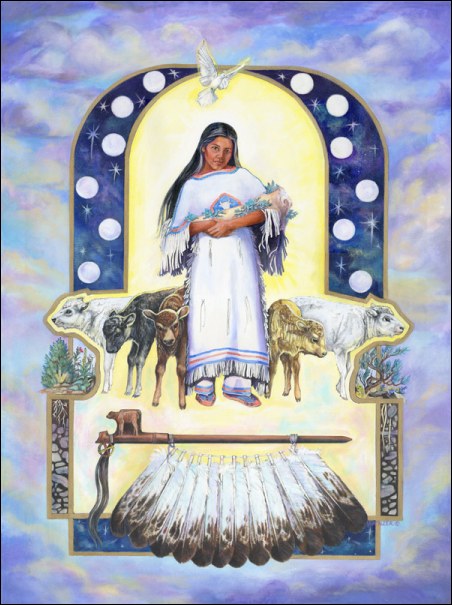
The Legend Of White Buffalo Calf Woman

Art work by Native artist Marcine Quinzer


As I wrote yesterday, today I bring you the Lakota story of the White Buffalo Calf Woman:


Legend of White Buffalo Calf Woman and the Sacred Pipe

The plains people had a religion, given to them long before the Euro-invasion. The religion had spread throughout the land to all people and Nations. It was first given to the Teton Sioux back when Standing Hollow Horn was a chief in the Lakota Nation. This religion promoted brotherhood and peace through the solemn rite of the sacred pipe. It came to the people in this manner. (Some estimates place the genesis of this story about 2000 years ago, well before the horse had been introduced by the Spanish.)

One summer so long ago that nobody knows how long, the seven sacred council fires of the Sioux came together and camped. The sun shone all the time, but there was no game, and the people were starving.

Standing High Hollow Horn, leader of the people, sent two young Lakota men on foot to hunt. The men were returning empty-handed when they climbed a high hill to scan the whole country. In the distance they saw a beautiful young woman who floated as she walked toward them. She was very beautiful, her long hair hanging down, and she wore a fine white buckskin dress.
She was so beautiful, that one young man desired her and said so. The other hunter said that he should not talk so as this was a Wakan woman, a Holy woman.

As the woman arrived she knew their thoughts and she beckoned the Evil minded young man to come to her where a cloud overcame them. When the cloud lifted, she stood alone and at her feet were a pile of bones with horrible snakes crawling over them. (It seems this Holy Woman seeks 'pure' hearts as well. I also note the concept of the Holy Woman and snakes at her feet.)

She then told the man with the Good mind to return to his people and tell them she was coming. When she arrived, the woman carried a sacred bundle that was wrapped in sage. She gave to the people seven sacred rites, among them the rite of the sacred pipe which she carried in the sacred bundle. She gave this to the people and taught them how to use it. (The numerous parallels between Catholicism and the Lakota religion were noticed by both the Lakota and the original French missionaries.)

"With this holy pipe, you will walk the Earth; for the Earth is your Grandmother and Mother, and she is sacred. Every step that is taken upon her should be like a living prayer," she said.

"The bowl of the pipe was made of the red stone. It represents the earth that bears and feeds us. On one side was carved a bison calf which represents the four legged on the earth. The stem of the pipe is wood and represents all that grows upon the earth. These twelve Eagle feathers hanging from the stem mean the sky and the twelve moons. The feathers are for the Spotted Golden Eagle and represents the winged peoples in the air. All these peoples and all the things of the universe are joined to you who smoke this pipe--all send their voices to the Great Spirit."

"This Earth which He has given to you is red, and the two-legged who live upon the Earth are red; and the Great Spirit has also given to you a red day, and red road. All this is sacred, so do not forget! Every dawn as it comes is a holy event, and every day is holy, for the light comes from your Father Wakan-Takan; and also you must always remember that the two-legged and all the other peoples who stand upon this earth are sacred and should be treated as such.…… Wakan-Takan has given you seven days to send your voices to Him."

The woman also told the Sioux about the value of buffalo, women and children. "You are from the Mother Earth," she told the women. " And like the Mother, women bring forth the continuance of life. What you are doing is as great as what the warriors do."

The sacred woman then started to leave the lodge, but turning again to Standing Hollow Horn, she said: "Behold this pipe! Always remember how sacred it is, and treat it as such, for it will take you to the End. Remember, in me is there are four ages. I am leaving now, but I shall look back upon your people in every age, and at the End I shall return.

Moving around the lodge in a sun-wise manner, the mysterious woman left, but after walking a short distance she looked back towards the people and sat down. When she rose, the people were amazed to see that she had become a young white buffalo calf, then this calf walked farther, lay down, and rolled, and become a black buffalo, then the calf walked farther, lay down, and rolled, and become a red buffalo, then the calf walked farther, lay down, and rolled, and become a yellow buffalo, then the calf walked farther, lay down, and rolled, and become a white buffalo. This buffalo then walked farther away from the people, stopped, and after bowing to each of the four quarters of the universe, disappeared over the hill.

Through the pipe ceremony, all men would become brothers and peace would exist in them and between them. (Hence the significance of the Woman turning into the colors of the four major races.)


The following words from Black Elk, an Ogalala Holy Man, best express the intent behind the gift of the Peace Pipe, and closely echo the intent behind many Marian apparitions.

"In the great vision which came to me in my youth, when I had known only nine winters, there was something which has seemed to me to be of greater and greater importance as the moons have passed by. It is about our sacred pipe and its importance to our People."

"We have been told by the white men, or at least by those who are Christian, that God sent to men His Son, who would restore Order and Peace upon the Earth: and we have been told that Jesus the Christ was crucified, but that he shall come again at the Last Judgment, the end of the world or cycle.

This I understand and know that it is true, but the white men should know that for the red people too, it was the Will of Wakan-Tanka, the Great Spirit, that an animal turn itself into a two-legged person in order to bring the most Holy Pipe to His People; and we too were taught that this White Buffalo Calf Woman, who brought our sacred pipe, will appear again at the end of the "world", a coming which we Indians know is now not very far off…"

"Most people call it a "Peace Pipe," yet now there is no Peace on Earth or even between neighbors, and I have been told that it has been a long time since there has been Peace in the world. There is much talk of Peace among the Christians, yet this is just talk. Perhaps it may be, and this is my prayer that through our Sacred Pipe, Peace may come to those peoples who can understand, an understanding which must be of the heart and not of the head alone. Then they will realize that we Indians know the One True God, and the we pray to Him continually…"


"I have wished to help my people understand the greatness and truth of our own tradition, and also to help in bringing Peace upon the Earth, not only among men, but within men and between the whole of creation. "


"We should understand well that all things are the works of the Great Spirit. We should know that He is within all things; the trees, the grasses, the rivers, the mountains, and all the four-legged animals, and the winged peoples; and even more important, we should understand that He is also above all these things and peoples. When we do understand all this deeply in our hearts, then we will fear, and love, and know the Great Spirit, and then we will be and act and live as He intends."


*******************************************************************

Some days when I start the process of writing for this blog, it's like Christmas. I never know what I will learn or where I will be taken in the numerous Google searches I need to do in order to write some of the articles.

I expected an easy time of it today, because I was very familiar with the legend of the White Buffalo Calf Woman. The article, however, is not my writing, but that of the artist whose painting graces this post.

While navigating her website I came across something I did not expect. It was in the explanation she gave about the genesis of this painting:

"I had planned this painting for two years but when I sat down to painting it, it evolved into something totally different than the planning I had done. As I worked on it, I became aware that Mother Mary was the same personage as White Buffalo Calf Woman. Two years later when I obtained a copy of "Learning Journey on the Red Road" by Floyd Hand, I received validation of this. This piece was a gift of spirit and even the cost of printing was supplied by spirit.

Obviously, I was sort of hinting at this same thing yesterday. It's why I stated I would post this story today. What makes it even more interesting is that the Sundance I attend, Floyd Hand is one of the ceremonial leaders. I had no idea Floyd's thinking ran along these lines.

He and I have a fun relationship. He frequently tries to scare the crap out me, and has offered to monitor me in a vision quest, amongst other things. So far I've failed to accept his invitations, as they seem to lead directly to my dancing in the Sundance, or being scared senseless. Neither of which appeals to me at the present time. Floyd says it's only a matter of time.

He may be right, because now that I've read this, I'm beginning to understand some of his teachings in an entirely different light. The two of us may have a stronger connection than I've thought, one not of this world. This is certainly an interesting time to be alive.

I do know this though, Floyd would agree completely with Dr. Clarissa Estes when she has this to say about the Virgin of Guadalupe, which also involved a Holy woman appearing to an Indigenous man.

"Guadalupe is the quintessential mother... and she does not encourage her sons and daughters who have been broken to walk as weaklings in this world... but rather for broken beings to walk as warriors... who are devoted to speak of her and for her in this world, to enact her holy heart by unfurling the ancient virtues of strength and sheltering, speaking up, standing up and doing... for the sake of goodness." And for the sake of peace.

Saturday, December 13, 2008

Two Little Known Marian Apparitions


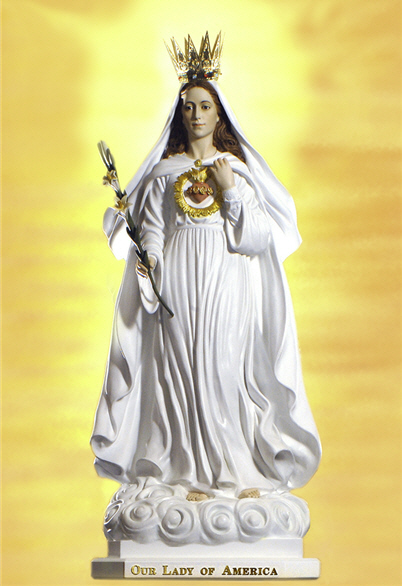
I was given a head's up by a reader about an American nun, to Sister Mary Ephrem (Mildred Neuzil), of the Precious Blood Sisters (1933-1979), who had a series of Marian visits in which Mary requested she be referred to as Our Lady of America. These visitations started in 1956 in Rome City, Indiana. This title was to be distinct from Mary's title of Empress of the Americas referenced in her visitations to Blessed Juan Diego at Guadalupe, Mexico.


One of the requests Mary made in this US visitation is that the National Shrine of The Immaculate Conception become a pilgrimage site. Mary also stated that the United States was specially chosen to lead the world towards peace: "Dear children, unless the United States accepts and carries out faithfully the mandate given to it by heaven to lead the world to peace, there will come upon it and all nations a great havoc of war and incredible suffering. If, however, the United States is faithful to this mandate from heaven and yet fails in the pursuit of peace because the rest of the world will not accept or cooperate, then the United States will not be burdened with the punishment about to fall."


As with other personal revelations, Catholics are under no obligation to credence any Marian visitation as dogma or doctrine unless the Vatican says so. Such has been the case with the Marian dogmas of her Immaculate Conception, and Assumption. Although the visitations of Sr Mary Ephrem received the imprimatur of Bishop Paul Liebold of Cincinnati, there hasn't been to this date any Vatican recognition of the apparitions. Bishop Liebold died in 1972 after serving as Sr. Ephrem's spiritual advisor since 1957. You can read more about this Marian apparition at this website .


As with most Marian apparitions, if you take the time to read the entirety of Mary's messages, you will find many warnings about the pending disaster facing mankind if we don't repent and mend our ways. But a closer reading will lend itself to some interesting differences. Mary seems to be stressing a personal internal conversion and connection with herself and her son, not necessarily obedience to an external authoritarian source. And it's all about forgiveness, compassion and love---'pure' compassion, forgiveness, and love, not the kind tainted with any self interest.


While researching Our Lady of America, I came across another contemporary visionary. This one happened in Nicaragua, to a peasant rancher Bernardo Martinex in 1980. It's a great story about a man overwhelmed with his experiences. Although this apparition is virtually unknown, it does have the approval of the local bishop.


In these messages Mary stresses the proper praying of the rosary, developing faith with in families, and, again, the importance of love and forgiveness: "Do not be grieved. I am with all of you even though you do not see me. I am the Mother of All you sinners.
"Love one another. Forgive each other. Make peace, because if you don’t make it, there will be no peace. Do not turn to violence. Never turn to violence.


In one part of this story Bernardo asks Mary if she wants a church built. Why wouldn't he, it seems to be a standard request. Mary answers:

No! The Lord does not want material churches, He wants living temples which are yourselves. Restore the sacred temple of the Lord. In you is the gratification for the Lord. Love each other. Love one another. Forgive each other. Make peace. Don’t just ask for it, make peace. From this day on do not accept even one cent for anything." (By the way, this never accepting one cent for any healing or other intervention is standard practice with truly spiritually gifted healers--well, at least not asking for anything.)


These latest Marian visions are quite fascinating. At Fatima, we were told to pray the rosary, and make First Saturdays, but in Nicaragua Mary is stressing not just doing it, but HOW you do it correctly, with intent and focus. At Fatima we were told to pray through her for Jesus's intercession, especially in Russia. That peace on earth was a process of petition and repentance, but now she is saying, "don't just ask for it, make peace" with in ourselves and with each other.


She's telling us we are no longer her dependent children, we are active participants in our own future. What we believe, and how we act on those beliefs are powerful and really do effect things. Like any really caring mother she is telling us "Don't expect me to give you what you won't work for yourself, what you won't be yourself. Beggars can't be choosers."


She's also telling us the rosary is not just a prayer device, it's a powerful spiritual tool when used and prayed correctly. It's the Catholic version of the Native American's peace pipe and should be treated with the same respect and honor with which Native's treat their ceremonial pipes. Praying the rosary is truly a spiritual ceremony. Sometimes I think Catholics forget that or don't realize it. It's not an exercise to be taken lightly or rotely. (Tomorrow, I'll write about the Souix legend of how they received their pipe and pipe ceremonies. It's pretty fascinating.)


To end this, I really did find this research exercise to be rewarding and want to thank the reader who gave me the heads up on Our Lady of America. One last thing, Archbishop Raymond Burke is a big supporter of our Lady of America and would probably disagree with some of my take on both of these apparitions, but that's the nice thing about personal revelation. It's personal.


Friday, December 12, 2008

Putting The Child First In Sexual Morality


I have spent some of my morning reading pro life posts dealing with death and murder. In one such post, written from a very personal perspective, the author relates three stories. One deals with a jury deliberating execution for a cop killer, one tells of her relationships with a grandmother who died of Alzheimer's, and one of her acquaintance with a 'crack' mother whose child was taken from her by the state. All three examples deal with separation in some way or another. The interesting thing was in the commentary associated with the article. None of the comments deal with the 'crack' mom story or her sick premature infant.


This represents the thing I find really scary about the pro life movement, and the sexual morality of the Church. Where is any concern shown for the fruits of pro creation? It's as if all sexual morality ends with the ejaculation of sperm into a uterus, followed by the birth of said pro creative product. But what about the morality associated with raising that said pro creative product?


I use the term pro creative product, rather than child, because that to me is the Church's attitude toward born children. Once the product is off the assembly line all concern for it stops. It's not the product which counts, it's the assembly line.


This is taken to such lengths, that it becomes more moral to rape a woman than to masturbate. Since patriarchy perceives sperm to be the start of the assembly line, it's proper placement takes precedent. This makes the receiving uterus, or the actual production line, a subordinate player, at the mercy of the fact sperm is in the area.


I find it interesting that there are never any sermons directed at the phenomenon of male abandonment. I suspect that's because the Church places responsibility for the nurturing and raising of the pro creative product a very distant second in the natural morality associated with males. It's their sperm which counts. Complimentarity says this is the way it is. Men don't have breasts.


Women on the other hand, are morally entrained to be completely at the service of the pro creative product. It's their baggage, their breasts, their fruit. This is their prime reason for existence. They are both the production line uterus and the party primarily responsible for the product, and they are morally culpable for failure in any aspect of this system.


But what if the pro creative product was the start, rather than the finish of our sexual morality? We might have developed a very different sexual ethic. We might have decided it is far preferable to masturbate rather than engage in a procreative act when one has no intention of taking on the responsibility of raising the child.


We might have decided that it is morally acceptable to use RU48 after being raped, rather than forcing a woman to take on the life long responsibility of a child she didn't want and will have no father to help her support.


We might have decided it's a much higher moral good to use any means possible to control births rather than have children one can't begin to raise in a way which truly does cherish their existence as something more than pro creative product.


We might have decided that it is better for children to have parents, no matter their configuration, than to limit parenting to one particular version of traditional family.


We might have decided it's far better to tell our pubescent children what exactly all that hormonal raging entails, in terms of responsible use of their nascent sexuality, than 'don't do it'.


We might have decided, based on anatomy, that sex does serve other functions than just procreation. It's also an endorphin rush about bonding, and that rush, even for women, is just as much about external orgasm as it is internal.


We might have had a really really different attitude about actual pro creative sex: It is a far greater evil to engage in heterosexual activity without any intention to raise a child or bond with your partner, than any other form of sexual sin.


I've often wondered if Thomas Aquinas was alive today if he would place sperm at the top of the natural law sexual morality pyramid. It's hard to imagine he would formulate his theology thinking women were 'malformed' males, and that sperm contained complete little humans looking for fertile soil. I've often wondered if he isn't in heaven somewhere totally appalled that his sexual theology hasn't been updated to reflect the knowledge of our reality.


He might even be nauseated, suspecting that his theology is really being used to maintain heterosexual male supremacy in society, and that's the real reason it hasn't been updated.


Given all of the above, I guess I'm not surprised that the 'crack mom' and her baby weren't mentioned in the comments. Except the crack baby is the perfect symbol for everything that's wrong with our current notions of natural law.


It's of no moral consequence that exploitative heterosexuality frequently produces children born into awful circumstances. Circumstances which all too frequently raise antisocial humans who think nothing of killing cops. Apparently pro lifers feel fine with these pro creative products becoming the state's business. Not worth commenting on---until they kill cops, and then it's morally justified to kill them. A sort of state sanctioned late term abortion.


Unfortunately, this 'leave the procreative products for the state to clean up', is happening way too frequently, and will get even worse in this economy. It's way past time to put the live baby at the front of any notions of natural law sexual morality. Way past time. I really think Aquinas would agree.


Thursday, December 11, 2008

Tradition, The Path From Fishermen to Potentates


The above photo is of Cardinal Pell of Sydney Australia celebrating a Traditional Latin Mass on the Feast of the Immaculate Conception, this past week. The service was held in Rome.


The picture to the left depicts Jesus calling Peter and Andrew to be his apostles. They were simple fisherman.

The history of Roman Catholic tradition is supposed to explain how the Holy Spirit inspired our leadership to progress from simple fishermen to Imperial Cardinal.


I have a problem with believing the Holy Spirit inspired the Church to take on Imperial trappings and a Romanesque military hierarchy, and make them dogma.

I don't see the rough and tumble fisherman in Cardinal Pell and his entourage. I do see boatloads of fish in the cost of their vestments.

I don't see love operating in Masses in which the pomp and circumstance become more important than the truth of the Eucharist. Where form matters more than content, where the devotion and awe is purposely centered on the celebrants and not the Mass itself.

I grew up with the Latin Mass and the gold filigree and the mountains of lace. It left me feeling insignificant and confused. How was I supposed to connect with the humanity of Jesus and see his face in the poor when I was presented with images which were completely the opposite of His message.

As I got older, took a few psychology classes, some church history, it became readily apparent that I was never supposed to connect with the human Jesus. The Jesus which is part and parcel of my interior life. I was supposed to feel insignificant and less than because the authority of the clerical caste depended on me being dependent. My relationship with Jesus was supposed to go through them and be external to me. But that's not what Jesus actually taught. He taught the exact opposite. His kingdom was WITH IN us, not external to us.

The church could very easily have taught the Gospel without the Imperial trappings. It did successfully for it's first three centuries, and it works spectacularly well for Evangelicals now.

Dragging the Church back to the 'drag' will not be successful. It is jarring, it is out of touch with reality, and it's message is not love and transcendence, but ego and control.

Rumor has it the Vatican is planning to move the Kiss of Peace to the beginning of the offertory. Distancing it from communion where it is seen as disruptive to the 'correct' personal preparation for reception of the Host. For some people this won't be a big deal, but it is because it's one more step backwards. One more step where the theology of community is lessened. One more step away from communal nature of the Last Supper for the sake of old notions of personal piety.

It's been announced that Cardinal Arinze's replacement for the Congregation of Divine Worship will be Spain's Cardinal Antonio Canizares. Traditionalists are ecstatic, as they foresee that Cardinal Canizares will enthusiastically continue with the 'reforming' of the Novus Ordo. Cardinal Canizares was also one of the most outspoken Spanish prelates in it's attacks on Spain's socialist government. Benedict certainly seems to be surrounding himself with hard core right wing Bishops and Cardinals. I guess that let's him take on the kindly pastoral face of Rome.

Be that as it may, this has nothing to do with inspired fishermen and everything to do with preferred Imperial tastes. There's very little in all this which is spiritual or inspired by the Holy Spirit. If this is the kind of church Jesus envisioned, if these are the kinds of leaders He wanted, then the Church should just ditch the New Testament or at least those passages in which Jesus defined leaders as servants to the servants. It might not improve the church, but at least it would ditch most of the hypocrisy.