Wednesday, July 14, 2010

I sometimes wonder if the younger restorationists really understand the sea change in Catholic thinking these pictures actually represent.


My daughter and I were having a discussion awhile back about the era in which Vatican II came on the scene. We weren't discussing the ubiquitous sixties so much as we were the state of Catholicism. I tried to paint her a picture that the Catholic world of the early sixties was not the secular world of the early sixties. It was still the same Catholic world that existed in twenties with more money and more education, but unlike it's secular counterpart, it was only beginning to come to grips with what a predominately Catholic Europe had wrought in two successive world wars.

I found it difficult to explain to her that in many respects Catholicism was out of sync with Western culture in some pretty fundamental ways. As far as Church participation, yes, it was much higher than now, but it was more a case of the patient being in a coma than actually living. The down trend in participation was already occurring in Europe, especially amongst males and most especially amongst middle class males. I told her the thing I most remember is the clergy themselves seemed the most somnambulent, going through the motions without much enthusiasm. I also said that the biggest change in the Church, directly during and after the council, for me anyway, was the enthusiasm of the younger clergy and the change that wrought in the relationship between them and the laity.

Today I came across a personal reflection written by Tom McMahon that really captures what I was trying to tell my daughter. Tom is a married priest in his early eighties who is a frequent contributor to Catholica Australia. The following is an excerpt of Tom's reflection:


My Ford stationwagon was weekly jammed during winter months with clerical peers on one day ski trips of 450 miles to and from Squaw Valley. We finally made time out rules, time for breviary and eating without serious talk. I had spent the first seven years of priesthood in pathological assignments, where alcoholism, lack of concern for people, and clerical egotism were a way of clerical life. Basically all I did before 1962 was say Mass, perform sacraments, and take census, with a teen club to liven up a church that was boring and dead. I was very much alone, except for my young priest friends, stationed with problemed older priests wondering how to interest people in the matters of God. I look back now and see myself on the brink of depression and despair. I was beginning to feel trapped in a no win—all lose situation. Vatican Two was my salvation as a human being.


Pope John the 23rd did not attend the first session, offering a clear signal to the gathered bishops that the Council was theirs, not a one pope show. John had summoned bishops from all over the world, those who were rich and those who were poor. John the 23rd saw to it that third world bishops had airline tickets and proper clothing. John had called for the Council only a short two years before the first session in 1962. Conservatives gathered up the left over documents of Vatican One, aka the Pope's Council, wherein Pius the Ninth had himself declared infallible. The powerful top dog pecking order of the Roman hierarchy gathered in Rome for a quick restatement of Episcopal power. They were summarily rebuffed. Little did they realize the weighty theologians, Rahner, Congar, Schillibeeckx, Suenens, Haring, etc., etc., who knew the mind of John the 23rd and had prepared a whole new agenda. The first session lasted a few weeks and the bishops were sent packing, sent home to study and to choose a periti, aka a skilled theologian. This Council would examine theologies, history, and the social role of the church in society. When they returned in 1963 a whole new future was outlined for the Roman institution. We were on our way to being more than "Mass priests". The church had outgrown Trent and there was vivid memory of World Wars One and Two, incubated in the old Holy Roman Empire. A blue print was in place with great skeletal reforms that would ideally reach into the lives of the world's people. The future rebuilding of the work of the Roman Catholic Church was on its transitional way and the laity was invited to partner with the clergy. The process would take time! And there was opposition.


If one reads carefully the 16 documents of Vatican Two one will find only positive statements, encouragements, hopeful possibilities, and reinforcement for living the way of Jesus. Nowhere is there to be found a condemnation, nor an excommunication, no threats nor violence. An old European version of religion literally began to die at Vatican Two. The bishops of Vatican Two, perhaps unwillingly for many, signed the death warrant of a medieval church. Hope pervades all documents, a positive restatement of the mind of the historical Gospel Jesus. Today psychologically it would be called cognitive therapy. The documents are evolutionary blue prints that needed to be fleshed out by humans. (Tom is dead on with this analysis. What Vatican II did is change the way we thought about being Catholics and how Jesus fit in the picture. We were moving from thinking about ourselves as Roman Catholics to thinking about ourselves as Jesus followers in the Catholic tradition.)


Back home priests were summoned to study sessions; education was underway and the priest would say Mass in the native language, the presider (a new term) facing the people and Mass was becoming a communitarian experience. The presider was to offer a homily, a personal reflections on the Gospel way of life ... the spiritual life of the priest was talked about as crucial to the efficacy of the sacraments, they now were seen as living experiences and non-automatic rituals. The laity was called The People of God — we shall address the Document on the LAITY later in this series. We formed priests' senates and parish councils and a newness began to cover the old void [Genesis Ch1, vs1].


The reaction begins to emerge...


Yet out of nowhere, silently and viciously the older clergy began to react. Their power positions were under attack and they did not like the people having a voice. Some said John the 23rd had been captured by the Russians and taken to Moscow for a lobotomy and the devil had taken over the Roman Institution. There was shit aplenty hitting the curial and clerical fans.........

......At the time the theology was prevalent that a legitimate Ecumenical Council was higher authority than a reigning pope; in time John Paul the 2nd would nullify this age old theology and return sole power and authority to the pope of Rome and the Curia. The old church and the new church was on a head-on collision course.


Arguments broke out publicly at clerical meetings. Elder priests saw God as being trashed and the church being made a fool of … meat ok on Friday and Mass attendance off and all due to those renegade priests and their stupid Vatican Two teachings, which the old clergy had never read or understood. People over the years became confused, splitting in their want for the good old days while a gray-haired membership held tightly to the old way. Massive numbers began to leave the institution to seek the way of Jesus. Bishops were unable to comprehend the turmoil. in America the bishops became obsessed with pelvic problems, becoming outspoken experts in the field of human sexuality while their clergy secretly sabotaged morale and reputation.


The post-WW2 generations have no idea how vast and deep are the John the 23rd changes that are now permanent fixtures. They are changes of attitude much more than mere change of liturgical practices. A cleric ordained in 1980 has no idea of the value of Vatican Two and their position has become one of the blind leading the blind. There is no trustworthy leadership in the American Catholic Church. Today an adult convert to Catholicism has no idea of how the SPIRIT changed the face of the Roman Church. Thomas Arthur Connelly is dead and Raymond Hunthausen bravely lead the people in protest of the nuclear train that dangerously crossed the United States, a move that warranted then President Ronald Regan to ask Rome to dismiss the Dutchman — old Roman church uniting with corrupt government to beat down a Jesus' peace movement. There is still opposition to reform, coming from the highest places in the Roman system. Yet Jesus is at work, patiently and calming, one person at a time, preaching the Beatitudes and his Father's way of peaceful renewal.


****************************************************


One of the ironic things about the JPII generation is their apparent lack of understanding that in that pre Vatican II Church they so espouse, they would not be allowed to open their mouths. They would find that most schools of theology were limited to clerics or seminarians and that even if they did somehow manage to get a degree in theology, no one would listen to them anyway, and most certainly not their fellow laity. The really sad part of all this is in that previous Church they could have written glowing papers agreeing with every jot and tittle coming from the Papacy and Vatican curia and not one person would have noticed, much less cared. Laity did not count except on expense ledgers.

Sometimes I ask myself if I'm really angry about the restorationist movement or just plain sad. When push comes to shove, I think I'm terribly concerned that the real target of the restorationist movement is not revamping the liturgy or re securing clerical power or even fighting secular relativism. The real target is the incredible change in thinking, in conceptualization that Vatican II actually wrought. All of the rest that happened was secondary to this change in thinking about the laity, the clergy, the world, and the relationships amongst all the people of God and the Church in the world.

A lot of people, self included, sometimes reference this historic change in thinking about these relationships strictly in terms of power. In some respects the Vatican itself has lent credibility to framing the discussion in power terms. But it wasn't just exclusively about power vis a vis Church authority, it was about redefining the boundaries concerning all relationships with in and with out the Church. Vatican II changed the language we use to think about all of this, and from there, the way we conceptualize and then act on all of these relationships. All of the other changes flowed from this core change in the language used to conceptualize the Church.

The restorationist movement is reworking all the changes piece by piece, but the end goal is to restore the prior thinking and the relational boundaries that thinking supports. Ultimately this will be a losing strategy. Once today's proponents of the restorationist movement realise the price for success is their virtual insignificance as meaningful players, they'll be hitting the streets with the very people they now wish would take the exit door. What they don't yet see, is the Church they want back so badly had neither a place nor a desire for lay input--unless it came with a great deal of money. It's that church they are really restoring and that is the real shame.


Tuesday, July 13, 2010

Reinvigorating That Ole Time Religion By Restoring The Emphasis On That Ole Time Adversary

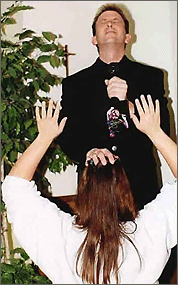
This image of the Roman Catholic priesthood still sells, and that most likely has a great deal to do with the upcoming conference on exorcism for the USCCB.


Fr. Richard McBrien's latest post for the National Catholic Reporter will surely generate a fascinating debate between progressives and traditionalists. The USCCB is sponsoring a conference on exorcism for bishops or others they have assigned to this field. Fr. McBrien is a bit of a sceptic as the following excerpt show:

In a letter dated May 18 of this year and addressed to "Eminences" and "Excellencies" of the U.S. Conference of Catholic Bishops, Bishop Thomas Paprocki, self-described as "Bishop Designate of Springfield in Illinois," announced that the bishops' Committee on Canonical Affairs and Church Governance, of which Paprocki is chairman, is sponsoring a special Conference on the Liturgical and Pastoral Practice of Exorcism, to be held in Baltimore in early November, just before the bishops' semiannual meeting.

Those with a deep interest in Catholic issues will recognize immediately how pertinent and even urgent this conference will be, given the present state of the church and the world, what with the ongoing wars in Iraq and Afghanistan, and the tragic oil spill and loss of 11 lives in the Gulf of Mexico. (Actually it is very important, but more on that after the break.)

For those less engaged in religious matters, an exorcism is an act by which an evil spirit is expelled from a person who is demonically possessed. The act also has a less dramatic function in the baptism of adults: when candidates are enrolled in the order of catechumens, during the period of the catechumenate itself, and during the three "scrutinies" that take place on the third, fourth and fifth Sundays of Lent, prior to the catechumens' baptism at the Easter Vigil.

The letter from Paprocki advises, "The conference is open to bishops and those priests or officials whom a bishop wishes to designate to attend," including those whom bishops have authorized to perform exorcisms, evidently apart from the sacrament of baptism.
However, there is one session open only to bishops. One can only speculate what sort of topics will be addressed in this closed session.

"The conference will address not only the theological and scriptural foundations of the rite of exorcism," the letter continues, "but it will also provide the necessary, practical insights into the many liturgical, canonical and pastoral issues associated with exorcisms and the church's battle against the demonic presence in the world and the lives of the Christian faithful."

**********************************************

What I find to be of note is this:

The session designated for bishops only (in italics), on the second afternoon of the two-day conference, will present and discuss "matters of special interest to bishops related to the phenomenon of evil and the use of the rite of exorcism."

I wonder if one of those special matters might be that one indicator of the relevance of traditional religious belief in a given culture is the level of belief in hell and external agents of evil. When folks stop believing in hell and the influence of Satan, they lose a great deal of their motivation for engaging in religious practice. One could make a serious case for the notion that the historic glue which held Catholicism's place in Western culture was not the Good News of Jesus, but the bad news about hell and it's legions of demons. Fear sells and you can buy or barter your way out of hell, but love is free and heaven can't be bought.

I wouldn't be the least bit surprised if the closed door session doesn't revolve around ways to make the devil 'real' again, and not necessarily how to exorcise demons. I imagine Paprocki's first job will be to convince a lot of his brother bishops that the devil is real, and he will probably do that by enlisting both the aid of mental health professionals, and exorcists who have experienced cases in which strange stuff happened and exorcism worked to stop the strange stuff. Paprocki will have to convince as many bishops as he can that there really is something going on and the traditional Church approach is both therapeutically effective and part of the truth of human history. Exorcism still sells and it's really scary stuff to boot. He might also feel it important to mention that the exorcist/priest is the last most powerful selling card for the priesthood, and one which still transcends the abuse scandal.

I would love to be a fly on the wall for this special session. I bet it would be like attending a GM sales conference in which dealers were evangelized to push traditional GM products like Cadillac and Corvette because it reconnects people to the dreams of their youth. In the case of exorcism it's attempting to sell people on reconnecting to the fears of their youth. But done correctly, it could still be really effective. There's enough video and other visual aids out there to help the process and besides, this world view is still prevalent in many cultures. It really is a pastoral issue. (Besides it's not unheard of for GM dealers to sell GM products and drive a BMW.)

And that's where I run into problems. Exorcism is a pastoral and at times psychological issue. There are behaviors and abilities some people exhibit which seem to be beyond their control and do respond to various forms of exorcism. They can also respond very well to modern psychotropic drugs, at least in terms of symptom reduction. Traditional religions say the operative paradigm is external supernatural influences. Modern psychiatric medicine says it's screwed up brain chemistry or pathological neurophysiology. Some therapeutic modalities postulate it's a product of a disconnect in spirit/mind/body integration and exclusively focusing on any of these areas will not lead to permanent successful outcomes. In other words, it may be a combination of both with symptomology manifesting in all areas of the mind body construct.

That these kinds cases exist is usually not disputed--just the number of cases. What's also not disputed is the higher the fear factor, the more intense the manifestation of symptoms. There does seem to be a sort of feedback loop. The stories in the New Testament in which Jesus casts out demons all have the same thing in common. Jesus acts as if this phenomenon is about as fear filling as dealing with bunions and the possessing demon about as powerful as a mosquito.

He seems to know what these spirits are and what they are about and it doesn't particularly intimidate him any more than we are necessarily intimidated by other predators who share our world with us. Jesus even tells the Apostles that some of these predators are more difficult to deal with than others and take more effort. Kind of like dealing with a predatory tiger is more difficult than dealing with a scavenging hyena. The only difference is these predators feed on emotional energy like fear, and not actual flesh. They can kill because they exhaust the body by maintaining a ramped up energy cycle of fear. A non fear filled state neutralizes their effect every bit as effectively as a well placed bullet neutralizes a predatory tiger. Trouble is in the modern world we no longer have an effective intellectual paradigm to control the fear when faced with non ordinary manifestations of reality. Way out on the fringes of scientific theory, we may just be getting there.

Bishop Paprocki will most likely emphasize the traditional Catholic approach because in my opinion fear of hell and Satan has been the singular belief structure that has kept Catholicism flourishing for a long long time. Fear so sells so much better than love and whether a bishop actually believes in Satan and hell will be irrelevant to the fact the Vatican is 'hell' bent on reinforcing this traditional fear paradigm. The Vatican would be saying: "We don't care if you drive a BMW, but we will insist you sell GM."

Without this atavistic fear of hell many aspects of doctrinal Catholicism become irrelevant. Exorcise a personal fear of hell and you also exorcise a lot of the motivation to maintain belief in a whole host of other Catholic doctrine. It does however, also free one to begin to understand just what Jesus actually was on about with all His talk of love and peace and joy. A world full of love and peace and joy is also a world which can't support the energy predators of either the human or the supernatural kind. I'm all for that kind of 'global warming'.


Saturday, July 10, 2010

The All Male Priesthood Maybe The Key To Marriage Equality

This really has nothing to do with the post, I just thought it was too funny not to post.


Theologian Mary Hunt has written a very compelling analysis of sacramental marriage and ordination vs secular and legal definitions of marriage and ministry. The following excerpt makes a very important point and suggests a new pathway for reconciling official Catholic opposition to gay marriage with the majority support for gay marriage in the lay Catholic population.

The parallel to the Catholic sacrament of ordination to the priesthood is the most telling one. Priestly ordination as understood in institutional Catholic theology, though I hasten to add not in Catholic theology at large, is reserved for men only. This is similar to limiting the sacrament of marriage to heterosexuals only. History demonstrates that no one can compel the institutional Roman Catholic church to ordain women even if nearly all other Christian denominations do so. But neither can the institutional Roman Catholic church, which -- I repeat -- represents only one among many Catholic views, impose its will in the public arena.

Ministers, rabbis and other religious professionals, both men and women, function as agents of the state when they witness marriages. They receive certain tax benefits because of their ordination. Institutional Roman Catholic opposition to women priests based on its sacramental theology does not equate to a ban on women in ministry in the world. To the contrary, almost every other Christian denomination ordains women. Neither should a sacramental theology of opposite-sex-only marriage equate to a ban on same-sex marriage in a democracy. Nor do I think it will in the long run.


*******************************************


Mary Hunt's observation here is almost so obvious it's a wonder it hasn't been shouted from the roof tops. Imagine the brouhaha if there was a Prop 12 or something demanding full gender access in ministerial positions with in the United States or face loss of all governmental perks and tax breaks. It would almost be poetic justice because the Catholic Church would then face the same institutionalized second rate status partnered gays now face vis a vis marriage. I strongly suspect that if it ever came down to a battle between protecting the all male clergy and dropping the political opposition to same sex marriage, protecting the all male clergy would priority numero uno.

One of the other things that struck me when reading the entire article is that the evolution of marriage is a great metaphor for the Power of Love breaking into society and changing social institutions. Marriage has gone from a property contract, with all it's inherent notions about the secondary status of women and children and it's ability to control the genetic expression of blood line and tribe, to a matter of a love contract between equals with shared family responsibilities. In pluralistic societies the notion of love in marriage has overcome all the taboos associated with 'mixed' marriages designed to protect genetic, religious and racial purity. The last taboo love must overcome is sexual purity, and it will, because love is an unstoppable evolutionary force.

It seems to me that if Christians really looked at the gay marriage debate as just another example of love willing itself into human expression it would be a very positive and hopeful sign that Jesus knew what He was talking about. If love has the capacity to reorganize the basis for such a fundamental social arrangement as marriage and family, imagine what it could do for the relationships between and with in religions, nation states, and cultures.

It so sad to me that the Church Jesus founded to spread His message of love is so obstructionist when it comes to where love leads. There's a part of me that sort of understands the importance of loyal opposition in helping to produce the energy necessary to propel change forward, but still, even knowing that, I wish the Institutional Church wasn't so good at it.


Friday, July 9, 2010

Oh Puhhleeeaaase. It's Truly Time For A Real Reality Check


Sex abuse and women's ordination?
By Bryan Cones - US Catholic - 7/9/2010

Great news from the Vatican, according to Catholic News Service: New norms against the sexual abuse of children will double length of time a victim has to bring charges from 10 to 20 years after the victim's 18th birthday. It will also extend the penalties for sexual abuse of children to those who abuse the mentally disabled.

Bad news: The new norms will simultaneously add to the list of grave offenses against the sacrament of holy orders the "attempted ordination of women."

Seriously?

Why is that bad? First, the "attempted ordination of women" already brings with it automatic excommunication, so making it one of the "delicta graviora" is redundant. Second, it conflates two completely separate issues, and in effect, or at least in the minds of many people who will read the news, seems to equate the "attempted ordination of women" with the rape and torture of children. (Now ordaining a woman will get a priest laicised and excommunicated, but bonking a three year old only gets one laicised. There's some Vatican justice for ya.)

Quite frankly, it is an outrage to pair the two, a complete injustice to connect the aspirations of some women among the baptized to ordained ministry with what are some of the worst crimes that can be committed against the least of Christ's members.

Furthermore, if I were a member or supporter of the Roman Catholic Womenpriests movement, I would be opening a bottle of champagne right now. The Vatican has in effect given legitimacy and momentum to what is still an incredibly tiny movement with this clumsy legal manuver, tantamount to the United States dropping a nuclear weapon on Luxembourg--only more ridiculous because this will do absolutely no damage to women's ordination movement. It is more like a gift. None of those women are afraid of excommunication any longer; indeed, it is now the Vatican that appears fearful.

This decision boggles the mind: The faithful have been justly demanding for nearly a decade clear guidelines for dealing with the sexual abuse of children, along with just punishments for both offenders and bishops who have abetted these crimes. What we have gotten is half of what we have been asking for (still no sanctions for bishops), along with a completely unconnected and unnecessary condemnation of the ordination of women. This is especially ironic given that many Catholics, and I include myself among them, see the absence of women in positions of power in the church as a contributor to the ongoing sex abuse crisis.

This move is a mistake, plain and simple, imprudent at best, at worst a serious further blow to Rome's already damaged credibility.


************************************************


Another example of Vatican logic has reduced me to tears---of laughter. Only the Vatican could come up with norms which equate attempting to ordain women with actually raping their children. That too me is what is so sad/funny about equating the two. Catholic theology already states that the whole idea of ordaining a woman is a fantasy, can't happen, isn't real, doesn't work. Yet now they turn around and assign it the moral equivalence to the very real act of raping children?

Since I can't really believe the Vatican really is this delusional, I'm going to have to assume the Vatican really knows really ordained bishops really did ordain real women and that their ordinations really are real--if illicit. They have to adopt this posture because if they don't then by gosh we might start questioning the reality of really ordained male priests by really installed bishops and really wonder if anything real actually really happens. There for it is really important to really punish anyone involved in these fantastical ordinations really hard by really excommunicating them and really laicising them. Really.

And as for the reality of sexual abuse, it is all to real that the reality of this norm does not extend to real bishops and their all too real involvement in actual abuse and it's cover up. That fantasy concerning bishop accountability is still very much the official reality.

And all of this leads me to believe the whole thing is really just one circular delusion.


Thursday, July 8, 2010

Vatican II Music To My Ears

Is Bishop Kevin Dowling of South Africa the spark that starts the fire glowing?


I feel like I have been struck by lightening. I have tear filled eyes and an open mouth. I promise I will pray for Bishop Kevin Dowling of Rustenberg, South Africa until God is sick of hearing from me. The following is from the middle part of Bishop Dowling's speech to selected laity in South Africa. It is music to my ears. The entire speech can be read here---and be sure to read the comments.


When I worked internationally from my religious congregation's base in Rome from 1985 to 1990 [Dowling is a Redemptorist] before I came back here as bishop of Rustenburg, one of my responsibilities was the building up of young adult ministry with our communities in the countries of Europe where so many of the young people were alienated from the church. I developed relationships with many hundreds of sincere, searching Catholic young adults, very open to issues of injustice, poverty and misery in the world, aware of structural injustice in the political and economic systems which dominated the world, but who increasingly felt that the "official" church was not only out of touch with reality, but a counter-witness to the aspirations of thinking and aware Catholics who sought a different experience of church. In other words, an experience which enabled them to believe that the church they belonged to had something relevant to say and to witness to in the very challenging world in which they lived. Many, many of these young adults have since left the church entirely.


On the other hand, it has to be recognized that for a significant number of young Catholics, adult Catholics, priests and religious around the world, the "restorationist" model of church which has been implemented over the past 30-40 years is sought after and valued; it meets a need in them; it gives them a feeling of belonging to something with very clear parameters and guidelines for living, thus giving them a sense of security and clarity about what is truth and what is morally right or wrong, because there is a clear and strong authority structure which decides definitively on all such questions, and which they trust absolutely as being of divine origin.


The rise of conservative groups and organizations in the church over the past 40 years and more, which attract significant numbers of adherents, has led to a phenomenon which I find difficult to deal with, viz. an inward looking church, fearful of if not antagonistic towards a secularist world with its concomitant danger of relativism especially in terms of truth and morality -- frequently referred to by pope Benedict XVI; a church which gives an impression of "retreating behind the wagons," and relying on a strong central authority to ensure unity through uniformity in belief and praxis in the face of such dangers. The fear is that without such supervision and control, and that if any freedom in decision-making is allowed, even in less important matters, this will open the door to division and a breakdown in the unity of the church.


This is all about a fundamentally different "vision" in the church and "vision" of the church. Where today can we find the great theological leaders and thinkers of the past, like Cardinal [Joseph] Frings of Cologne, Germany] and [Bernard Jan ] Alfrink [Utrecht, Netherlands] in Europe, and the great prophetic bishops whose voice and witness was a clarion call to justice, human rights and a global community of equitable sharing -- the witness of Archbishop [Oscar] Romero of El Salvador, the voices of Cardinals [Paulo Evaristo] Arns and [Aloísio Leo Arlindo ] Lorscheider, and Bishops [Dom] Helder Camara and [Pedro] Casadaliga of Brazil? Again, who in today's world "out there" even listens to, much less appreciates and allows themselves to be challenged by the leadership of the church at the present time? I think the moral authority of the church's leadership today has never been weaker. It is, therefore, important in my view that church leadership, instead of giving an impression of its power, privilege and prestige, should rather be experienced as a humble, searching ministry together with its people in order to discern the most appropriate or viable responses which can be made to complex ethical and moral questions -- a leadership, therefore, which does not presume to have all the answers all the time.


Then a little further on Bishop Dowling has this to say about Vatican II's principle of subsidiarity:


Applied to the church, the principle of subsidiarity requires of its leadership to actively promote and encourage participation, personal responsibility and effective engagement by everyone in terms of their particular calling and ministry in the church and world according to their opportunities and gifts.


However, I think that today we have a leadership in the church which actually undermines the very notion of subsidiarity; where the minutiae of church life and praxis "at the lower level" are subject to examination and authentication being given by the "higher level," in fact the highest level, e.g., the approval of liturgical language and texts; where one of the key Vatican II principles, collegiality in decision-making, is virtually non-existent. The eminent emeritus Archbishop of Vienna, Cardinal Franz König, wrote the following in 1999 -- almost 35 years after Vatican II: "In fact, however, de facto and not de jure, intentionally or unintentionally, the curial authorities working in conjunction with the pope have appropriated the tasks of the episcopal college. It is they who now carry out almost all of them" ("My Vision of the church of the Future", The Tablet, March 27, 1999, p. 434).


What compounds this, for me, is the mystique which has in increasing measure surrounded the person of the pope in the last 30 years, such that any hint of critique or questioning of his policies, his way of thinking, his exercise of authority etc. is equated with disloyalty. There is more than a perception, because of this mystique, that unquestioning obedience by the faithful to the pope is required and is a sign of the ethos and fidelity of a true Catholic. When the pope's authority is then intentionally extended to the Vatican curia, there exists a real possibility that unquestioning obedience to very human decisions about a whole range of issues by the curial departments and cardinals also becomes a mark of one's fidelity as a Catholic, and anything less is interpreted as being disloyal to the pope who is charged with steering the bark of Peter.


It has become more and more difficult over the past years, therefore, for the College of Bishops as a whole, or in a particular territory, to exercise their theologically-based servant leadership to discern appropriate responses to their particular socio-economic, cultural, liturgical, spiritual and other pastoral realities and needs; much less to disagree with or seek alternatives to policies and decisions taken in Rome. And what appears to be more and more the policy of appointing "safe", unquestionably orthodox and even very conservative bishops to fill vacant dioceses over the past 30 years, only makes it less and less likely that the College of Bishops -- even in powerful conferences like the United States -- will question what comes out of Rome, and certainly not publicly. Instead, there will be every effort to try and find an accommodation with those in power, which means that the Roman position will prevail in the end. And, taking this further, when an individual bishop takes issue with something, especially in public, the impression or judgment will be that he is "breaking ranks" with the other bishops and will only cause confusion to the lay faithful -- so it is said - because it will appear that the bishops are not united in their teaching and leadership role. The pressure, therefore, to conform.


*****************************************


Bishop Dowling has given a very clear picture of how some of us see the current Roman Catholic Church. He is absolutely correct when he says it's all about a fundamentally different view of 'in the church' and 'of the church'. I maintain these different views reflect different positions on the spiritual maturity scale. The basic reason these differences seem insoluble is because once one moves on the spiritual maturity scale, one can not go back to a prior position. It's not just that ones spirituality has changed, it's that ones entire world view has changed.


The level of spirituality that Vatican II espoused was further out on the scale. For those ready to move on, it was a blessing. For those not ready to move on, it was terrifying. For those not ready to move on in the curia, it was doubly terrifying, and for those who materially benefited from the pre Vatican II church it had to be stopped.


When seeds have been sown and plants begin to sprout, you can't shove the plants back in the ground. You can only rip them out. For all the restorationist's attempts to rip out the sprouts of Vatican II they have essentially failed. Instead the clergy abuse crisis has put them in the unique position of defending themselves and their restorationist mindset from Vatican II accountability standards. And no, people who have moved on in a Vatican II spirituality are not going to cut the restorationists much slack. They are operating from too different a world view. This is a world view which emphasises personal conscience and personal responsibility and that makes for a huge, virtually unbridgeable gap with the obedience driven group think mindset.


I have a great deal of respect for Bishop Dowling. I really hope he is not left standing alone by other Catholic bishops who see things similarly. To paraphrase a song most likely despised by the restorationists, "it only takes a spark to get a fire going". May this be that spark.


A Little Of This And A Little Of That

This time the clerical offender is accused of embezzlement and theft. Like with other clerical offenders the Archdiocese of Connecticut seriously failed in it's supervisory capacity-- and did so for seven years.


It seems the military is asking for email responses to the thought of gay and straight soldiers showering together. I'm like haven't we all been doing that for forever? My thoughts were never concerned with possible lesbians in the shower with me, they were concerned with the thought that anyone was in the shower with me. I was a good Catholic girl and if we had been allowed to, I would have showered totally dressed. Of course that has nothing to do with orientation and everything to do with a warped sense of modesty. Once I got over that I didn't care who was in the shower with me. I was usually hot, sweaty, and totally unconcerned with things sexual. I can't think guys are much different. Personally I'd be far more concerned that the soldier next to me knew how to use his/her rifle and had my back.

I see where Michael Sean Winters has finally given himself permission to see that LifesiteNews is a propaganda front rather than a news service. Good for him. If MSW keeps going on this track he might just begin to put a few things together. Things like too many of the self described centrist Catholic writers are really espousing watered down versions of the political right and not defending core Jesus teachings.

The Vatican is to come out with new norms for dealing with clerical abusers. They are not new exactly, but the fact they are being issued at all is probably a bigger statement than it would first appear. In a New York Times article this point was made:

"The changes are not expected to include adoption of the “zero tolerance” policy used by bishops in the United States and elsewhere, which remove a priest from ministry at the first credible accusation of abuse, as some victims’ groups and critics had hoped.

But in the quiet battle raging deep inside Vatican City, they are likely to appear as a defeat for the many traditionalist members of the hierarchy who believe that anything short of a full canonical trial betrays the church’s trust in a priest and deprives him of due process."

This is a bigger issue than it would first appear because the hierarchy has universally operated on the notion Canon Law superseded civil law in cases of clergy malfeasance. They were allowed to get away with this for a very long time by the very governmental judicial systems which should have put a stop to it. It now appears Canon Law will only supersede governmental law in the one place where they are more or less one and the same, and where Ceasar is also God--the Vatican City States. To the traditionalists this represents a curtailing of their influence on an epic scale and the raid in Belgium just underscores this loss of influence and unwarranted protection. I would imagine there is more than one Cardinal/Archbishop having heart palpitations over the treatment of Cardinal Daneels. It seems the Cardinal could move from being a witness to being a suspect.

Finally we have another story about the other transparency issue in the Church, that of financial malfeasance. Somehow a Connecticut priest was able to embezzle some 1.4 million dollars from a parish over the space of seven years. Somehow said priest was able to operate without the over site of a legally mandated parish financial council, or filing mandated annual reports to the Archdiocese. It was a nice lucrative gig while it lasted. What interested me about this case is the sense of entitlement the accused priest conveys, an entitlement that apparently included zero supervision. Haven't we seen that same thing fueling some other crisis in the clergy?


Wednesday, July 7, 2010

It does seem that some of the USCCB, and especially the American Cardinals in Rome, have a politically vested interest in making this caricature of the LCWR seem not only plausible but true.


I haven't written much on the LCWR visitation lately. Part of that is because Mother Millea's visitation has been thoroughly covered elsewhere. My other reason is I have been waiting for some information on the other investigation of the doctrinal questions of the LCWR leadership which originated with Cardinal Levada and the CDF. I really believe Mother Millea's investigation is designed to give more support for the Vatican when the hammer comes down from the CDF on the LCWR leadership conference. The following is an excerpt from an NCR article by Tom Fox which is hugely 'enlightening' about the CDF investigation.


Describing the gathering as “frank and open,” the leadership team wrote that it had insisted at the meeting it does not support abortion, but did support the idea of speaking out on a political issue.

“We clarified that LCWR does not support abortion and that we have made this position clear,” the letter said. “We explained that we feel a moral imperative to see that there is health care coverage for all persons, and that we believe this bill will guarantee that more than 30 million uninsured persons would finally be provided health care.” The letter added: “We were very clear in stating that our actions were not in opposition to the U.S. bishops.” (It looks to me like Olmstead's actions in Phoenix are designed to demonstrate that the LCWR is dishonest when they say they don't support abortion. The timing of his announced excommunication of Sr. McBride and these meetings between the LCWR and the Vatican is most 'interesting'.)

The Leadership Conference told its membership that Levada was concerned that the organization’s actions “were being interpreted as a public display of disunity within the church and that they undercut the perception of the church as one, holy, Catholic, and apostolic.”

The conference said it responded, speaking of the necessity to be able to exercise “rights, duties, and obligations as citizens.” The letter stated that Levada acknowledged women religious operate in two worlds -- as Catholics and as citizens. However, he insisted that the bishops are the ones who make key decisions in matters of faith and morals. (This is more affirmation that the USCCB is embarking on a path which makes voting a question of following Catholic morality as taught by the USCCB.)

Addressing the doctrinal assessment, the letter indicated the women expressed surprise as some of the materials requested by the Congregation of the Doctrine of the Faith “go beyond the scope of a doctrinal assessment.” The letter did not elaborate on what those materials are.

The Vatican requests, the letter stated, caused the women to ask if the process “had moved beyond an assessment and into an investigation of LCWR.”

The letter did not indicate how Levada responded to the question.

Levada told the women, the letter stated, that once Blair sends his final report to the congregation, his assessment will be sent for review to different groups, including “a subcommission, the American cardinals in Rome, and perhaps some others.” Levada explained he will then consult with Rodé and develop a final report that will be presented to Pope Benedict XVI. (Cardinals who are no longer bound by US tax law as it pertains to promotion of political causes.)

Blair’s diocesan director of communications, Sally A. Oberski, said the bishop has a policy of not speaking with the media about the assessment.

According to the letter, the leadership team met the next day, April 24, with Rodé and members of his congregation. Again, Vatican officials queried the women about the conference’s support for the health care legislation.

The meeting moved on to discussions about the apostolic visitation and to a Leadership Conference statement approved at its 2009 national assembly in New Orleans. That statement, “LCWR Call,” was intended to set a five-year course for the organization.

“We discussed at length the LCWR support of the health care bill. The cardinal stated his belief that we cannot defend our position because it was contrary to the bishops,” the letter went on. “We again clarified that we do not support abortion and that we are quite aware that we are citizens of our country who must take action, and we base our actions upon our understanding of all the moral imperatives brought to the table within this particular piece of legislation.”

The letter said Rodé instructed the women that “LCWR cannot declare a pastoral direction since this responsibility belongs to the episcopal conference alone and, he noted, that by our actions we broke unity. We reiterated our view that we do not support abortion and our belief that the moral imperative of providing health care for more than 30 million uninsured was an action we had to support.” (Again Rode equates political with pastoral.)

According to the letter, the women noted “some the benefits we have experienced [in the apostolic visitation], including the support and appreciation women religious have received from the public, as well as the opportunity to learn more about the rights and duties of religious within the church. We also noted that the process has caused confusion among our members because neither we nor the U.S. bishops were well-informed about all aspects of the apostolic visitation.” (Yes, the vast majority of the US Bishops were left in the dark by their American brethren in Rome.)

The letter stated Rodé spoke of “his serious concern over the many congregations that did not complete the entire apostolic visitation questionnaire.”

It stated that a doctrinal congregation staff member, Passionist Fr. Leonello Leidi, reiterated that Mother Mary Clare Millea, in her position as apostolic visitator, “is the vicar of the pope,” and that the actions of some religious communities that did not fully comply in answering visitation questionnaires last year were acting in “open opposition” to Rome.

The letter stated that Leidi spoke of “possible consequences for leaders who may be judged as disobedient.”

The women religious leadership team asked Rodé what he hoped would be the final outcome of the visitation, the letter noted.

“He responded by saying that he understands that women religious have historically worked for migrants and persons who are poor, and acknowledged that we have built schools and hospitals and have provided services to many people. He expressed a desire to get a clear, objective view of religious life as it is lived today and that a focus be placed on values, life in community, prayer, and living the evangelical life.”

The letter stated that the meeting ended with the cardinal making two recommendations: that the Leadership Conference of Women Religious be clear about its position on abortion, and that it invite members to collaborate with the apostolic visitation process.

“He again stated that LCWR has influence and we must use it to support the church and its efforts. He further indicated that he has spoken with Pope Benedict about the apostolic visitation and noted that the pope is concerned and may be making a statement about the process or may ask Cardinal Rodé to issue a statement.” (There's the real rub. Why do I get the feeling the LCWR can do what ever they want with the sick and poor as long as they do not drag those concerns into political views which impact the wealthy and powerful.)

The letter ended with the leadership team saying it will keep members informed about other aspects of the visit.


***********************************************

This is such an interesting article. It's pretty obvious, at least to me, that the real concern of the Cardinals in Rome, especially the American ones, is that the LCWR demonstrated they have serious political influence. Forget the gibberish about pastoral confusion. That's not the issue. The issue is political influence. This whole thing is about power politics, not Roman Catholic orthodoxy. If there's an orthodoxy in current Catholic politics it seems to be that it's OK to do anything you want for the poor as long as you leave the wealthy and powerful alone. Stay in the soup kitchens and out of Congress like the True Catholics do. Believe it when we tell you your vote is a moral issue over which we have Christ's teaching authority. If we can't trust you to do that we might just put you back behind convent walls where you can't be such a political rival.

What's good for the wealthy and the powerful must be good for everybody the thinking seems to go. That's been pretty traditional thinking for eons and it's been supported by the Vatican for eons. Liberation theology was fine and dandy until it got political and it's politics pointed to the wealthy as the political problem. Communism was way worse than fascism because unlike fascism, communism didn't include a place for the Church and had no intention of sharing the wealth. No quid pro quo with those atheistic godless commies. Indulgences and death bed confessions aren't worth too much in the Communist system.

Since I've gotten a tad cynical I guess I will stop here. Keep up the good work LCWR because you really do speak pastorally and politically for a whole bunch of us.


Tuesday, July 6, 2010

Spiritual Wars, Culture Wars, And Younger Generations Who Are Moving Beyond This World View

The policy makers can turn their back on progress, but the truth is the younger generations won't follow, and maybe neural development says they never will.


Betty Clermont has a must read post over on Open Tabernacle about the Tea Party Church based on John Allen's current NCR post dealing with recent Vatican moves. Actually John Allen's post is a must read as well. It's one of the most honest posts I think I've read from John in quite awhile. This post is John Allen at his analytical best. This particular observation has stayed with me all week end:

"Collectively, I think these events both symbolize and advance the collapse of Catholicism as a culture-shaping majority in the West. When the dust settles, policy-makers in the church, particularly in the Vatican, will be ever more committed to what social theorists call “identity politics,” a traditional defense mechanism relied upon by minorities when facing what they perceive as a hostile cultural majority."

Betty's post deals in more detail with the markers that John listed which describe what he calls the "defense mechanism" relied on my minorities when facing a hostile culture. They are the same kinds of markers which define the Tea Party.

What interests me though is that in both the Church's case and the Tea Party movement it's been the powerful policy makers who have put the time, money, and organization into defining the markers and building the momentum of these respective movements. They are both very top down movements, one circling around fears about spiritual wars and personal salvation, and the other circling around fears about culture wars and cultural salvation. They are most certainly complimentary movements each defining their own sphere of influence, and both are based in atavistic existential questions. Who am I, where do I fit in the universe, why do I feel so alone? Rather than really addressing these questions, both movements exacerbate them by giving their adherents an externally defined identity. They answer highly personal questions by giving an artificially derived group identity.

It works because this is exactly how we are enculturated as children. We accept our notion of who we are from observing our family and how it identifies itself. We then identify with those external definitions because our very survival depends on doing so. The really important part of the maturation process begins when our brains have developed higher level processes and we start questioning what had previously been unquestionable. We begin to notice differences as easily as we identify similarities. At about this same time we also begin to make judgments, and the criteria for those judgments usually come from the family construct. It's not surprising then that both Vatican Catholic policy-makers and the Tea Party equivalent stress the "traditional family' and strongly desire to control it's make up and thinking.

One of the reasons I think this is basically falling on it's face in the West is because the culture no longer needs young people to marry early and economically does not support early marriage. The longer marriage and child rearing are postponed, the more time the young person has to develop an identity independent of their family structure and culture. I don't know that humanity has ever experienced this particular phenomenon where young adults are free to develop independently in quite this manner for this length of time. It may be nature's way of providing a development period for the part of our brains which develop last, between the ages of fifteen to twenty five, known as the secondary developmental stage of the prefrontal cortex.

This part of the brain biologically develops in all of us, but that doesn't mean it lights up in boundless activity on a PET scan. In point of fact, we don't really know what this last stage of development is for. We do know that based on other developmental stages, being the last in line, it should generate another huge jump in world view and abilities, while incorporating and controlling all neural stages and experiences that have come before. At least it should if it was given the freedom to do so.

Past cultural influences did not facilitate this freedom. Those influences predisposed teenagers to take on adult responsibilities before this neural development was finished, perhaps inadvertently shutting down the expression of an amazing set of human abilities and a totally new world view. I feel compelled to point out that Jesus did not take on the customary duties of a Jewish male which would have had Him married at eighteen or so, and He did develop an entire new world view with some pretty amazing abilities. The prevailing culture, both political and spiritual, did not appreciate His world view because it transcended all their cultural identity markers and conceived of them as a secondary influence. Things haven't changed much, but they might have changed radically for today's younger generations. That should be worth fighting for, not against.


Saturday, July 3, 2010

Reasoning Out Why Religious Fundamentalists Are Unreasonable

This flow chart is a good place to start realistically evaluating the individual pieces of religious doctrine in one's faith journey. If one's ego would let them be really truthful, quite a bit would be in the outer circles.

'The following are the last three paragraphs of an insightful post written by Frank Schaeffer. Frank is the son of Francis and Edith Schaeffer who were both Evangelical leaders in the 70's and 80's. Both were instrumental in the rise of the right wing Christian political movement, as was Frank--especially in the rise of the vehement pro life movement. Today Frank is one of the Christian right's most astute critics. In many ways his personal story illustrates spiritual progression and just how difficult that progression can be in that it really does set up a war in one's mind between faith, reason, and observations about the real world.

The solution to that mental war is either to move on or to practice a rather vicious form of denial. This denial is usually given vent by projecting the conflict onto and into 'others'. Frank explains this process very well in the following:

The history of theology (Christian or otherwise) is the history of people desperately trying to fit the way things actually are into the way their holy books says they should be. And since the holy books -- if taken literally -- are filled with backward nonsense, something has to give.

What "gives" is decency, compassion, honesty and truth. Result? Some people do what my mother and dad did, spend a lot of time making excuses for God. The other result is the congenital sneakiness of fundamentalist religion pretending that it is more enlightened than it is or ever can be. Roman Catholic medieval dogma is rechristened as "Natural Law" and Creationism is re-baptized as "Intelligent Design," Islam calls the oppression of women the "protection of women" and so on. Proposition 8 in California is presented as something to "protect children" and so forth.

Why do religious fundamentalists hate "sinners" (in other words anyone not like them)? Answer: because otherwise they would have to blame God following the logic of their own theology. They have to say gay men and women chose to be gay or that the disaster in Haiti was "caused" by the Haitians themselves. They must say this because otherwise -- according to the logic of their own ideas -- they must blame God, for instance, for gay men and women even existing!


The past week or so has given Catholics plenty of opportunity to see this process at work in the Vatican. Cardinal Sconborn's truthful evaluation of Cardinal Sodano's behavior became an issue of Schonborn's insubordination. In papal 'logic' it made perfect sense in Benedict's mind to tell us that only the pope can criticize a cardinal. In doing this, Benedict absolves himself of really dealing with Sodano because Benedict the Pope did not make such observations and only he can. It was just totally wrong of Schonborn to make such statements about Sodano. The whole sad story has absolutely nothing to do with the real actions of Cardinal Sodano in the real world and everything to do with Cardinal Schonborn's violation of the rules in Benedict's fantasy world.

The same kind of thinking is operative in Benedict's creation of a new commission to Evangelize the west. The need for this solution is not that some of the intellectual fantasy he holds as truth is at fault, it absolutely has to be that the reality of the Western world view is at fault. Benedict is incapable it seems, of blaming the Church or God (equated in his mind) for the fact the West no longer sees reality the way the traditional church sees reality. It has to be the fault of society because other wise the whole house of cards comes tumbling down. It always has to be the 'others' fault when religious fantasy collides with reality. "Othering" is absolutely necessary defense mechanism when attempting to maintain faith fantasies.

The Phoenix abortion case is exhibit number one of how decency, compassion, honesty, and truth are sacrificed in order to uphold an illogical teaching. A reasonable person will not accept that it is better to let two people die to uphold an absolute teaching. When the truth is the fetus can not live, but the mother can, reasonable people will not throw compassion and decency out the window for the sake of a teaching based in an unknowable fantasy about when ensoulment occurs. For a believer like Bishop Olmstead however, it is absolutely necessary to uphold the reality of the fantasy because to do other wise starts chipping at the very foundation of his 'faith'.

The truth is, it's really not Olmstead's version of Catholic faith which is the fundamental issue. It's the fear generated by his ego. It's not God whose truth is at stake. What's at stake is one of the core foundations of Olmstead's ego construct. Ego, or the self aware sense of I, literally takes on a life of it's own. It's 'life' can actually become more important than biological life itself.

One of the traits of the left brain is it's ability to generate ideas specifically designed to protect the ego construct. It can be very efficient at this particular function. Intellectualizations, plausible deniability, rationalizations, and circular reasoning are the preferred defensive strategies of the left brain to shore up the illogical fantasies of the ego. When sense perceptual reality collides with the fantasy reality of the ego, the left hemsishere will protect the integrity of the ego. Ultimately the concern is not whether the defenses are credible to 'others', they must be credible to the individual's ego and they must serve to soothe the ego's existential fear.

Compassion, for instance, is usually not an attribute which fundamentalists extend to their own egos because it's judged to be a form of weak willed enabling behavior. Since self compassion does not serve to soothe their ego generated anxiey it's not something they will extend to others. Instead, anxiety is soothed by projecting the cause of the anxiety onto others. It's sort of like getting rid of one's own garbage by blindly bagging it up and tossing it on a bigger designated garbage pile.

I have written before that when Jesus said we must love each other as we love ourselves He was not kidding. Self love is a crucial component to spiritual progress. Our construct ego will not treat others any better than it's been constructed to treat itself. One of the biggest impediments to spiritual growth that Catholicism has foisted on it's followers is the whole notion of humanity's intrinsic predisposition towards sin. I have never been able to fathom how one can hold a baby in one's arms and think humanity is predisposed towards sin. (Well I can, but that's for another post and generally involves not actually holding a baby in your arms.)

The real truth is we actually are predisposed towards sin, not because we are failed humanity, but because we are raised to think we are failed humanity. I firmly believe that gay and abortion issues are so front and center at this time precisely because we are being asked to look at the theology which supports them. They are an opportunity to realistically assess some very potent belief structures surrounding human nature, God, and the foundations of religious authority. In a very real sense humanity is in a dialogue with itself about the basis for the religious reality of our future.

Lately our Catholic hierarchy has been giving us one concrete example after another to assess these core belief structures about Catholic reality. In some cases the almost desperate brazenness of the example demands we make this assessment. It does seem the Holy Spirit is beckoning us to growth and using our teaching authority to do it. That they seem blind to the consequences may be a necessary part of the process. I truly do honor and thank them for their efforts, but that doesn't mean I won't keep writing on why they can be so wrong and so counterproductive. After all if some of us 'others' didn't do so, their inspired efforts would be pointless.

Friday, July 2, 2010

Western secularists sun themselves, apparently indifferent to the self sinking of the good ship
Vatican.

The New York Times, that Vatican styled bastion of Anti Catholicism, has another must read article on the history of the Vatican's handling of clerical sexual abuse. The following is an excerpt and deals with a meeting in Rome between bishops of English speaking countries and the multitude of Vatican dicastery heads who were involve in cases of clerical sexual abuse. The most important parts about this meeting is it took place in 2000, two years before the Boston scandal and that the CDF was aware of the fact that they had jurisdiction over all cases of clerical sexual abuse since the issuance of a 1922 instruction.


Frustrations Boil Over

The visiting bishops had reached the boiling point. After flailing about for 20 years, with little guidance from Rome, as stories about pedophile priests embroiled the church in lawsuits, shame and scandal, they had flown in to Rome from Australia, Canada, England and Wales, Ireland, New Zealand, Scotland, South Africa, the United States and the West Indies.

Many came out of frustration: the Vatican had too often thwarted bishops’ attempts to oust pedophile priests in their jurisdictions. Yet they had high hopes that they would make the case for reform. Nearly every major Vatican office was represented in the gathering, held in the same Vatican hotel that was built to house cardinals electing a new pope.

“The message we wanted to get across was: if individuals are to hide behind church law and use that law to impede the ability of bishops to discipline priests, then we have to have a new way of moving forward,” said Eamonn Walsh, auxiliary bishop of Dublin, one of 17 bishops who attended from overseas. (He was one of several Irish bishops who offered the pope their resignations last year because of the abuse scandal, but his has not been accepted.)

Yet many at the meeting grew dismayed as, over four long days in early April 2000, they heard senior Vatican officials dismiss clergy sexual abuse as a problem confined to the English-speaking world, and emphasize the need to protect the rights of accused priests over ensuring the safety of children, according to interviews with 10 church officials who attended the meeting.

Cardinal Darío Castrillón Hoyos, then the head of the Congregation for the Clergy, set the tone, playing down sexual abuse as an unavoidable fact of life, and complaining that lawyers and the media were unfairly focused on it, according to a copy of his prepared remarks. What is more, he asked, is it not contradictory for people to be so outraged by sexual abuse when society also promotes sexual liberation? (At this point in time the Vatican was well aware of the fact that clerical abuse was not just a problem of Western sexual culture. They had real problems in Africa and South America which included openly married priests and other priests using convents as AIDS free brothels. The West was a problem because of it's legal code and media freedom, not it's liberal sexuality.)

Another Vatican participant even observed that many pedophile priests had Irish surnames, a remark that offended delegates from Ireland.

“Prejudices came out,” said Bishop Robinson of Australia. “There were some very silly things said at times.”

Though disappointed, the visiting bishops were not entirely surprised.

“It wasn’t that there was bad will in Rome,” Bishop Walsh said. “They just didn’t have the firsthand experience that the dioceses were having around the world — experience with the manipulative, devious ways of the perpetrators. If the perpetrator said, ‘I didn’t do it,’ they would say, ‘He wouldn’t be telling a lie, he has to be telling the truth, and he’s innocent until proven guilty.’ ” (I beg to differ. The Vatican has plenty of experience in manipulative, devious ways.")
An exception to the prevailing attitude, several participants recalled, was Cardinal Ratzinger. He attended the sessions only intermittently and seldom spoke up. But in his only extended remarks, he made clear that he saw things differently from others in the Curia.

“The speech he gave was an analysis of the situation, the horrible nature of the crime, and that it had to be responded to promptly,” recalled Archbishop Wilson of Australia, who was at the meeting in 2000. “I felt, this guy gets it, he’s understanding the situation we’re facing. At long last, we’ll be able to move forward.”

Clarity Comes in a Letter

Even so, the meeting served as much to expose Cardinal Ratzinger’s inattention to the problem as it did to showcase his new attitude.

Archbishop Wilson said in an interview that during the session he had to call Vatican officials’ attention to long-ignored papal instructions, dating from 1922, and reissued in 1962, that gave Cardinal Ratzinger’s Congregation for the Doctrine of the Faith, previously known as the Holy Office, sole responsibility for deciding cases of priests accused of particularly heinous offenses: solicitation of sex during confession, homosexuality, pedophilia and bestiality.

Archbishop Wilson said he had stumbled across the old instructions as a canon law student in the early 1990s. And he eventually learned that canonists were deeply divided on whether the old instructions or the 1983 canon law — which were at odds on major points — should hold sway.
If the old instructions had prevailed, then there would be no cause for confusion among bishops across the globe: all sexual abuse cases would fall under Cardinal Ratzinger’s jurisdiction.

(The Vatican has recently insisted that Cardinal Ratzinger’s office was responsible only for cases related to priests who solicited sex in the confessional, but the 1922 instructions plainly gave his office jurisdiction over sexual abuse cases involving “youths of either sex” that did not involve violating the sacrament of confession.)

Few people in the room had any idea what Archbishop Wilson was talking about, other participants recalled. But Archbishop Wilson said he had discussed the old papal instructions with Cardinal Ratzinger’s office in the late 1990s and had been told that they indeed were the prevailing law in pedophilia cases.


***********************************************


I can't help but wonder if Cardinal Ratzinger allowed the confusion to continue for so long because he prioritized clerical sexual abuse as a much lower priority for the CDF than hunting out theologians, disciplining bishops and national bishops conferences, and advising JPII on his multiple and continuous teaching letters and encyclicals. In other words the CDF under Cardinal Ratzinger was too busy building his and JPII's autocratic version of Catholicism to deal with the fact it was rotting to death from the very clerical system they were so busy shoring up. This is akin to undergoing cosmetic plastic surgery when one has terminal cancer.

I'm sure the Times will be taken to task for this latest infusion of Anti Catholicism. It's much easier to throw stones than to refute the facts. There is real rot in the Vatican, and to distract us from noticing that, we are getting another cosmetic face lift with another of Benedict's liturgical motu proprios. Another dose of Vatican reformist kool aid is not going to make the clerical abuse scandal magically disappear. It's just another sign of the same kind of power dynamic that any abuse is always about.

For a brilliant analysis of the linked John Allen report check out Bill Lyndsey's commentary. It sure is beginning to look more and more like the Vatican ship is sinking in the West.